 VedaWatch
Recovery & Apple Watch
Normal respiratory rate during sleep, and what Apple Watch shows
Normal respiratory rate during sleep for adults, how Apple Watch measures breathing overnight, how accurate it is, and why a rise can be an early sign of illness.
By VedaWatch editorial team · · 9 min read
The short answer
For a healthy adult at rest, a normal respiratory rate is about 12 to 20 breaths per minute, and sleeping rates usually sit in that range. More useful than the range is your own normal: sleeping breathing rate barely changes from night to night, so a rise of a breath or more that lasts can be an early sign of illness.
What is a normal respiratory rate during sleep?
Respiratory rate is the number of breaths you take in a minute. For adults at rest, clinical references give a normal range of roughly 12 to 20 breaths per minute. A widely used nursing textbook (OpenStax Clinical Nursing Skills) uses 12 to 20, while Cleveland Clinic gives a slightly narrower 12 to 18. There is no separate official "sleeping" range, so most people's overnight readings are judged against the same resting range.
Children breathe faster than adults. The same nursing textbook lists 30 to 60 breaths per minute for infants, 20 to 30 for toddlers, 20 to 25 for preschoolers, 14 to 22 for school-age children, 12 to 18 for adolescents and 12 to 20 for adults. If you are checking your own Apple Watch data as an adult, the adult range is the one to compare against.
Where the edges sit matters less than many articles suggest. Below 12 is called bradypnea and above 20 is called tachypnea, but these are terms for a measured resting rate in a clinical setting, not a verdict on a single night from a watch. Cleveland Clinic says a resting rate under 12 or over 25 may be a sign of an underlying health condition, which is a reason to talk to a doctor, not a diagnosis in itself.
Normal breathing rate by age, at a glance
Use this as a reference for resting breathing rate. For sleep tracking, compare against your own typical number first and these ranges second.
- Infants: 30 to 60 breaths per minute.
- Toddlers: 20 to 30 breaths per minute.
- Preschoolers: 20 to 25 breaths per minute.
- School-age children: 14 to 22 breaths per minute.
- Adolescents: 12 to 18 breaths per minute.
- Adults: 12 to 20 breaths per minute (Cleveland Clinic uses 12 to 18).
- Worth raising with a doctor: an adult resting rate under 12 or over 25 that keeps showing up, or any breathing change that comes with symptoms.
Does your breathing slow down when you sleep?
Not in the way most people assume. A classic study in Thorax measured breathing in 19 healthy adults awake and asleep. It found that breathing in every sleep stage was more rapid and shallower than during wakefulness, and that the total amount of air moved per minute (ventilation) fell during sleep, most of all in REM sleep. So sleep mainly makes breaths smaller. It doesn't reliably make them less frequent.
That has two practical consequences. First, your sleeping respiratory rate can be similar to, or even a little higher than, your calm daytime rate, and that's normal. Second, breathing varies between sleep stages, which is why a watch reports a summary of the whole night rather than one moment.
Everyday things that can nudge an overnight reading include alcohol in the evening, a hot bedroom, a late hard workout, altitude, some medications, and illness or fever. Fever raises the body's metabolic rate, and conditions that increase metabolism increase breathing rate too.
How Apple Watch measures respiratory rate overnight
Apple added sleeping respiratory rate in watchOS 8. In Apple's words, "Apple Watch uses the built-in accelerometer to measure respiratory rate while sleeping." In other words, the watch senses the tiny movements of breathing at your wrist while you are still, rather than counting breaths through a mask or chest strap as a sleep lab would.
Readings are only taken while the watch thinks you're asleep, so you need sleep tracking turned on (Track Sleep with Apple Watch in the Sleep settings) and the watch on your wrist overnight. The data goes to the Health app on iPhone, where you can see it under Respiratory Rate along with trends over time. Other apps, such as VedaWatch, can read it from Apple Health with your permission.
On recent watchOS versions, the Vitals app on Apple Watch puts respiratory rate next to heart rate, wrist temperature, blood oxygen and sleep. Apple says you need to wear the watch to sleep for 7 days to establish your typical range, and if multiple metrics fall outside that range you get a notification the next morning with possible causes. Apple lists medications, elevation, alcohol and illness among the factors that can affect your numbers.
How accurate is Apple Watch respiratory rate?
Apple says Vitals measurements are not intended for medical use, and we couldn't find a peer-reviewed study that validates Apple Watch's sleeping respiratory rate against a sleep lab. So the honest answer is that its accuracy hasn't been independently published in detail.
The closest evidence comes from another wrist wearable. A 2023 study in Sensors tested a Samsung Galaxy Watch, using its accelerometer and optical sensor, on 195 adults during overnight sleep-lab tests, with a nasal sensor as the reference. Accuracy was defined as landing within 2 breaths per minute of the reference. For the whole-night average, the watch was within that margin 91.79% of the time overall, and 99.18% of the time in people without severe sleep apnea. In people with severe sleep apnea it fell to 79.45%. The study was funded by Samsung, and it tells you what wrist sensors can do, not how Apple's algorithm performs.
What this means in practice: treat a nightly reading as a good estimate that may be off by a breath or so, and a poor-fit night (loose band, arm under the pillow, very restless sleep) as less reliable. Because errors in the same person, on the same wrist, tend to be similar from night to night, the trend over a week tells you more than any single number.
Why a change in sleeping breathing rate matters
The most useful thing about sleeping respiratory rate is how steady it is. In a study of Whoop wearable data from 25,000 people over 30 nights each, a person's average night-to-night variation was only about 0.51 breaths per minute, even though rates differed a lot between people. A number that steady makes a real change easy to spot.
The same research group then followed 271 people, 81 of whom tested positive for COVID-19. A model built on overnight respiratory rate changes identified 20% of positive cases two days before symptoms began, and 80% by the third day of symptoms. That shows breathing rate can shift early in a respiratory infection, but also that it misses many cases at first and isn't a test.
Breathing rate also rises for reasons that have nothing to do with infection, such as alcohol, a hot room or a very hard training day. That's why it's best read alongside your other overnight signals. A rise in breathing rate together with higher resting heart rate, lower HRV or higher wrist temperature is more meaningful than any one of them alone. The HRV when sick guide covers how those signals move together.
How to read your own overnight breathing rate
Here's a simple routine that avoids both ignoring a real change and worrying about noise. The numbers in the example are illustrative.
- Learn your normal. Look at the last 2 to 4 weeks of sleeping respiratory rate in Health or Vitals. Say most nights sit between 13.8 and 14.6 breaths per minute, around 14.2.
- Ignore small wobbles. A night at 14.6 or 13.9 is within your usual spread. Changes of a few tenths are mostly measurement noise.
- Notice a clear step. A night at 15.4, about 1.2 above your usual, is worth noting, especially if it's out of character for you.
- Look for a reason. Alcohol, a late workout, a warm room, travel or a short, broken night can all explain one high night.
- Check the other signals. Is resting heart rate up, HRV down or wrist temperature up as well? Several signals moving together point more strongly at strain or illness.
- Watch the next night. If it's back to normal and you feel fine, carry on. If it stays up and you start to feel unwell, rest and take it easy.
- Know when to get help. See a doctor if you have shortness of breath, chest pain, a high fever, or a sleeping rate that stays well outside your normal for days. Get urgent help for severe breathing difficulty.
Respiratory rate vs sleep apnea notifications
A normal respiratory rate doesn't rule out sleep apnea. Apnea is about pauses and disturbances in breathing during the night, and a whole-night average can look perfectly ordinary while those happen.
Apple has a separate feature for this. Sleep apnea notifications use the accelerometer to look for breathing disturbances and can alert you if elevated disturbances show up consistently over a 30-day period. Apple lists Apple Watch Series 9 or later, Apple Watch Ultra 2 or later, or Apple Watch SE 3, and the feature is for people 18 or older who haven't been diagnosed with sleep apnea. Apple says it isn't meant to diagnose sleep apnea and that not everyone with the condition will get a notification.
If you snore loudly, wake up gasping, or feel very sleepy during the day, talk to a doctor whatever your watch says. A sleep study is how sleep apnea is diagnosed.
How VedaWatch helps you keep an eye on breathing rate
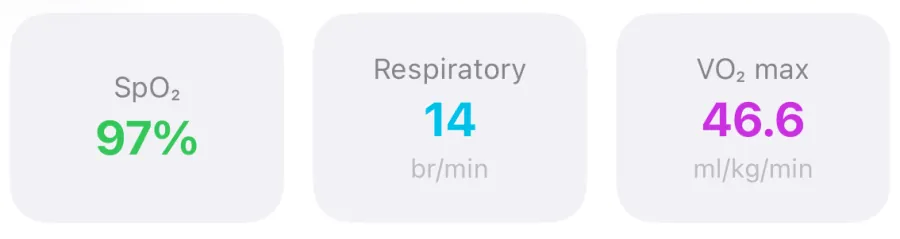
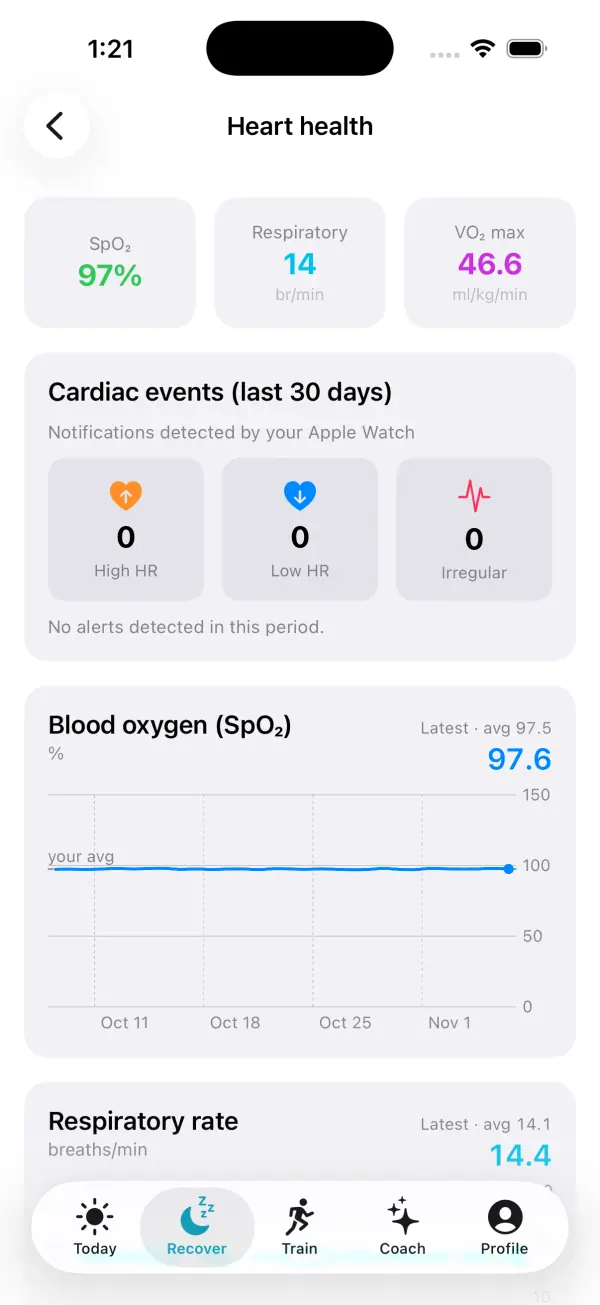
VedaWatch reads your sleeping respiratory rate from Apple Health and puts it in context. On the Recover tab, Heart health shows your latest breathing rate in breaths per minute next to blood oxygen and VO2 max, with a trend chart underneath. Tapping it opens a detail view that explains what the number means and marks 12 to 20 breaths a minute as the typical adult range.
The Last night card on the Recover tab compares last night's breathing rate with your own normal, based on your previous 28 nights. It shows "Normal" when you're inside your usual band, or the change, such as +1.2 br/min, when you're outside it. Your normal uses the median of those nights, so one odd night doesn't drag it around.
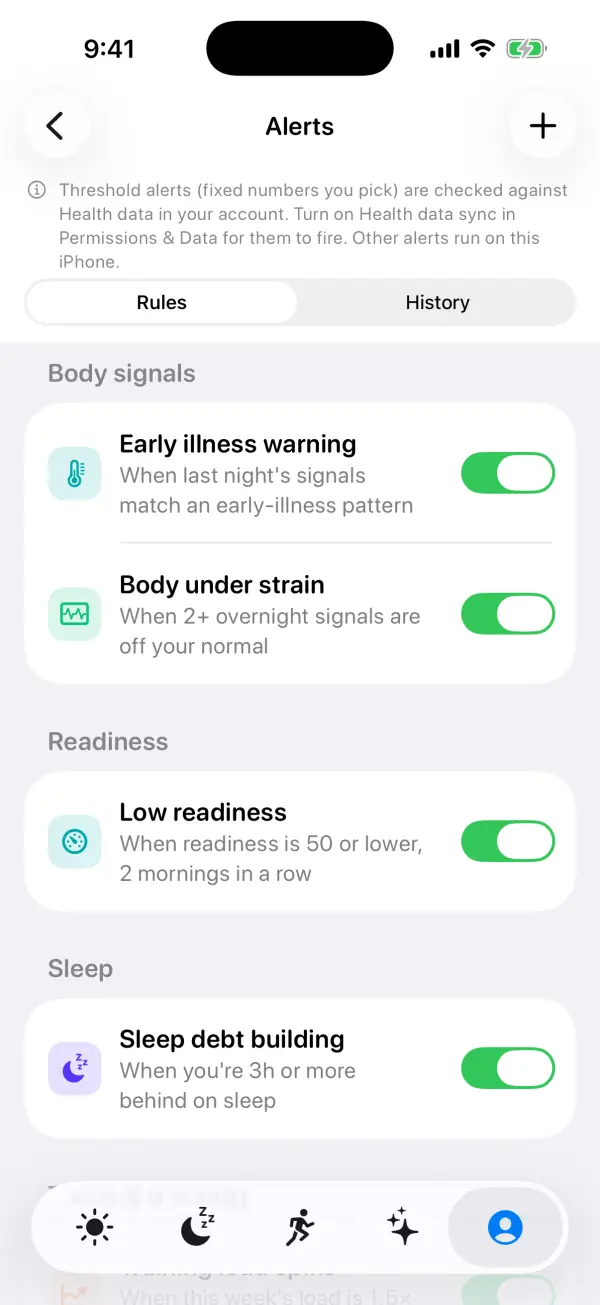
Two smart alerts use breathing rate. Body under strain fires when two or more overnight signals (resting heart rate, HRV, breathing rate, wrist temperature) are off your normal at once; for breathing rate that means well outside your usual spread and at least 1 breath per minute above your median. Early illness warning looks for a fever-like signal, breathing rate or wrist temperature up, together with other signals, either 3 or more at once or a pattern 2 nights running. It skips nights after you've tagged alcohol, sauna or travel in your journal. Both alerts describe a pattern; they can't tell you you're ill and aren't a diagnosis.
Turning breathing-rate alerts on or off
In VedaWatch, the Alerts screen groups alerts by what they watch. Early illness warning and Body under strain are under Body signals, each with its own switch. They're worked out on your iPhone from the Health data already there, and the aim is a few alerts a month rather than a daily ping.
Frequently asked questions
Is 20 breaths per minute while sleeping normal?
It's at the top edge of the usual adult range of 12 to 20. If that's your steady normal and you feel well, it's usually not a concern; if your rate has recently climbed to 20 from a much lower baseline, look at your other signals and how you feel.
Is a sleeping respiratory rate under 12 bad?
Not necessarily. A single low reading from a watch can be measurement error, and the 12-breath cutoff comes from resting measurements in clinics. If your rate stays low and you have symptoms such as unusual drowsiness or breathing pauses noticed by a partner, or you take medicines that slow breathing, talk to a doctor.
Why is my Apple Watch not showing respiratory rate?
It's only recorded during sleep, so check that Track Sleep with Apple Watch is on and that you wore the watch to bed with a snug fit. A night with very little recorded sleep may have no reading.
Does respiratory rate go up when you're sick?
Often, yes. Fever and respiratory infections tend to raise breathing rate, and wearable studies have seen overnight rises around the time symptoms start, sometimes earlier. It isn't specific to illness, though, since alcohol, heat and hard training can do the same.
Can I use Apple Watch respiratory rate to monitor a lung condition?
Not on its own. Apple says these measurements are not intended for medical use, so follow the monitoring plan your doctor gives you and use the watch trend only as extra context.
Related guides
- HRV when sick: what your Apple Watch shows before symptoms
- Apple Watch health alerts: early illness warning, body strain and other smart alerts in VedaWatch
- Apple Watch wrist temperature: how it works and what changes mean
- Apple Watch Vitals app explained: typical range and outliers
- Apple Watch sleep apnea notifications: what they mean
- Apple Watch blood oxygen: normal SpO2, sleep and accuracy
Sources & further reading
- OpenStax Clinical Nursing Skills: 15.6 Respiration
- Cleveland Clinic: Vital signs
- Thorax (1982): Respiration during sleep in normal man (Douglas et al.)
- Apple Newsroom (2021): watchOS 8 brings new access, connectivity, and mindfulness features to Apple Watch
- Apple Support: Track your overnight and daytime vitals with Apple Watch
- Apple Support: Sleep apnea notifications on your Apple Watch
- Sensors (2023): Validating a Consumer Smartwatch for Nocturnal Respiratory Rate Measurements in Sleep Monitoring (Jung et al.)
- PLOS ONE (2020): Analyzing changes in respiratory rate to predict the risk of COVID-19 infection (Miller et al.)
This guide is educational, not medical advice, and has not been clinically reviewed. VedaWatch is not a medical device. If you have symptoms or concerns about your heart or health, contact a qualified healthcare professional.
Put your trends in perspective.
Explore HRV, sleep, and recovery with VedaWatch on your iPhone.
Download VedaWatch on the App Store →