 VedaWatch
Strength Training
Push pull legs split for beginners: 3-day and 6-day plans
A push pull legs split for beginners: 3-day and 6-day weeks written out, sample workouts, PPL vs full body, weekly sets per muscle and how to progress.
By VedaWatch editorial team · · 11 min read
The short answer
A push pull legs split trains pushing muscles (chest, shoulders, triceps) one day, pulling muscles (back, biceps) the next, and legs on the third. Beginners can run it 3 days a week, each muscle once, or 6 days, each muscle twice. Weekly sets per muscle matter more than the split itself.
What is a push pull legs split?
A push pull legs split (PPL) divides your training by movement pattern. Push day covers exercises where you press weight away from your body: bench press, overhead press, push-ups and triceps work, which train the chest, shoulders and triceps. Pull day covers exercises where you pull weight toward you: rows, pulldowns, pull-ups and curls, which train the lats, upper back, rear shoulders and biceps. Legs day covers squats, hinges such as Romanian deadlifts, lunges and calf raises, which train the quads, glutes, hamstrings and calves. Core work can go on any day.
The appeal is simple. Muscles that work together are trained together, then rest while you train the other two groups. Each session has a clear focus, and the plan scales from 3 to 6 days a week without changing its shape.
The split itself is not magic. Research comparing split routines with full-body routines finds similar strength and muscle gains when the total weekly work is the same (Ramos-Campo and colleagues, 2024). So the useful questions are how often you can train, how many hard sets each muscle gets per week, and whether you add a little weight or a few reps over time. The rest of this guide answers those three questions.
Is push pull legs good for beginners?
It can be, with one caveat. Many coaches start beginners on full-body training, because practising each main lift two or three times a week helps you learn the movements faster. A 3-day PPL only practises each pattern once a week, so the squat you learned on Friday gets a full week before you try it again.
On the other hand, the evidence on outcomes is reassuring. A 2024 meta-analysis of 14 studies with 392 healthy adults found no meaningful difference in strength or muscle growth between split and full-body routines when volume was equated, and its authors suggest choosing by personal preference. The American College of Sports Medicine's progression position stand recommends 2 to 3 training days a week for novices, which a 3-day PPL fits. The CDC's guideline for adults is muscle-strengthening activity on at least 2 days a week that works all the major muscle groups: legs, hips, back, abdomen, chest, shoulders and arms. Push, pull and legs days together cover that list.
A practical rule: if you can reliably train 3 days a week and you enjoy focused sessions, a 3-day PPL is a fine start, as long as you keep sets per muscle high enough (see the sets math below). If your schedule is unpredictable, full body is more forgiving, because missing one session doesn't leave a whole muscle group untrained for two weeks. If you can train 5 or 6 days, PPL is one of the simplest ways to organise that much training.
Before you start any new strength routine, check with a doctor if you have a heart condition, high blood pressure that isn't controlled, a recent injury, are pregnant, or have pain that hasn't been looked at. Stop any exercise that causes sharp pain, chest pain, dizziness or unusual shortness of breath.
The 3-day push pull legs split, written out
The 3-day version trains each group once a week, with a rest day between sessions. Use loads you could lift for 2 or 3 more reps at the end of each set, so you finish with good form and a little left in the tank. Rest 1 to 2 minutes between sets of the smaller exercises and up to about 3 minutes on the big lifts if you need it.
Swap any exercise for one with the same movement pattern that suits your equipment, such as dumbbell press for bench press.
- Monday, push: bench press or dumbbell press 3 × 8–12, overhead press 3 × 8–12, incline dumbbell press 2 × 10–12, lateral raise 2 × 12–15, triceps pushdown or overhead extension 2 × 10–15.
- Tuesday: rest, walk or do easy cardio.
- Wednesday, pull: lat pulldown or assisted pull-up 3 × 8–12, seated cable row or one-arm dumbbell row 3 × 8–12, face pull 2 × 12–15, dumbbell curl 2 × 10–12, hammer curl 2 × 10–12.
- Thursday: rest or easy cardio.
- Friday, legs: goblet or back squat 3 × 8–12, Romanian deadlift 3 × 8–10, leg press or split squat 2 × 10–12 (each leg for split squats), leg curl 2 × 10–15, calf raise 3 × 12–15, plank 2 × 30–45 seconds.
- Saturday and Sunday: rest or easy activity. If Monday slips, simply shift the whole sequence on by a day.
The 6-day push pull legs split, written out
The 6-day version runs the same three sessions twice a week, so each muscle is trained twice and gets roughly 72 hours between sessions. It doubles your weekly sets without making any single workout longer, which is its main advantage. It also asks for six training slots a week and good sleep and food to recover, so most beginners are better off earning it after a few months of consistent 3-day training.
The B days below add some variety for your joints. You can also just repeat the A days, which makes progress easier to track.
- Monday: push A (the push day above).
- Tuesday: pull A.
- Wednesday: legs A.
- Thursday: push B, for example dumbbell bench press, Arnold press, cable or dumbbell fly, lateral raise, overhead triceps extension.
- Friday: pull B, for example barbell or chest-supported row, pull-up negatives or pulldown, rear-delt fly, barbell curl.
- Saturday: legs B, for example leg press, hip thrust, walking lunge, leg curl, calf raise.
- Sunday: rest.
- In between: a 4-day rotation (push, pull, legs, rest, then repeat) gives each muscle about 1.5 sessions a week, and a 5-day week can run push, pull, legs, then an upper and a lower day.
Push pull legs vs full body: which should you pick?
When researchers hold weekly volume equal, the choice of split doesn't change results much. The 2024 meta-analysis found similar gains in bench press and lower-body strength and similar muscle growth in the arms, thighs and lean mass. A 2019 meta-analysis of 25 studies by Schoenfeld, Grgic and Krieger reached a similar verdict for frequency: with volume equated, training a muscle once, twice or three times a week made no significant difference to growth.
An earlier 2016 meta-analysis by the same group favoured training each muscle at least twice a week, but higher frequency often came with more total sets. Two sessions per muscle mainly help because they let you do more good sets without marathon workouts.
So pick the version you'll actually keep. Full body 3 days a week suits an unpredictable schedule or anyone who wants more practice on the main lifts. A 3-day PPL suits focused sessions on 3 fixed days. A 6-day PPL suits people with the time and recovery for more weekly volume. An upper/lower split on 4 days is a common middle ground.
How many sets per muscle does PPL give you?
Weekly sets per muscle is the most useful number for comparing plans. A 2017 meta-analysis of 15 studies (Schoenfeld, Ogborn and Krieger) found a graded dose-response relationship: more weekly sets were associated with more muscle growth, with each extra weekly set linked to about a 0.37% greater gain. Groups doing 10 or more sets per muscle per week tended to do best, although that category comparison was only a statistical trend. Ten hard sets a week is a sensible target to build toward, not a minimum you need from day one.
Here is the math for the 3-day plan above. Counting direct sets only, chest gets 5 a week (bench 3 plus incline 2), lats and upper back get 6 (pulldown 3 plus row 3), quads get 5 (squat 3 plus leg press 2), hamstrings get 5 (Romanian deadlift 3 plus leg curl 2), shoulders get 5 (overhead press 3 plus lateral raise 2), biceps get 4 and calves get 3.
Muscles also work as helpers. A common convention, and the one VedaWatch uses, is to count a full set for the main muscles of an exercise and half a set for the helpers. Triceps then get 2 direct sets plus half of the 8 pressing sets, about 6 in total. Biceps get 4 direct plus half of the 6 pulling sets, about 7.
Run the same sessions twice a week and every number doubles: about 10 sets for chest, 12 for the back, 10 for quads and hamstrings, and 12 or more for triceps and biceps once helper sets are counted. That's the real difference between 3 and 6 days.
If you're on 3 days and want more, add one set to each main lift (bench 4, incline 3, squat 4 and so on). That takes chest, back, quads and hamstrings to about 7 or 8 sets without adding a day. A full-body plan that does 3 chest sets in each of 3 sessions lands at 9, which shows why the two approaches end up close when volume is matched.
Starting at 5 to 6 sets per muscle and adding a set at a time over the first months is reasonable. If soreness lasts into the next session for that muscle, hold the volume where it is.
How to progress on a push pull legs split
The plan only works if the work gets a little harder over time. The simplest method for beginners is double progression: pick a rep range such as 8–12, stay at one weight until you reach the top of the range on every set with good form, then add weight and work back up from the bottom of the range.
The ACSM position stand gives a concrete rule: when you can do one or two reps more than your target at a given load, increase the load by 2 to 10%. Use the smaller end for upper-body and isolation exercises, and the larger end for squats and deadlifts. If the next dumbbell is too big a jump, add reps or a set first.
A worked example: on bench press you do 3 × 8 at 40 kg. Over the next sessions you build to 10, then 11, then 12 reps on all three sets. Next push day, go to 42.5 kg (about a 6% increase) and expect to manage around 8 reps again. On a 3-day PPL each lift comes round once a week, so this cycle typically takes a few weeks per lift; on a 6-day PPL it can move twice as fast.
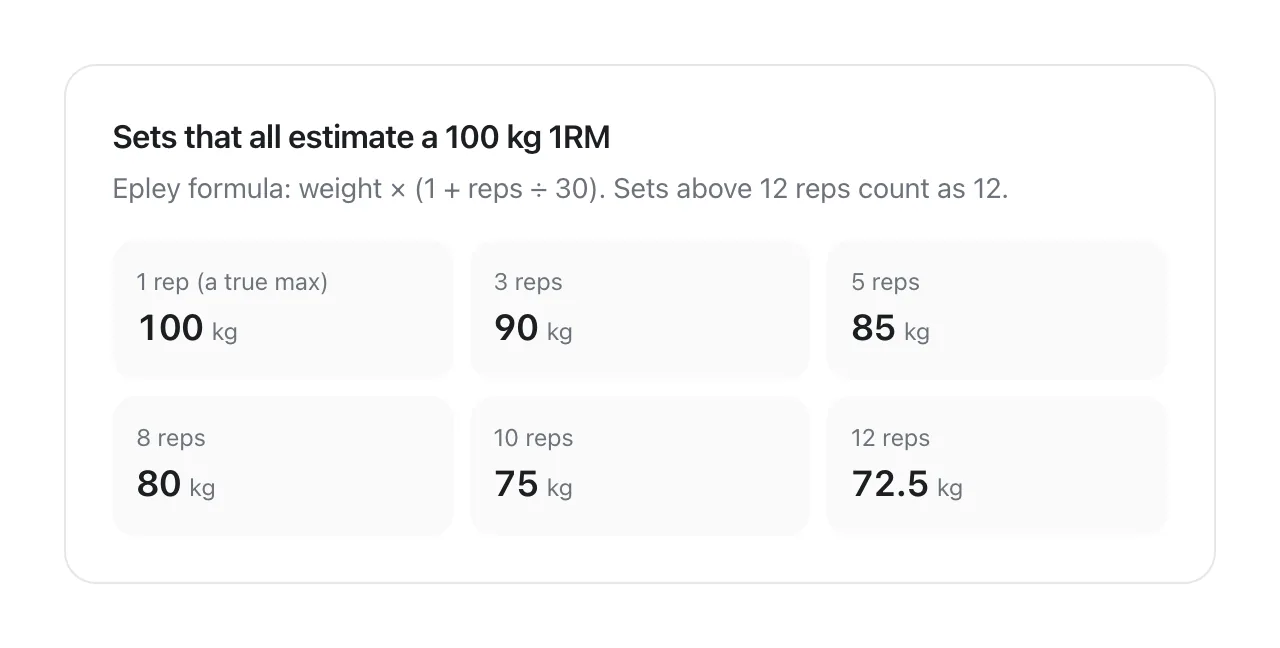
Write every set down. Progress on one exercise is easier to see as an estimated one-rep max, which turns any set into a single comparable number. The widely used Epley formula is weight × (1 + reps ÷ 30), so 40 kg for 12 reps estimates 56 kg, and 42.5 kg for 8 reps estimates about 53.8 kg.
When a lift stalls for two or three weeks, check sleep, food and stress first, then try a lighter week (about half the sets, same exercises) before pushing again.
Common push pull legs mistakes
Too many exercises, too few hard sets. Four or five well-chosen exercises per session, each done for 2 to 4 challenging sets, are easier to progress than eight moves done once.
Treating pull day as arm day, or skipping legs. Rows and pulldowns are the backbone of pull day. Legs day is usually the hardest session, which is exactly why it gets skipped.
Running six days too soon. Six days doubles your volume while you're still learning technique. Start with 3 and add days once the sessions feel routine and you recover between them.
Skipping a session on a 3-day plan. A missed legs day means two weeks without leg training, so shift the sequence on by a day instead.
Chasing weight with worse form. Add load only when every rep in the range looks like the first one.
Running a push pull legs split with VedaWatch
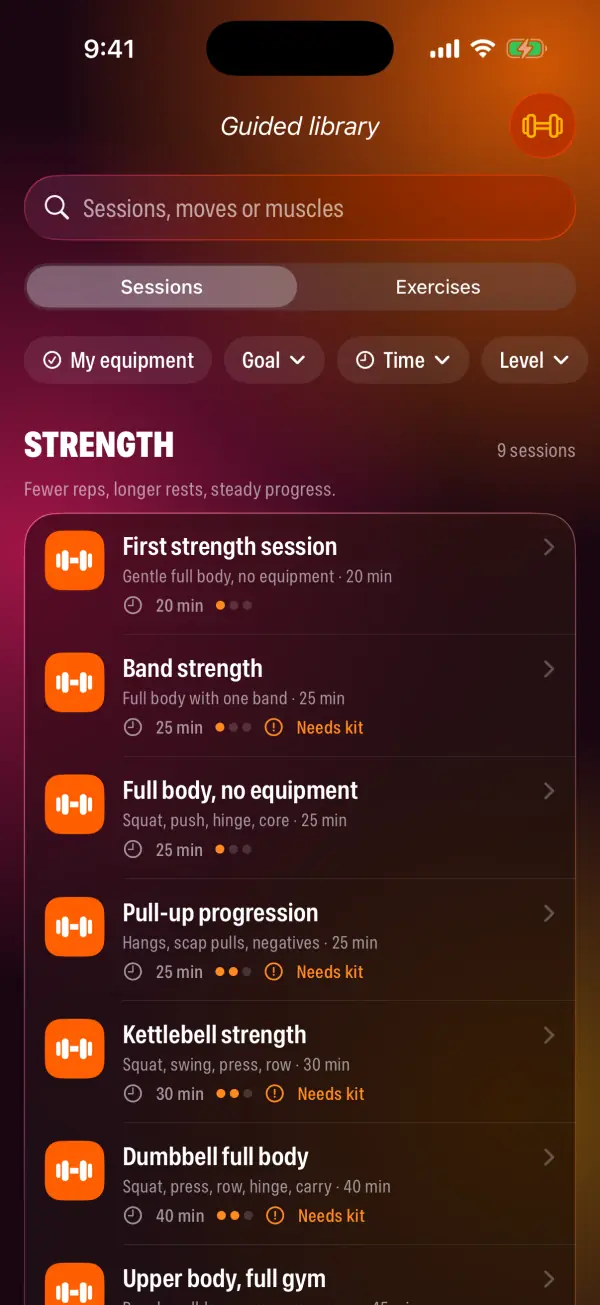
VedaWatch is an iPhone and Apple Watch app, and it can help you follow a PPL week and see whether the sets math is working. Its Guided library already includes Push day, full gym (chest, shoulders and triceps), Pull day, full gym (back, biceps and grip) and Leg day, full gym (squat, Romanian deadlift, leg press, curls and calves). They're about 50 minutes each and marked Advanced, so beginners may prefer to build their own versions.
To set up the week, open the This week card on the Train tab and choose Plan your usual week. For each training day you can pick a Library session, or use Build a session under My sessions to make your own from library exercises with your own sets, reps and rest, such as the push, pull and legs days in this guide. The automatic Plan my week for me option builds upper, lower and full-body focus days rather than a push/pull/legs rotation, so for PPL pick the sessions yourself.
You can play each session on your Apple Watch or iPhone with timers, rest countdowns and spoken cues. On the watch it can count reps for many pushing, pulling, squatting and hinging moves, and you confirm reps and weight with the Digital Crown. Finished sessions are saved to Apple Health as workouts if you allow it.
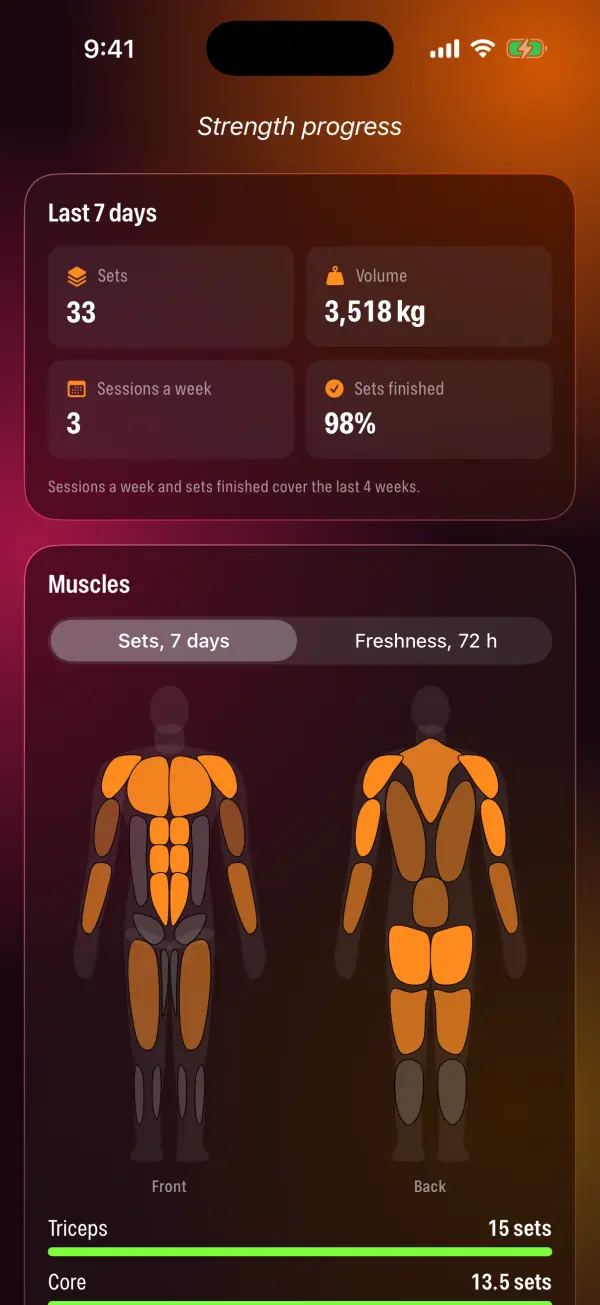
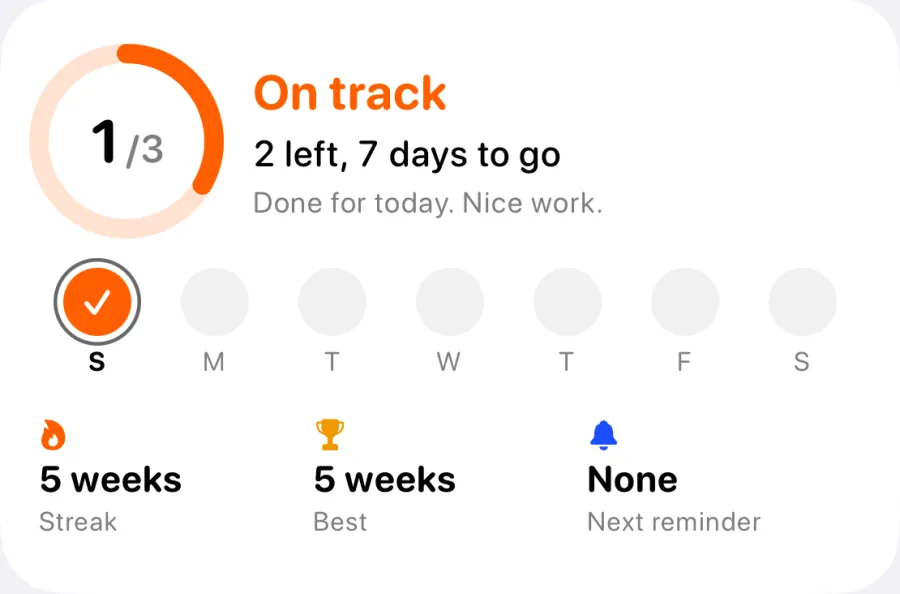
Strength progress on the Train tab shows sets per muscle over the last 7 days, with bars that fill at about 10 sets a week, and each exercise's Epley estimated 1RM and best sets. A weekly target with reminders helps you keep the days you planned.
It's general fitness guidance, not medical advice or a substitute for a coach who can watch your form.
Frequently asked questions
Can I do push pull legs at home with dumbbells?
Yes. Use dumbbell presses and push-ups for push day, one-arm rows and band or doorframe pull-ups for pull day, and goblet squats, split squats and dumbbell Romanian deadlifts for legs. The weekly sets math works the same way.
Should I do abs on push pull legs?
You can add 2 or 3 sets of a core exercise such as planks, dead bugs or hanging knee raises to any day, often legs or pull day. Heavy squats and rows also train your trunk.
How long should a push pull legs workout take?
With 5 or 6 exercises, about 12 to 15 total sets and 1 to 3 minutes of rest, most sessions take 45 to 70 minutes including a short warm-up. Cut an isolation exercise if you're short on time rather than rushing rest on the big lifts.
Can I do cardio on a push pull legs split?
Yes. On a 3-day PPL, easy cardio fits on rest days. On a 6-day PPL, keep hard intervals away from the session before legs day so tired legs don't spoil your squats.
How long should I stay on a beginner PPL before changing it?
As long as you're still adding reps or weight most weeks, there's no need to change. Many lifters keep the same exercises for 8 to 12 weeks, then swap a few for variety or move from 3 to 6 days.
Related guides
- Beginner full body workout plan: 3 days a week for 8 weeks
- How many sets per muscle per week? What the research says
- Progressive overload explained: how to progress every lift
- How long to rest between sets: rest times by goal
- Guided strength workouts on Apple Watch: step-by-step sessions with spoken cues and rep counting
- How to track strength training progress with Apple Watch: volume, 1RM and muscle balance
Sources & further reading
- Journal of Strength and Conditioning Research (2024): Efficacy of split versus full-body resistance training on strength and muscle growth: a systematic review with meta-analysis (Ramos-Campo et al.)
- Journal of Sports Sciences (2017): Dose-response relationship between weekly resistance training volume and increases in muscle mass (Schoenfeld, Ogborn, Krieger)
- Sports Medicine (2016): Effects of resistance training frequency on measures of muscle hypertrophy: a systematic review and meta-analysis (Schoenfeld, Ogborn, Krieger)
- Journal of Sports Sciences (2019): How many times per week should a muscle be trained to maximize muscle hypertrophy? (Schoenfeld, Grgic, Krieger)
- Medicine & Science in Sports & Exercise (2009): American College of Sports Medicine position stand. Progression models in resistance training for healthy adults
- CDC: Adult activity, an overview (physical activity guidelines for adults)
This guide is educational, not medical advice, and has not been clinically reviewed. VedaWatch is not a medical device. If you have symptoms or concerns about your heart or health, contact a qualified healthcare professional.
Put your trends in perspective.
Explore HRV, sleep, and recovery with VedaWatch on your iPhone.
Download VedaWatch on the App Store →