 VedaWatch
Strength Training
How long to rest between sets: rest times by goal
How long to rest between sets for strength, muscle growth and endurance, what the research says, how supersets save time, and how to time rests on Apple Watch.
By VedaWatch editorial team · · 10 min read
The short answer
For heavy strength work (about 1 to 6 reps), rest 2 to 5 minutes. For muscle growth with moderate loads (6 to 12 reps), rest at least 1 to 2 minutes; recent research finds little extra benefit past about 90 seconds. For light, high-rep endurance work, under 90 seconds is fine. Rest longer when the next set's reps drop.
How long should you rest between sets?
The honest answer is: long enough to do your next set well. Rest exists so you can repeat good-quality work. If you rest too little, your reps fall off fast, the load you can lift drops, and the set stops doing the job you planned it for. If you rest far longer than you need, you mostly just make the workout longer.
Research and the American College of Sports Medicine (ACSM) position stand on resistance training give useful starting ranges by goal. Use them as defaults, then adjust using what happens to your reps from set to set (more on that below).
These ranges are for healthy adults. If you have a heart condition, high blood pressure, a recent injury or you're new to exercise after a long break, check with a doctor or a qualified professional before you start lifting, especially before heavy sets with short rests.
- Maximal strength (heavy loads, roughly 1 to 6 reps): rest 3 to 5 minutes for intermediate and advanced lifters, per ACSM; at least 2 minutes for trained lifters, per a 2018 systematic review.
- Muscle growth (moderate loads, roughly 6 to 12 reps): rest 1 to 2 minutes as a baseline, per ACSM. A 2024 meta-analysis found a small benefit from resting longer than 60 seconds and no detectable extra benefit beyond about 90 seconds.
- Power (light, fast, explosive lifts): rest 3 to 5 minutes so every rep stays fast, per ACSM.
- Muscular endurance (light loads around 40 to 60% of your one-rep max, more than 15 reps): keep rests under 90 seconds, per ACSM.
- Beginners chasing general strength: 60 to 120 seconds is usually enough, according to the 2018 review.
Rest between sets for strength: why heavy lifts need 2 to 5 minutes
Heavy sets draw on the fastest energy systems in your muscles and tax your nervous system. When you come back too soon, you simply can't lift as much or do as many reps, so each set is a bit weaker than it should be. Over weeks, that adds up to less total heavy work.
A 2009 review of 35 studies in Sports Medicine found that with loads between 50 and 90% of one-rep max, resting 3 to 5 minutes let people complete more repetitions across multiple sets than shorter rests, and was associated with larger gains in absolute strength. A 2018 systematic review by Grgic and colleagues, covering 23 studies and 491 participants, reached a more nuanced conclusion: people can make solid strength gains even with rests under 60 seconds, but trained lifters seem to need more than 2 minutes to get the most out of their training, while untrained people do fine with 60 to 120 seconds.
In practice, that means your rest should depend on the lift as well as your goal. Rest the longest on your heaviest, most demanding sets, such as squats, deadlifts, bench presses and overhead presses in the 3 to 6 rep range. Smaller accessory moves later in the session (lateral raises, curls, calf raises) can usually get by with 60 to 90 seconds, because they use smaller muscles and lighter loads.
Rest between sets for muscle growth: is 60 seconds enough?
For years, the standard advice for building muscle was short rests of 30 to 60 seconds. That idea leaned heavily on short-term hormone measurements: shorter rests briefly raise growth hormone after a workout, and the 2009 review above still suggested 30 to 60 seconds for hypertrophy partly for that reason. Later studies that measured actual muscle size have challenged it.
In a 2016 study by Schoenfeld and colleagues, 21 resistance-trained young men followed the same 8-week program, resting either 1 minute or 3 minutes between sets. The 3-minute group gained more maximal strength in the squat and bench press and more thigh muscle thickness. Upper-body muscular endurance improved similarly in both groups. It was a small study, so treat it as one data point rather than a final answer.
The broader picture comes from a 2024 Bayesian meta-analysis by Singer and colleagues in Frontiers in Sports and Active Living, which pooled 19 measurements from 9 studies. It found a small hypertrophy benefit from resting longer than 60 seconds, likely because longer rests let you keep more volume (reps times load) across sets. Beyond about 90 seconds, it found no detectable additional difference. The effects were small and the studies varied a lot, so the authors' findings are a guide, not a rule.
The practical takeaway: for muscle growth, there's little reason to rush. Around 90 seconds to 2 minutes is a sensible default for most exercises, longer for big compound lifts if your reps are dropping a lot. If you're short on time, shorter rests still build muscle; you may just need an extra set to make up the lost reps.
Rest for endurance, circuits and conditioning
When the goal is muscular endurance, short rests are part of the point. ACSM recommends light to moderate loads (around 40 to 60% of one-rep max) for more than 15 reps with rests under 90 seconds. You're training the muscle to keep working while partly fatigued, so not fully recovering between sets is expected.
Circuits take this further: you move from exercise to exercise with little or no rest, then rest longer between rounds. Because each exercise in a circuit usually uses a different body part, one muscle group rests while another works. Interval formats such as EMOM (every minute on the minute) build the rest into the clock: finish your reps, then rest for whatever is left of the minute.
These formats are great for fitness and time efficiency, but they aren't the best way to lift your heaviest weights. If a session mixes goals, put the heavy lifts with long rests first and finish with a short-rest circuit.
What else changes how long you should rest
Your goal sets the starting range, but a few other things should push you toward the short or long end of it.
- How close to failure you went: a set taken to failure or one rep short needs more recovery than one where you stopped with three or four reps in reserve.
- How big the exercise is: squats, deadlifts and rows work a lot of muscle and raise your heart rate more than a biceps curl, so they usually need longer.
- How heavy the load is: the closer you are to your one-rep max, the longer the rest. Light warm-up sets need only a short pause, and rests can get longer as the weight climbs.
- Your training experience: trained lifters tend to need longer rests to keep performance up on heavy sets, per the 2018 review.
- How you feel that day: after poor sleep, illness or a hard week, you may need longer rests, or fewer heavy sets, to hold the same reps.
- Between exercises: moving to a new exercise isn't a free reset. Take at least your normal between-set rest, and a little more before a heavy compound lift.
How to tell if you rested long enough
The simplest test is your rep count. Pick a weight you can lift for about 10 reps and do three sets. If you get 10, 10 and 9, your rest is fine. If you get 10, 7 and 5, you came back too soon for that goal, unless short rests were the point of the session.
Here is a worked example. Say you do 3 sets of goblet squats at 20 kg with 60 seconds of rest and get 12, 9 and 7 reps: 28 reps in total. Next week you rest 2 minutes and get 12, 11 and 10: 33 reps at the same weight. That's 5 more reps of quality work for about 2 extra minutes of rest, which is usually worth it if building strength or muscle is your goal.
Breathing and heart rate are rougher guides. If you're still breathing hard and can't hold a sentence, you probably aren't ready for a heavy set. But heart rate recovers at different speeds for different people, so don't wait for it to drop to a specific number before every set.
Stop the session and get medical help if you feel chest pain or pressure, faintness, unusual shortness of breath, or a racing or irregular heartbeat. Those aren't signs that you need a longer rest; they need checking by a doctor.
Supersets: how to rest less without losing gains
A superset pairs two exercises back to back, then rests after the pair. It's one of the best ways to shorten a session without cutting the rest each muscle gets.
A 2025 meta-analysis in Sports Medicine by Zhang and colleagues pooled 19 studies with 313 participants. Compared with traditional sets, supersets shortened sessions and raised training efficiency, while long-term gains in maximal strength, strength endurance and muscle size were similar. Supersets did feel harder: people rated their effort higher.
The type of pairing matters. Agonist-antagonist supersets, which pair opposing muscles such as a press with a row or a biceps curl with a triceps extension, let people do more reps than traditional sets in that analysis. Pairing two exercises for the same muscle reduced the total load lifted. So if you superset to save time, pair opposing or unrelated muscles, and keep same-muscle supersets for when you deliberately want extra fatigue.
For a simple worked example, imagine 3 sets of dumbbell bench press and 3 sets of dumbbell rows with 2 minutes of rest after each set. Done one exercise at a time, that's 5 rests, or 10 minutes of resting. Done as a superset with 2 minutes after each pair, it's 2 rests, or 4 minutes, and each muscle still gets several minutes between its own sets.
Using a rest timer on Apple Watch with VedaWatch
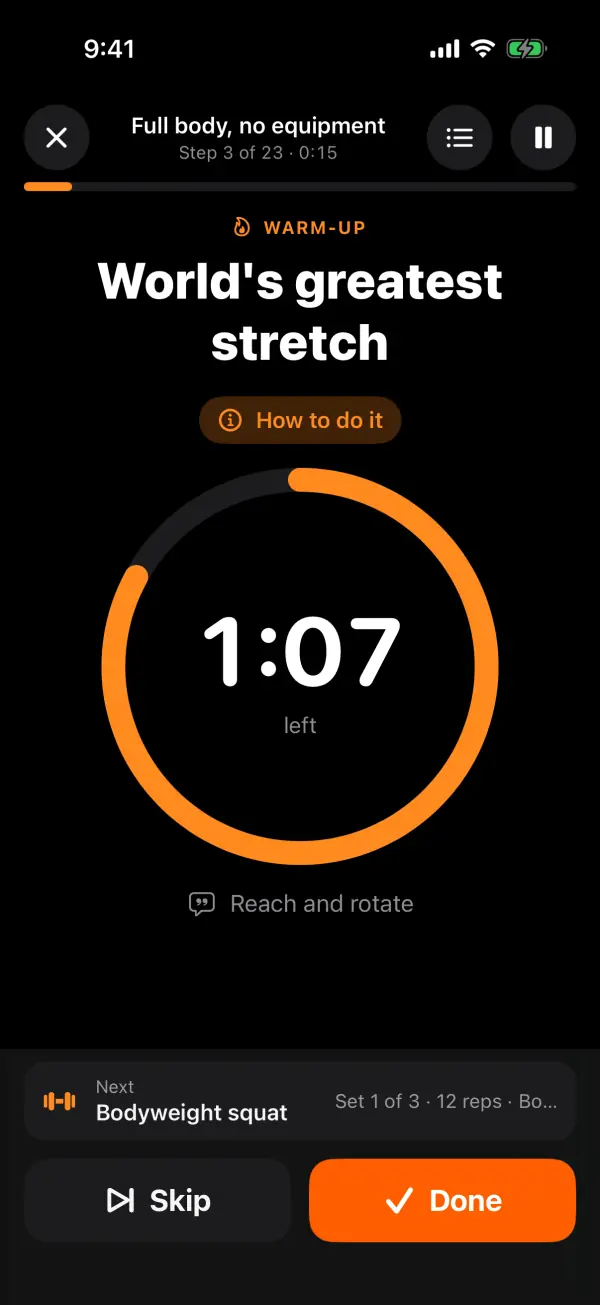
The hardest part of resting well is actually timing it. Phones get picked up, a 90-second rest becomes four minutes of scrolling, or you rush back because you lost track. VedaWatch's guided player builds each rest into the session as its own timed step, on Apple Watch or iPhone, so you don't have to watch a clock.
When a set ends, the rest step starts a countdown ring and shows what's coming next. If you need more time, tap +15 s; if you're ready early, tap Skip rest on iPhone or Skip on the watch. On Apple Watch you can add up to 5 extra minutes to a single rest. With spoken cues on, the player says "10 seconds. Next," followed by the exercise, then counts down 3, 2, 1, and haptic taps mark each change, so you can rest with your wrist down.
Rest lengths are written into each session to suit what it trains. Sessions in the Guided library use rests from 30 seconds to 3 minutes: for example, Barbell 5x5 rests 3 minutes between squat and bench press sets and 2 minutes between barbell rows, while the Band arms and shoulders session uses supersets with 45 seconds after each pair. When the daily coach builds a strength session, it uses 90 seconds between sets (2 minutes on hard days) if you're past beginner level and have dumbbells, a kettlebell or a barbell, 60 to 75 seconds otherwise, and 45 seconds for core moves.
You can also set your own. When you build a session (New session with this on any exercise's page, or Build a session when planning a day), each exercise has a Rest setting from 0 to 5 minutes in 15-second steps. It starts at 60 seconds for rep exercises and 30 seconds for timed ones, and the rest comes after each set and before the next exercise.
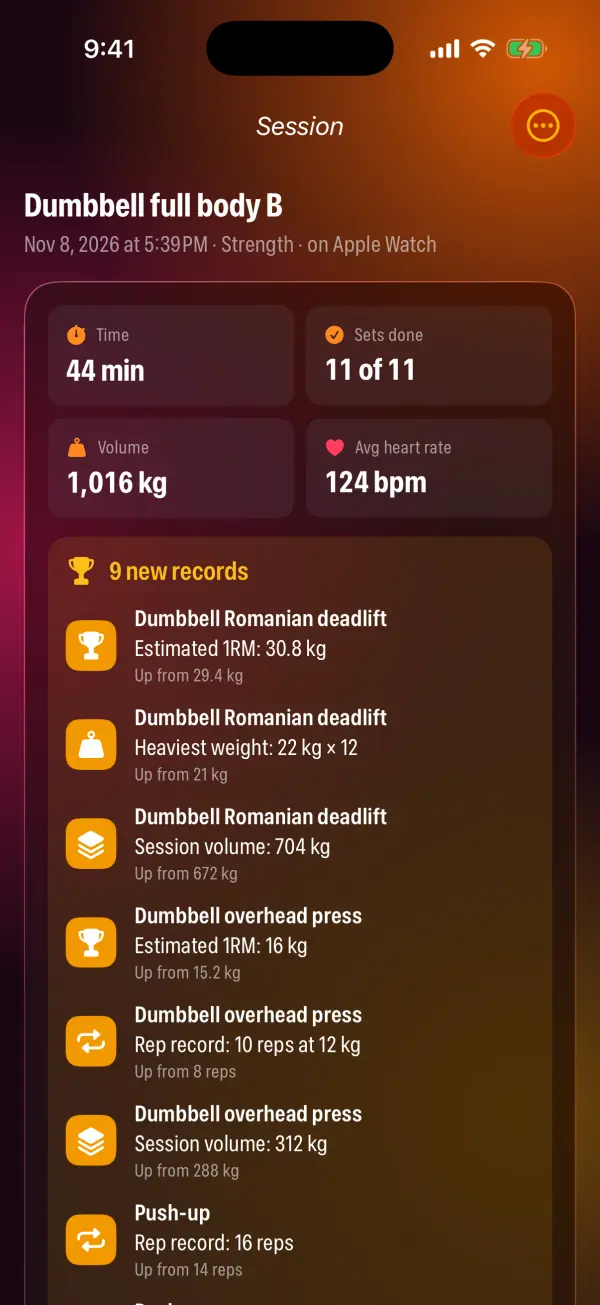
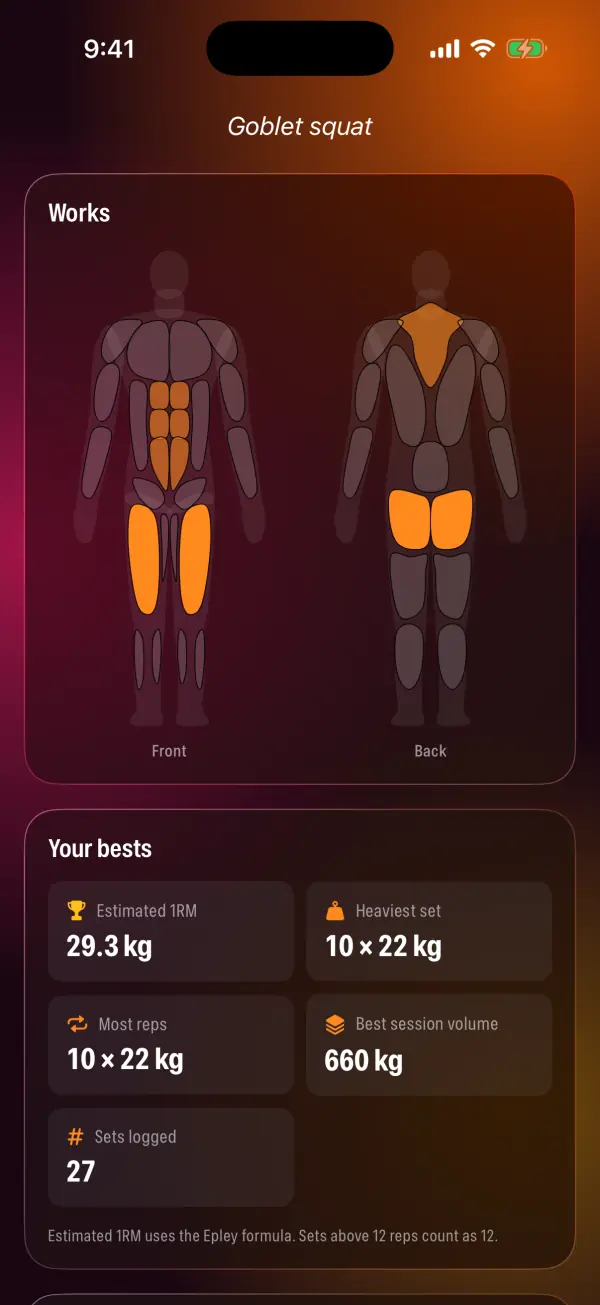
After the session, each set's reps and weight are saved, and on Apple Watch many lifts are counted from your wrist motion, so you can confirm the number with the Digital Crown. That gives you the set-by-set record you need for the rep-count test above. Exercise pages then show your bests, such as heaviest set and estimated one-rep max, over time.
A simple rest plan you can use today
If you want one plan without thinking too hard, use these defaults and adjust from your rep counts.
- Main heavy lift of the day (3 to 6 reps): 2 to 3 minutes, up to 5 if reps keep dropping.
- Other compound lifts (6 to 12 reps): about 90 seconds to 2 minutes.
- Isolation and accessory moves (10 to 15 reps): 60 to 90 seconds.
- Core holds and light endurance work: 30 to 60 seconds.
- Short on time: superset opposing muscles and rest 60 to 90 seconds after each pair.
- Each week, compare reps across sets. If the last set falls more than 2 or 3 reps below the first, lengthen the rest by 30 seconds or lighten the load.
Frequently asked questions
Is 30 seconds of rest between sets enough?
For light endurance work, circuits or core holds, yes. For heavier sets aimed at strength or muscle growth, 30 seconds usually cuts your reps on the next set, so most people do better with 90 seconds or more.
Should I rest longer between exercises than between sets?
Usually a little, especially before a heavy compound lift. Switching exercises doesn't reset fatigue in your heart, lungs or shared muscles, so treat the gap as at least a normal set rest.
Does resting longer burn fewer calories?
A session with shorter rests packs more work into each minute, so it may feel harder and raise your heart rate more. But longer rests let you lift more in total, and the bigger long-term benefits of strength training come from consistent, progressive work rather than burning the most calories in one session.
Should I sit down or keep moving during rest?
Either is fine for most people. Light movement such as walking around or a gentle stretch for a muscle you're not about to train can help you feel ready, but don't turn your rest into extra hard work.
Can I skip rest if I feel ready?
Yes, if your next set comes out at the reps and weight you planned. If you skip rests and your reps drop sharply, you're trading quality for speed, which only makes sense when conditioning is the goal.
Related guides
- Progressive overload explained: how to progress every lift
- How many sets per muscle per week? What the research says
- Guided strength workouts on Apple Watch: step-by-step sessions with spoken cues and rep counting
- How to track strength training progress with Apple Watch: volume, 1RM and muscle balance
- Beginner full body workout plan: 3 days a week for 8 weeks
- How to calculate your one rep max: Epley, Brzycki and Lombardi
Sources & further reading
- Medicine & Science in Sports & Exercise (2009): American College of Sports Medicine position stand. Progression models in resistance training for healthy adults
- Sports Medicine (2018): Effects of rest interval duration in resistance training on measures of muscular strength: a systematic review (Grgic et al.)
- Journal of Strength and Conditioning Research (2016): Longer interset rest periods enhance muscle strength and hypertrophy in resistance-trained men (Schoenfeld et al.)
- Frontiers in Sports and Active Living (2024): Give it a rest: a systematic review with Bayesian meta-analysis on the effect of inter-set rest interval duration on muscle hypertrophy (Singer et al.)
- Sports Medicine (2009): Rest interval between sets in strength training (de Salles et al.)
- Sports Medicine (2025): Superset versus traditional resistance training prescriptions: a systematic review and meta-analysis (Zhang et al.)
This guide is educational, not medical advice, and has not been clinically reviewed. VedaWatch is not a medical device. If you have symptoms or concerns about your heart or health, contact a qualified healthcare professional.
Put your trends in perspective.
Explore HRV, sleep, and recovery with VedaWatch on your iPhone.
Download VedaWatch on the App Store →