 VedaWatch
Strength Training
Beginner full body workout plan: 3 days a week for 8 weeks
A beginner full body workout plan for 3 days a week: two workouts with sets, reps and rest, a 6-minute warm-up and an 8-week progression based on ACSM guidance.
By VedaWatch editorial team · · 11 min read
The short answer
Train three non-consecutive days a week, such as Monday, Wednesday and Friday, alternating two full body workouts. Do 5 or 6 exercises covering squat, hinge, push, pull and core, 2 to 3 sets of 8 to 12 reps, stopping 2 to 3 reps short of failure. Add reps first, then weight, over 8 weeks.
The 3-day beginner full body workout plan at a glance
This plan uses two workouts, A and B, that each train your whole body. You alternate them on three non-consecutive days: in week 1 you do A on Monday, B on Wednesday and A on Friday; in week 2 you do B, A, B. Each muscle group gets trained three times a week, with at least one rest day between sessions.
Every workout covers the five basic movement patterns: a squat or lunge for the legs, a hip hinge for the glutes and hamstrings, a push for the chest, shoulders and triceps, a pull for the back and biceps, and a core exercise. With the rests below, each session takes roughly 45 to 60 minutes including the warm-up.
The numbers follow the American College of Sports Medicine (ACSM). Its 2009 position stand on progression recommends that novices train 2 to 3 days a week with loads they can lift for 8 to 12 reps, and add 2 to 10% to the load once they can do 1 to 2 reps more than the target. Its 2026 position stand, built on 137 systematic reviews, recommends training all major muscle groups at least twice a week, at least two sets per exercise, and stopping sets with about 2 to 3 reps in reserve rather than going to failure.
The plan assumes adjustable dumbbells and a bench or sturdy step. Each exercise has a gym and a no-equipment swap.
Is a 3-day full body workout good for beginners?
Yes, for most people it's one of the simplest ways to start. Three full body sessions let you practise each movement three times a week, which helps you learn the technique faster than training each muscle once a week. If you miss a day, every muscle still gets at least two sessions, which is still the ACSM minimum.
Full body versus split is less important than it sounds. The 2026 ACSM review found that, when total weekly sets were equal, training a muscle once a week or more than five times a week gave similar muscle growth. What it did link to more growth was volume: 10 or more sets per muscle per week, with diminishing returns somewhere around 18 to 20. At full volume, this plan gives each major movement pattern about 9 hard sets a week, close to that 10-set mark, without the long sessions a beginner would need to get there in two days.
For strength, the same review found the best results from 2 to 3 sets per exercise, at least two sessions a week, a full range of motion and doing the main lift early in the session. This plan builds all four in. It also stressed that any resistance training beats none, so consistency matters more than the perfect programme.
How to warm up before a full body workout
A good warm-up takes about 6 minutes and has three parts: something to raise your heart rate, a few dynamic moves through the ranges you're about to use, and lighter sets of your first exercise. Research on warm-ups for strength training is small and mixed, but a 2021 systematic review found the clearest benefit from a specific warm-up, meaning sets of the same exercise working up toward the weight you'll lift.
- Minutes 0 to 3, general: brisk walk, easy bike, marching in place or jumping jacks, until you're breathing a little harder and feel warm.
- Minutes 3 to 5, dynamic moves: 5 world's greatest stretches per side, 10 bodyweight squats, 10 hip hinges with your hands on your hips, and 10 arm circles each way.
- Minute 5 onward, ramp-up sets: before your first exercise, do 1 set of 8 reps at about half your working weight, then 1 set of 4 reps at about three-quarters. These don't count as work sets.
- Before later exercises, one light set of 5 to 6 reps is usually enough, because your body is already warm.
- Optional cool-down: 3 to 5 minutes of easy walking and a few gentle stretches for the hips, hamstrings and chest.
Workout A: exercises, sets, reps and rest
Workout A starts with the squat, your biggest lower-body lift, while you're fresh. Rest 90 seconds to 2 minutes after the big lifts and about 60 to 90 seconds after the smaller ones. The 2026 ACSM review found no difference in strength gains between rests shorter and longer than a minute, so the real rule is to rest long enough that your next set looks as good as the last one. Reps listed for one side are per side.
- 1. Goblet squat: 3 sets of 8 to 12 reps, rest 90 to 120 s. Gym swap: leg press. No equipment: bodyweight squat to a box, then a slower tempo.
- 2. Dumbbell bench press: 3 sets of 8 to 12 reps, rest 90 to 120 s. Gym swap: machine chest press. No equipment: push-up, on a bench or wall if needed.
- 3. One-arm dumbbell row: 3 sets of 8 to 12 reps per side, rest 60 to 90 s. Gym swap: seated cable row. No equipment: towel row on a door or a table row.
- 4. Dumbbell Romanian deadlift: 3 sets of 8 to 12 reps, rest 90 s. Gym swap: barbell or cable Romanian deadlift. No equipment: single-leg hip hinge holding a wall.
- 5. Dead bug: 2 sets of 8 reps per side, rest 45 s. Slow and controlled, lower back staying in touch with the floor.
- 6. Plank: 2 sets of 20 to 40 seconds, rest 45 s. Stop when your hips start to sag.
Workout B: exercises, sets, reps and rest
Workout B trains the same patterns with different exercises, so you get variety and each joint sees a slightly different angle. It also adds a loaded carry for grip, posture and core.
- 1. Dumbbell split squat: 3 sets of 8 to 12 reps per leg, rest 60 to 90 s. Gym swap: walking lunge or leg press. No equipment: bodyweight split squat, holding a wall for balance.
- 2. Hip thrust or glute bridge with a dumbbell on your hips: 3 sets of 8 to 12 reps, rest 90 s. Gym swap: machine or barbell hip thrust. No equipment: single-leg glute bridge.
- 3. Seated dumbbell overhead press: 3 sets of 8 to 12 reps, rest 90 to 120 s. Gym swap: machine shoulder press. No equipment: pike push-up with your hands on a bench.
- 4. Lat pulldown: 3 sets of 8 to 12 reps, rest 60 to 90 s. Home swap: chest-supported dumbbell row or a band pulldown. No equipment: table row with bent knees.
- 5. Farmer's carry: 2 sets of 30 to 40 seconds, rest 60 s. Walk tall with a heavy dumbbell in each hand.
- 6. Bird dog: 2 sets of 8 reps per side, rest 30 s. Reach long, keep your hips level.
How much weight should a beginner lift?
Pick the weight from the reps, not the other way round. For each exercise, find a load you can lift for the bottom of the range, 8 reps, with clean form and about 2 to 3 reps left in the tank. That's what reps in reserve (RIR) means: how many more good reps you could have done. If you could have done 6 more, it's too light. If your form breaks down before 8, it's too heavy.
In your first session, start lighter than you think and use the first set to find the weight. Write down the weight and reps of every set so you know what to beat next time.
You don't need to train to failure. The 2026 ACSM review found that sets taken to momentary muscular failure did not give more strength, size or power than sets stopped a little short, and stopping short makes it easier to keep good technique and recover for the next session.
A useful worked example: say you do goblet squats with 16 kg and get 10, 9 and 8 reps. Next session you aim for 11, 10, 9. Once you hit 12 on all three sets with about 2 reps in reserve, move up to the next dumbbell, here 18 or 20 kg (a 12 to 25% jump, which is why smaller steps or micro-plates help on lighter lifts), and work back up from 8 reps.
The 8-week progression: what changes each week
The progression uses double progression: first add reps within the 8 to 12 range, then add weight and drop back to 8. It's the simplest way to follow ACSM's advice to increase the load by 2 to 10% once you can beat the target reps by 1 or 2. The 2026 review notes that beginners see good results even without strict progression, but adding load over time is what keeps the gains coming after the first weeks.
- Weeks 1 and 2, learn the moves: 2 sets per exercise, 10 to 12 reps, with 3 to 4 reps in reserve. Focus on full range of motion and smooth technique. It should feel easy; that's on purpose.
- Weeks 3 and 4, build volume: go to 3 sets on the main lifts (core and carries stay at 2), 8 to 12 reps, 2 to 3 reps in reserve. Start double progression: add a rep or two where you can.
- Weeks 5 and 6, add load: whenever you hit 12 reps on every set of an exercise, increase the weight by the smallest step available and restart at 8 reps. Expect most exercises to move up at least once.
- Week 7, keep pushing: same structure. If a lift stalls for two sessions in a row, drop back to the previous weight and work back up, or hold the weight and aim for one more rep in total.
- Week 8, check and adjust: repeat the same workouts, then compare your weights and reps with week 3. If you feel run down, make this a lighter week with 2 sets per exercise.
- After week 8: keep going with the same plan while it's still working, swap 1 or 2 exercises for variations, or add a fourth day if you want more volume.
Weekly schedule, cardio, rest days and soreness
Any three non-consecutive days work: Monday, Wednesday, Friday; Tuesday, Thursday, Saturday; or Sunday, Tuesday, Thursday. If you miss a session, do it the next day and carry on with the alternation, rather than squeezing two sessions into back-to-back days.
Strength training doesn't replace cardio. The CDC recommends adults get at least 150 minutes a week of moderate-intensity aerobic activity, such as brisk walking, as well as muscle-strengthening activity on at least 2 days that works the legs, hips, back, core, chest, shoulders and arms. Walking, cycling or easy runs on your off days, or after a lifting session, fit well with this plan.
Some muscle soreness a day or two after the first sessions is normal and usually fades as your body adapts. Sharp pain, pain in a joint, or pain that gets worse during a set is different: stop that exercise and try an easier swap. If you have a heart condition, high blood pressure, are pregnant, are returning from an injury or haven't exercised in a long time, check with a doctor or physiotherapist before starting. Get medical help straight away for chest pain, unusual breathlessness, dizziness or fainting during exercise.
Common beginner mistakes to avoid
Most beginners stall for the same few reasons.
- Starting too heavy: the first two weeks are for learning. Leaving reps in reserve now makes adding weight later easier.
- Not writing anything down: without last session's numbers you can't apply double progression.
- Cutting the range of motion: a full range is one of the factors the ACSM review linked to more strength. Use a lighter weight rather than half reps.
- Training through pain: soreness is fine, pain in a joint isn't. Swap the exercise and get it checked if it doesn't settle.
How VedaWatch can guide this plan on your Apple Watch
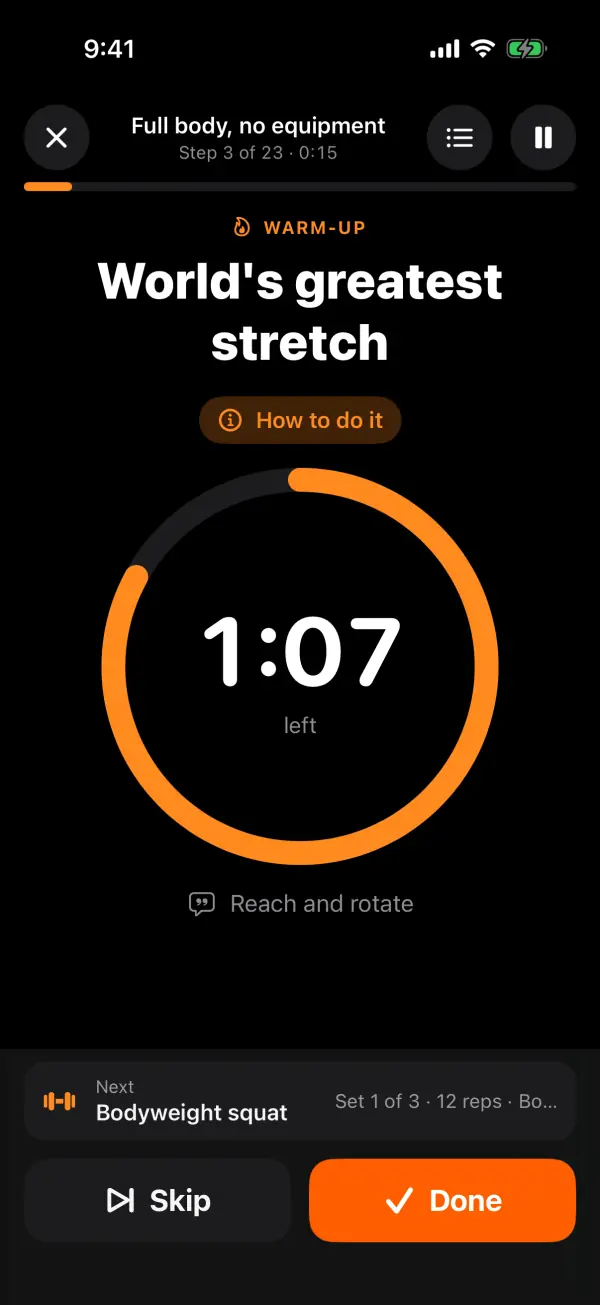
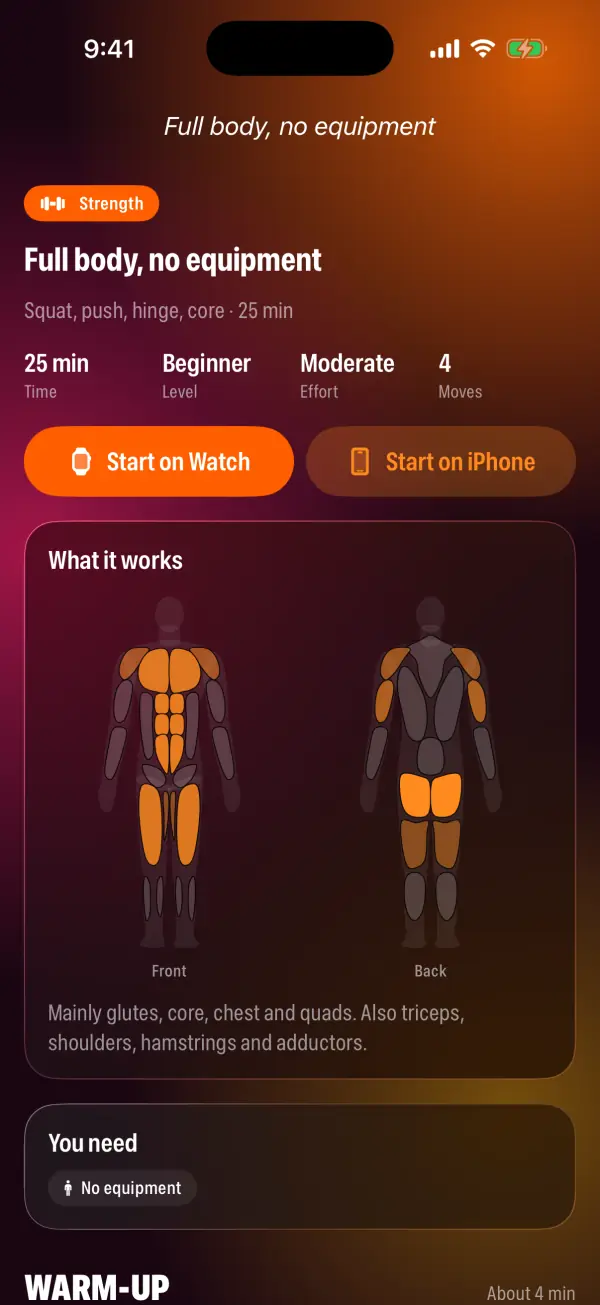
If you'd rather not follow the plan from a notes app, VedaWatch can run it as guided sessions. Build a session lets you make Workout A and Workout B yourself: pick each exercise from the library, then set 1 to 10 sets, the reps or a time, and the rest from 0 to 300 seconds in 15-second steps. If you'd rather start with something ready-made, the Guided library includes beginner sessions such as First strength session and Full body, no equipment, and a Dumbbell full body session for later.
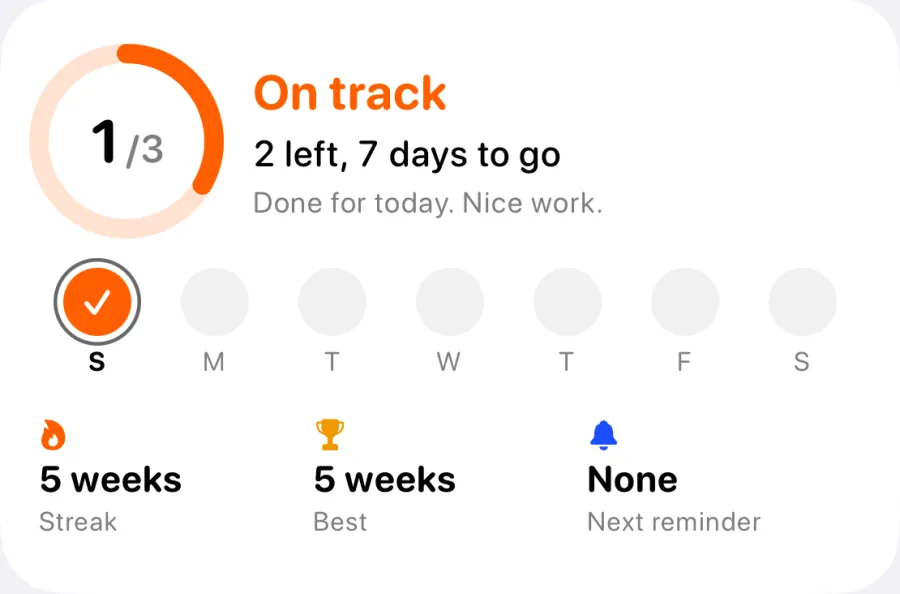
In Your week you can plan the usual week, for example Monday, Wednesday and Friday, and give each day a library session, one of your own sessions or the coach's pick, with reminders. A weekly target counts your sessions and keeps a streak of weeks you hit it.
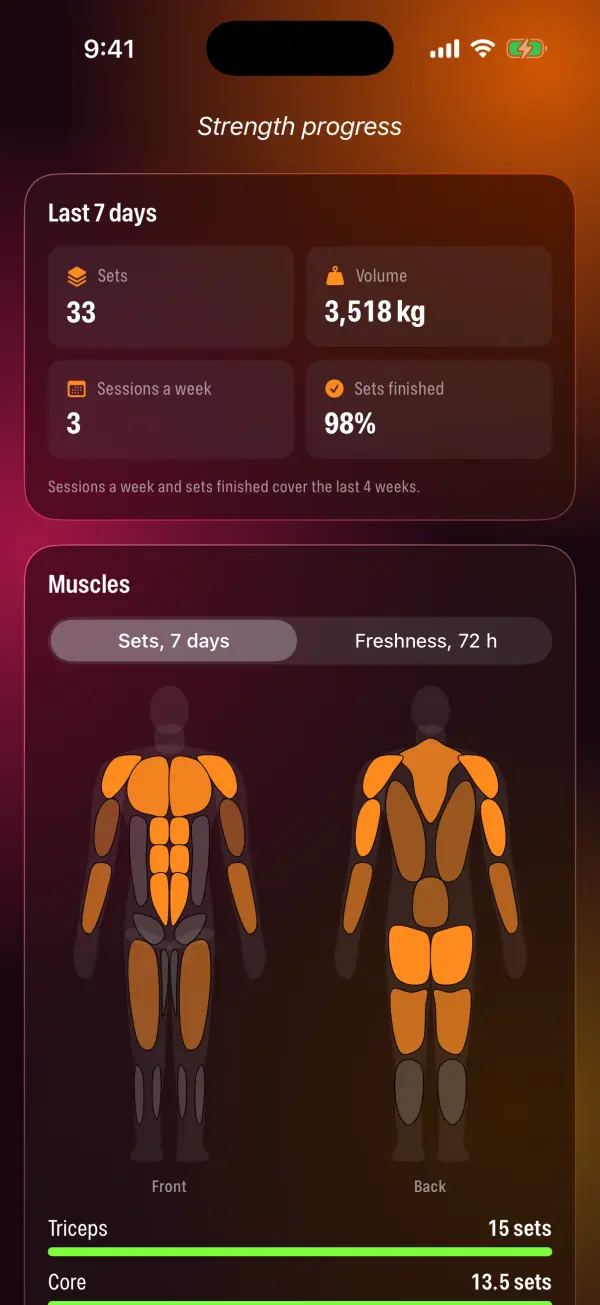
When you start a session on your Apple Watch or iPhone, the player walks you through warm-up, sets and rests with timers and spoken cues, and on the Watch it can count many strength reps from your wrist motion, such as squats, rows and presses; planks and carries you finish with Done. You log the reps and weight of each set, and Strength progress then shows sets per muscle against a 10-sets-a-week guide and an Epley estimated one-rep max for each exercise, so you can see whether week 8 really beats week 3. Finished sessions are saved to Apple Health as workouts.
The Guided library, your own sessions, the weekly target and Strength progress don't need a subscription. VedaWatch Pro ($6.99 a month or $59.99 a year on the US App Store, November 2026) adds a readiness-based training plan. As with any app, the sessions are general fitness guidance, not medical advice.
Frequently asked questions
Can I do the same full body workout 3 times a week?
Yes. Repeating one workout three times a week works, especially in the first month. Alternating two workouts, as here, adds variety and trains each pattern from slightly different angles without changing the weekly volume much.
Can I train on back-to-back days?
It's better not to repeat a hard full body session on consecutive days, because the same muscles haven't had a rest. If your schedule forces it, make the second day lighter or swap it for a walk or easy cardio.
Should I do cardio before or after lifting?
If strength is your main goal, lift first while you're fresh and do cardio afterwards or on your off days. A short, easy bout of cardio as part of the warm-up is fine.
Can I follow this plan with no equipment?
Yes, use the no-equipment swaps for each exercise. Without weights, progress by adding reps, slowing the lowering phase, or moving to a harder variation, such as from incline push-ups to floor push-ups.
When should I move to a split routine?
When three full body sessions get too long for the sets you want to do, or you want to train four or more days a week. For many beginners a full body plan keeps working well beyond the first 8 weeks.
Related guides
- Progressive overload explained: how to progress every lift
- How many sets per muscle per week? What the research says
- How long to rest between sets: rest times by goal
- Push pull legs split for beginners: 3-day and 6-day plans
- Guided strength workouts on Apple Watch: step-by-step sessions with spoken cues and rep counting
- How to track strength training progress with Apple Watch: volume, 1RM and muscle balance
Sources & further reading
- Medicine & Science in Sports & Exercise (2026): ACSM Position Stand. Resistance Training Prescription for Muscle Function, Hypertrophy, and Physical Performance in Healthy Adults: An Overview of Reviews (Currier et al.)
- Medicine & Science in Sports & Exercise (2009): ACSM position stand. Progression models in resistance training for healthy adults
- CDC: Adult Activity: An Overview (Physical Activity Guidelines for Americans)
- Motricidade (2021): The effect of warm-up in resistance training and strength performance: a systematic review (Ribeiro et al.)
This guide is educational, not medical advice, and has not been clinically reviewed. VedaWatch is not a medical device. If you have symptoms or concerns about your heart or health, contact a qualified healthcare professional.
Put your trends in perspective.
Explore HRV, sleep, and recovery with VedaWatch on your iPhone.
Download VedaWatch on the App Store →