 VedaWatch
Strength Training
How to calculate your one rep max: Epley, Brzycki and Lombardi
How to calculate one rep max from any set: the Epley, Brzycki and Lombardi formulas with worked examples, how accurate they are, and how to train by %1RM.
By VedaWatch editorial team · · 10 min read
The short answer
Lift a weight for as many clean reps as you can (ideally 3 to 10), then plug it into a formula. Epley: 1RM = weight × (1 + reps ÷ 30). Brzycki: weight × 36 ÷ (37 − reps). Lombardi: weight × reps^0.1. 80 kg for 6 reps gives about 93 to 96 kg: an estimate, not a tested max.
How to calculate your one rep max
Your one rep max (1RM) is the heaviest weight you can lift once with good form for a given exercise. You can find it two ways: test it directly by working up to a single heavy rep, or estimate it from a lighter set you take close to failure. Estimating is what a 1RM calculator does, and it's what most people should do most of the time.
The estimate only needs two numbers from one set: the weight and the number of reps you completed. The fewer reps, the closer the set already is to a true max, so the less the formula has to guess.
- Pick one exercise, such as the back squat, bench press or a dumbbell goblet squat. A 1RM belongs to one lift, not to a muscle.
- Warm up with a few lighter sets of the same movement.
- Choose a weight you think you can lift about 3 to 10 times, and do as many clean reps as you can. Stop when your form starts to break down or the bar slows to a grind, not at a grinding failure.
- Write down the weight and the reps you completed with good form.
- Put them into a formula: Epley is weight × (1 + reps ÷ 30). For 80 kg × 6 reps that's 80 × 1.2 = 96 kg.
- Round down to a weight you can actually load, and treat it as a working estimate you'll update as you get stronger.
The Epley, Brzycki and Lombardi formulas, worked through
Dozens of 1RM equations exist, but three show up in almost every calculator. All three take the same inputs (weight w and reps r) and differ in how much extra they add for each rep.
Epley: 1RM = w × (1 + r ÷ 30). Each extra rep adds one-thirtieth of the weight, a straight line. It's the formula most apps use, and the one VedaWatch uses.
Brzycki: 1RM = w × 36 ÷ (37 − r). Matt Brzycki published it in 1993 as a way to predict a max from reps to fatigue. It gives slightly lower numbers than Epley below 10 reps, the same number at exactly 10, and climbs steeply above that.
Lombardi: 1RM = w × r^0.1 (reps to the power of 0.1). Because it's a power curve, each extra rep adds less than the one before, so it's the most conservative of the three at high reps.
Here is the same set run through all three. Notice how close they are for low-rep sets and how they spread apart as reps climb.
- 80 kg × 6 reps: Epley 80 × 1.2 = 96.0 kg. Brzycki 80 × 36 ÷ 31 = 92.9 kg. Lombardi 80 × 6^0.1 = 95.7 kg.
- 100 kg × 3 reps: Epley 110.0 kg. Brzycki 105.9 kg. Lombardi 111.6 kg.
- 185 lb × 5 reps: Epley 215.8 lb. Brzycki 208.1 lb. Lombardi 217.3 lb.
- 60 kg × 10 reps: Epley 80.0 kg. Brzycki 80.0 kg. Lombardi 75.5 kg.
- 50 kg × 20 reps: Epley 83.3 kg. Brzycki 105.9 kg. Lombardi 67.5 kg. A spread of almost 40 kg, which is why high-rep sets make poor 1RM estimates.
Which 1RM formula is most accurate?
No single formula wins for everyone. In a classic study, LeSuer and colleagues tested seven prediction equations on 67 untrained college students in the bench press, squat and deadlift. Predicted and real maxes were strongly correlated (r above 0.95), yet for the bench press and squat most equations were still off on average by a statistically significant amount, and every equation underestimated the deadlift.
That pattern matters more than which name you pick. Formulas rank people well (stronger lifters get bigger estimates) but can miss any one person's max by a meaningful margin, and how far off they are depends on the exercise.
Rep count is the bigger lever. Reynolds and colleagues tested 70 men and women at 1, 5, 10 and 20 reps to failure in the bench press and leg press. Sets of 5 predicted the true 1RM best, accuracy dropped as reps rose, and the authors concluded that no more than 10 reps should be used in linear equations like Epley.
In practice: pick one formula and stick with it so your numbers are comparable over time. If you want a range, run Epley and Brzycki together; for sets of 3 to 6 reps they rarely differ by more than a few percent.
Why high-rep sets give unreliable estimates
Every 1RM formula assumes a fixed link between the percentage of your max and how many reps you can do. Real people don't follow one curve. The largest analysis to date, a 2024 meta-regression by Nuzzo and colleagues, pooled 952 reps-to-failure tests from 7,289 people. It found the spread between individuals grows as the load gets lighter: at 80% of 1RM the standard deviation was about 2.5 reps, and at 60% it was about 4.4 reps.
The exercise matters too. At 70% of 1RM, the meta-regression estimated about 14 reps for the bench press but about 19 for the leg press. Plug 19 reps into Epley and you'd overestimate a leg press max, because the formula expects only about 13 reps at that load.
Other things nudge the result: how close to true failure you went, how fresh you were, whether it was the first set or the fifth, and your technique. A set of 5 done fresh and a set of 5 done after three hard sets aren't the same test.
Some practical rules follow. Use sets of about 3 to 10 reps, with 3 to 6 the sweet spot. Compare like with like: the same exercise, a similar rep range and a similar point in the workout. Don't estimate a squat max from leg presses, or a barbell max from dumbbells.
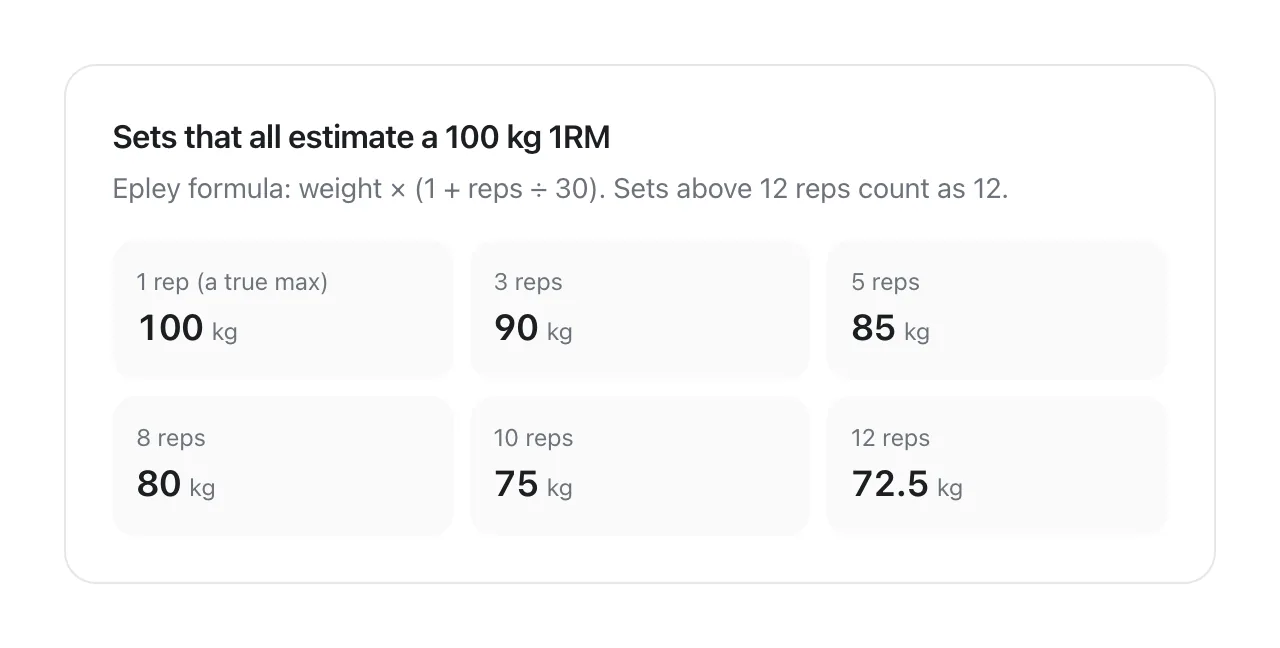
Should you test your 1RM or estimate it?
A tested 1RM is the real number. A systematic review by Grgic and colleagues pooled 32 studies (1,595 people) and found the 1RM test highly repeatable: the median test-retest correlation was 0.97 and the median day-to-day variation was 4.2%, in trained and untrained people, younger and older adults, and with or without practice sessions. Adverse events were rare, mostly muscle soreness.
Estimating is easier to fit into normal training. You don't need a spotter for a true max, a dedicated session or a full recovery afterwards, and you get a fresh number every time you do a hard set. The cost is precision, especially from high-rep sets.
A reasonable split: estimate by default, and test only if you compete in powerlifting or weightlifting, a program asks for an exact max, or you're experienced with the lift and have a spotter or safety bars. Beginners usually gain more from practising technique with submaximal weights than from maxing out.
If you do test, follow the pattern the studies in that review used. Most warmed up with one to three submaximal sets, usually at 40 to 80% of the estimated max for 1 to 10 reps, then made single attempts with rest between them (often 3 to 5 minutes), capped at a few attempts.
- Start with a few minutes of easy cardio, then a light set of the lift for several easy reps at around 40 to 50% of your estimated max.
- Add weight for one or two shorter sets, finishing around 80% of your estimate. One study in the review used 5 reps at 60%, 3 at 75%, 2 at 85% and a single at 90% before the first max attempt.
- Rest a few minutes, then attempt a weight at or just under your estimate.
- If it moves well, rest again and add a small jump. If it was a grind, that's probably your max for today.
- Stop at the first rep where form breaks down or after a few heavy attempts. Have a spotter or use safety bars. Your 1RM is the heaviest clean rep.
How to use %1RM to choose your training weights
Most programs prescribe weights as a percentage of 1RM: 5 sets of 5 at 80%, for example. Once you have an estimate, multiply. With a 100 kg max, 80% is 80 kg and 70% is 70 kg. Round to the nearest weight you can load.
You can also run Epley backwards to find a weight for a rep target: weight = 1RM ÷ (1 + reps ÷ 30). For 8 reps with a 100 kg max, that's 100 ÷ 1.27 = about 79 kg. Treat this as the most you could do for 8, so most training sets sit a little below it.
The traditional textbook table says 80% of 1RM is good for about 8 reps and 70% for about 11. The 2024 meta-regression found people often do more than that at lighter loads, roughly 9 reps at 80% and 14 at 70% in the bench press. So if a percentage feels too easy, you're probably normal, not miscalculating.
The American College of Sports Medicine's position stand on resistance training gives load ranges by goal. They're expressed as RM (the weight you can lift that many times), which the steps below also convert to approximate percentages with Epley.
- Beginners: loads you can lift for 8 to 12 reps, roughly 70 to 80% of 1RM.
- Strength, for intermediate and advanced lifters: a wider range from 1 to 12 RM over time, with emphasis on heavy 1 to 6 RM loads (about 83 to 100% of 1RM) and 3 to 5 minutes of rest between sets.
- Muscle growth: 1 to 12 RM over time, with emphasis on 6 to 12 RM (about 70 to 83% of 1RM) and 1 to 2 minutes of rest.
- Muscular endurance: light to moderate loads of 40 to 60% of 1RM for more than 15 reps, with under 90 seconds of rest.
- Progression: when you can do 1 to 2 reps more than your target at a given weight, add about 2 to 10% to the load.
Using estimated 1RM to track strength progress
An estimated max is most useful as a trend, not a trophy. If last month 80 kg × 6 estimated 96 kg and this week 82.5 kg × 6 estimates 99 kg, you got stronger, even though you never attempted a single heavy rep.
Because estimates from different rep ranges disagree, compare sets done in a similar way. Many lifters log their best set of each session, or their heaviest set of 3 to 6 reps, and chart the estimate. Expect noise: a bad night's sleep or a rushed warm-up can shave a few percent off a day's number. Look at the direction over several weeks.
Rating how hard a set felt helps you trust the number. Researchers use a reps-in-reserve scale where you note how many more reps you could have done. A set of 6 with zero reps left in the tank gives a truer estimate than a set of 6 with four left.
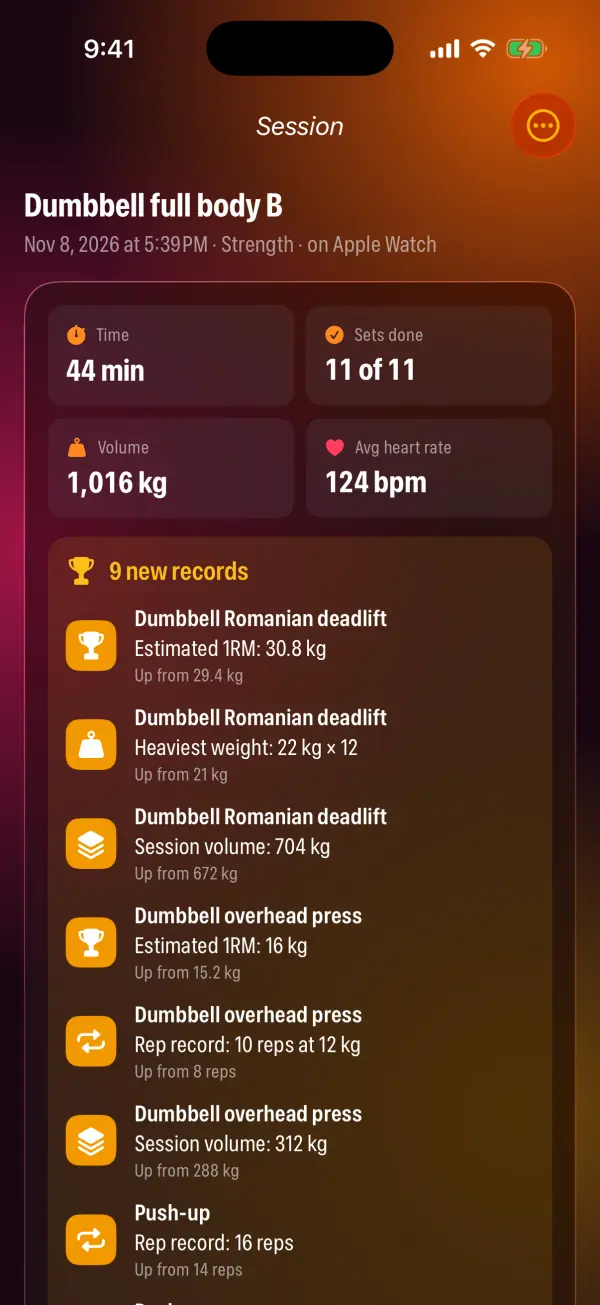
How VedaWatch estimates your 1RM automatically
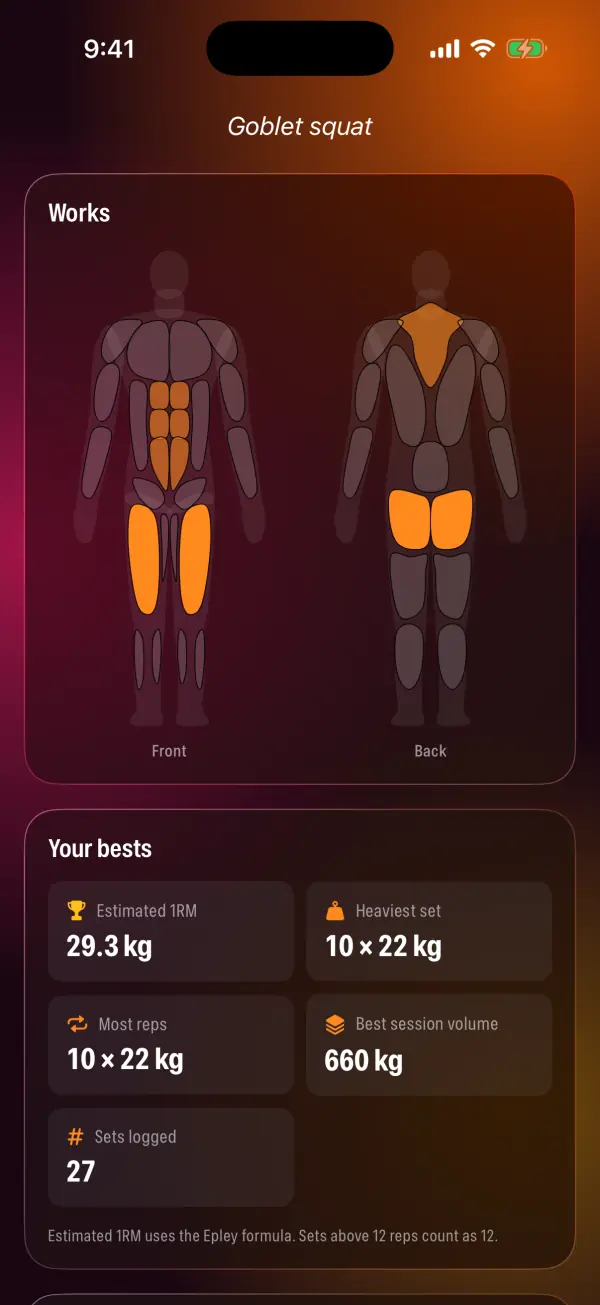
If you train with VedaWatch's guided strength sessions on Apple Watch or iPhone, you don't have to do the maths. Every completed work set is logged with its reps and weight, and each exercise gets its own page with an Estimated 1RM, your heaviest set, most reps, best session volume and a chart of your best estimated 1RM per session.
VedaWatch uses the Epley formula. A single rep counts as its own weight, and any set above 12 reps counts as 12, so a set of 25 light reps can't look like a big jump in strength. The 50 kg × 20 set from earlier would show as 70 kg rather than 83 kg.
The exercise page also lists Best sets, the heaviest weight you've lifted for each rep count, which is a handy rep-max table for picking training weights. When a session beats your previous best estimate, it's flagged as an Estimated 1RM record, and Trends calls an exercise's estimated 1RM up when, within the last four weeks, it rose at least 3% between your first and latest sessions at least a week apart.
Two honest limits: it only counts guided VedaWatch sessions, not strength workouts started in Apple's Workout app (they don't record exercises, reps or weights), and like any formula it estimates. If you need an exact max, test it.
Frequently asked questions
Is a 1RM calculator accurate?
It's close for most people when the set is 3 to 6 hard reps, and less reliable above about 10 reps. Studies find estimates rank people well but can be off for an individual, and they tend to underestimate the deadlift.
How often should I recalculate my one rep max?
Recalculating at the start of each new training block is plenty for setting percentages. If you log your sets, the estimate updates every time you do a hard set, so you can simply watch the trend.
Can I calculate a 1RM for dumbbell or bodyweight exercises?
For dumbbells, yes: use the weight of one dumbbell and compare it only with the same exercise. For bodyweight moves like push-ups or pull-ups the load isn't simply your body weight, so track reps instead, or add weight and estimate from that.
Why is my estimated 1RM higher than what I can actually lift?
Usually because the set had many reps, you're more endurance-trained than average for that lift, or a true single needs technique and nerve you haven't practised. Estimate from heavier sets of 3 to 6 reps for a closer number.
Is testing a 1RM safe for beginners?
Research reviews report few adverse events in supervised 1RM tests, mostly soreness. Still, beginners usually don't need one; estimating from a submaximal set gives a usable number. If you have a heart condition, high blood pressure, a recent injury or pain when lifting, check with a doctor or physiotherapist before maximal efforts.
Related guides
- How to track strength training progress with Apple Watch: volume, 1RM and muscle balance
- Progressive overload explained: how to progress every lift
- How many sets per muscle per week? What the research says
- How long to rest between sets: rest times by goal
- Guided strength workouts on Apple Watch: step-by-step sessions with spoken cues and rep counting
- Best strength training app for Apple Watch: 2026 roundup
Sources & further reading
- Brzycki M. Strength testing: predicting a one-rep max from reps-to-fatigue. Journal of Physical Education, Recreation & Dance. 1993
- LeSuer DA, McCormick JH, Mayhew JL, Wasserstein RL, Arnold MD. The accuracy of prediction equations for estimating 1-RM performance in the bench press, squat, and deadlift. J Strength Cond Res. 1997
- Reynolds JM, Gordon TJ, Robergs RA. Prediction of one repetition maximum strength from multiple repetition maximum testing and anthropometry. J Strength Cond Res. 2006
- Nuzzo JL, Pinto MD, Nosaka K, Steele J. Maximal number of repetitions at percentages of the one repetition maximum: a meta-regression and moderator analysis. Sports Med. 2024
- Grgic J, Lazinica B, Schoenfeld BJ, Pedisic Z. Test-retest reliability of the one-repetition maximum (1RM) strength assessment: a systematic review. Sports Med Open. 2020
- American College of Sports Medicine. Progression models in resistance training for healthy adults. Med Sci Sports Exerc. 2009
- Zourdos MC et al. Novel resistance training-specific rating of perceived exertion scale measuring repetitions in reserve. J Strength Cond Res. 2016
This guide is educational, not medical advice, and has not been clinically reviewed. VedaWatch is not a medical device. If you have symptoms or concerns about your heart or health, contact a qualified healthcare professional.
Put your trends in perspective.
Explore HRV, sleep, and recovery with VedaWatch on your iPhone.
Download VedaWatch on the App Store →