 VedaWatch
Recovery & Apple Watch
Jet lag recovery for athletes: light, sleep and training
Jet lag recovery for athletes: when to seek or avoid light, how to shift sleep before you fly, what melatonin evidence shows, and how to train after landing.
By VedaWatch editorial team · · 11 min read
The short answer
Your body clock shifts about 1 hour a day after flying east and about 1.5 hours a day after flying west. Speed it up by getting bright light at the right local times, shifting sleep before you fly, and keeping the first 2 to 3 days of training easy. Expect HRV and resting heart rate to look off for several days.
How to recover from jet lag as an athlete
Jet lag happens when you cross time zones faster than your internal clock can follow. Your watch says it's 7 am in London, but your body still thinks it's 2 am in New York, so it wants to sleep, digest and perform on home time. A 2021 consensus statement on jet lag in athletes defines it as following rapid travel across 3 or more time zones. It separates jet lag from travel fatigue, the general tiredness after any long journey, which also happens on north-south flights with no time change.
The fix is to move your clock toward local time on purpose instead of waiting for it to drift. Light is the strongest signal your clock responds to. Sleep timing, meal and caffeine timing, exercise timing and, for some people, melatonin add smaller pushes. Training is the part athletes most often get wrong: arriving and going straight into a hard session means training hard while your body thinks it's the middle of the night.
The evidence base is thinner than most travel tips suggest. A large share of the research comes from non-athletes, and the authors of the 2021 consensus say the lack of athlete-specific studies limits how firm their recommendations can be. Treat everything below as a sensible starting point, then adjust to how you respond.
How long does jet lag last? East vs west
Direction matters more than distance. Flying west means your clock has to run later, which it does fairly easily. Flying east means it has to run earlier, which is harder. The CDC Yellow Book gives an average adjustment of about 1.5 hours a day after westward travel and 1 hour a day after eastward travel. The 2021 athlete consensus uses a simpler rule of thumb: about half a day per time zone going west and a full day per time zone going east.
Worked example with the consensus rule: New York to London is 5 time zones east, so plan on about 5 days before you're fully adjusted. The return trip, 5 zones west, takes closer to 2 or 3 days. A 9-hour shift east, such as Los Angeles to Paris, could take more than a week.
This shows up in performance too. In a study of 10 trained men who flew 21 hours across 8 time zones between Australia and Qatar in each direction, eastward travel did more harm to sleep, jet lag ratings, fatigue and motivation. Sprint and intermittent running performance also dropped, especially in the first 72 hours after arrival. Your chronotype plays a part as well: the consensus notes that morning types tend to cope better with eastward trips and night owls with westward ones.
When to seek light and when to avoid it
Your clock is most sensitive to light around the low point of your body temperature, which the CDC places roughly 2 to 4 hours before your usual wake time on home time. Bright light after that low point moves your clock earlier, which is what you need after flying east. Light before it moves your clock later, which helps after flying west. That's why the same morning sunshine can help one traveler and set another back.
The rule that follows: after an eastward flight, avoid bright light in the early local morning and seek it from late morning. After a westward flight, get light in the late afternoon and evening, and keep the early morning dim. Outdoor daylight is far brighter than indoor lighting, so a walk outside does more than sitting by a window. The consensus also suggests doing your training during the light window when you can, so the two signals work together.
If you fly more than about 8 time zones east, both the consensus and a widely cited review by Eastman and Burgess suggest it may be easier to shift your clock later all the way around instead of trying to pull it that far earlier. That one is worth planning with a jet lag calculator or a sports physician, because getting the light window wrong can push your clock the wrong way. Here is a worked plan for a 5-hour eastward trip, New York to London, for someone who usually wakes at 7 am New York time:
- Find your temperature low on home time: about 3 to 5 am New York time, which is 8 to 10 am in London on arrival.
- Day 1 in London: wear sunglasses and stay indoors or in shade until about 10 am local. Then get as much outdoor light as you can through late morning and early afternoon.
- Day 2: your clock has moved about 1 hour earlier, so start your light window about an hour earlier, around 9 am.
- Days 3 to 5: keep moving the window earlier by about an hour a day until you're getting light soon after your normal local wake-up.
- Every evening: keep lights dim and screens low in the 2 hours before your target local bedtime.
Shift your sleep before you fly
You can start adjusting at home. The CDC suggests moving your sleep 1 hour earlier per day before an eastward trip, or 1 hour later per day before a westward one, for 2 to 3 days before you leave. Eastman and Burgess advise against advancing more than 1 hour a day, pairing each earlier wake-up with bright morning light, and note that even one or two days of shifting helps.
For athletes, the consensus adds a few things that matter as much as the clock. Arrive at the airport well rested rather than already short on sleep. Plan training so the travel days fall where some rest makes sense. On the plane, nap if it fits your target schedule, use an eye mask and earplugs, and skip alcohol. Avoid caffeine in the 6 hours before you intend to sleep, on board and after landing.
Pre-shifting has limits. If you're crossing 9 time zones and race 2 days after landing, you won't fully adjust, so focus on getting the best possible sleep in local night time and scheduling the hardest efforts for when your body clock is most awake.
Does melatonin help jet lag? What the evidence says
Melatonin is the hormone your body releases in the evening as a darkness signal. As a supplement it does two things: it can make you a little sleepy, and if timed well it can nudge your clock. According to the US National Center for Complementary and Integrative Health (NCCIH), reviews from 2010 and 2014 suggest it may help: 4 studies with a total of 142 travelers found it may reduce symptoms better than placebo after eastward flights, and 2 studies with 90 travelers after westward flights. That is modest evidence from small studies, not proof.
Timing matters more than dose. The CDC Yellow Book says doses of 0.5 to 1 mg are often enough and advises against more than 5 mg. Taken in the early evening at your destination it helps move your clock earlier (useful after flying east); taken when your body clock thinks it's morning it moves the clock later (useful after flying west). It does little in the middle of your biological night, when your own melatonin is already high.
There are real cautions. In the US, melatonin is sold as a dietary supplement, and NCCIH reports that in a 2017 test of 31 products, the amount in most didn't match the label. Short-term use appears safe for most people, with mild side effects like headache, dizziness, nausea and sleepiness. People who take other medicines, especially blood thinners or epilepsy medication, and anyone pregnant or breastfeeding should check with a clinician first. If you're a tested athlete, follow your federation's guidance on supplements, since any supplement can carry a contamination risk. In some countries melatonin needs a prescription.
Training after a long flight: a day-by-day plan
The 2021 consensus recommends low to moderate intensity training on arrival. That matches the performance data: the hit from eastward travel was largest in the first 72 hours. Hard intervals in those first days add strain while your sleep is broken and your clock is out of step, and they're unlikely to go well anyway.
Exercise also acts as a clock signal of its own, though a weaker one than light. In a lab study of 99 adults, an hour of moderate exercise at 7 am or between 1 and 4 pm moved the body clock earlier, and exercise between 7 and 10 pm moved it later. Those times are on the body clock you arrived with, not local time, so early on, a late-morning or early-afternoon local session after an eastward flight is a reasonable choice. A rough plan for a trip of 5 or more time zones:
- Arrival day: an easy 20 to 40 minute walk, jog or spin outdoors in your light window. It helps your legs after sitting for hours and gets you light at the right time.
- Days 1 to 2: easy aerobic work and mobility, or light technical sessions. Skip maximal efforts, heavy lifting to failure and long sessions.
- Days 3 to 4: bring back moderate intensity if you're sleeping in local night time and feel normal in warm-ups. Keep volume a bit lower than usual.
- Day 5 onward (east) or day 3 onward (west): build back toward normal training if sleep, energy and your morning readings are heading back toward your usual range.
- Race or key session: if you can choose, arrive about one day per time zone crossed going east and half a day per zone going west. If you can't, schedule the hardest work for the time that feels like your home-clock afternoon.
- Throughout: caffeine in the local morning only, short naps (early in the day) only if you need them, and regular meals at local times.
What HRV and resting heart rate do after travel
If you track recovery with an Apple Watch, expect your numbers to look off after a long trip. Overnight HRV and resting heart rate reflect your nervous system's balance, and travel stacks up several things that move them: short and broken sleep, sleeping at the wrong time for your body clock, long periods of sitting, and often a drink or a late meal on the way.
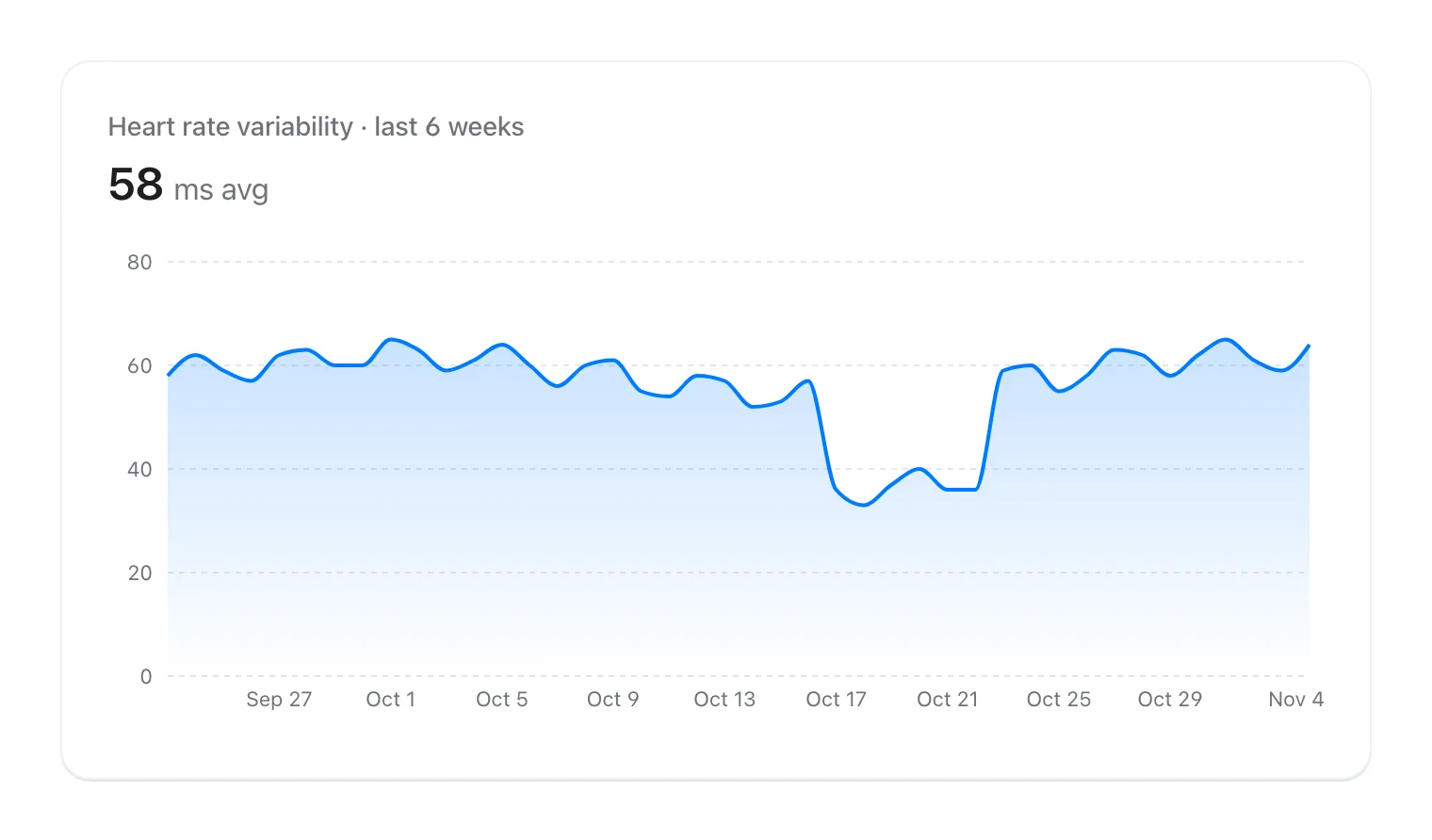
A study of 12 Olympic rugby sevens players who flew about 20 hours to Brazil with a 4-hour time change found their daily HRV (LnRMSSD) was lower and less stable in the first week after travel. The dip was mainly seen in non-starters, and their numbers were back at or above baseline by the start of the tournament, which the authors credited to proactive support from team staff. The takeaway is that a dip of a few days is normal, people respond very differently, and good travel habits seem to shorten it.
How to read your own data: compare each morning with your own recent normal, not with a single number. A first-night reading may also reflect an unusual sleep window, so the trend over several mornings tells you more. If HRV is well below normal and resting heart rate is above it, treat it as a reason to keep the day easy, and expect both to drift back as your sleep moves onto local time. If they don't improve after a week or so, look for something else, such as illness, accumulated training load or a sleep debt you brought with you.
These are wellness signals, not a diagnosis. Get medical help promptly for chest pain, shortness of breath, or swelling, pain or redness in one leg after a long flight, and see a doctor if you feel unwell or your readings stay unusual.
How VedaWatch helps you track recovery from travel
VedaWatch reads the HRV, resting heart rate and sleep your Apple Watch already records and puts them in context, which is useful when a trip throws everything off at once.
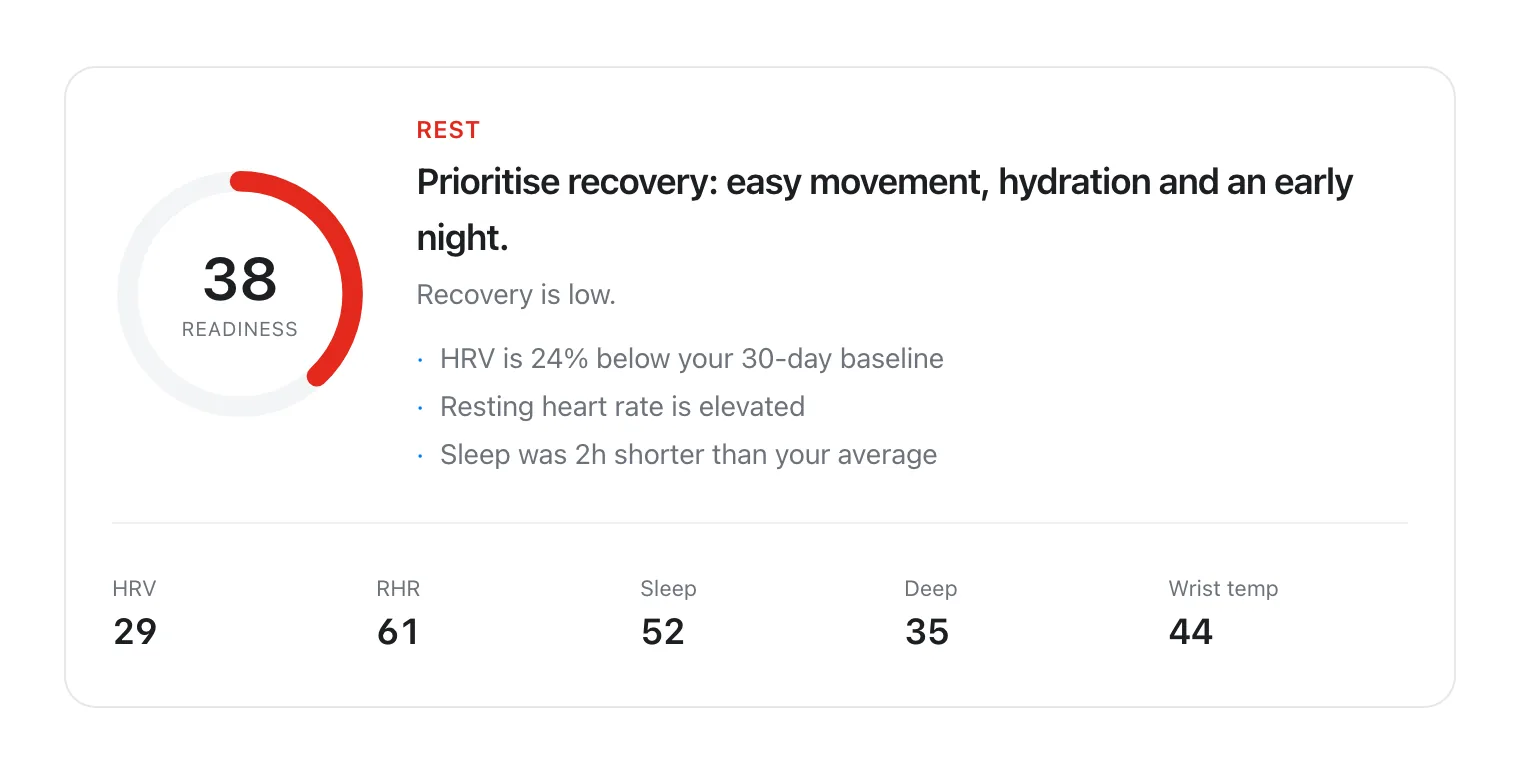
Each morning, the readiness score compares last night's HRV, resting heart rate and sleep with your recent baseline and lists the reasons behind the score, such as HRV below baseline or a short night. After a long flight, that helps you tell "my numbers are down because of the trip" from "I've been run down for a while", and choose an easier day.
The Daily tags journal has a built-in Travel tag, which you can log from the iPhone or the Watch app. Once you've logged Travel on at least 5 days and logged at least 5 days without it, and your Watch has 30 mornings of overnight HRV, VedaWatch shows how your next-morning HRV usually differs after travel days. If there's a clear pattern and you tagged Travel yesterday, Today can lead with "Expect a dip after yesterday's travel" and suggest keeping the day on the easy side. It's a pattern in your own data, not proof of cause.
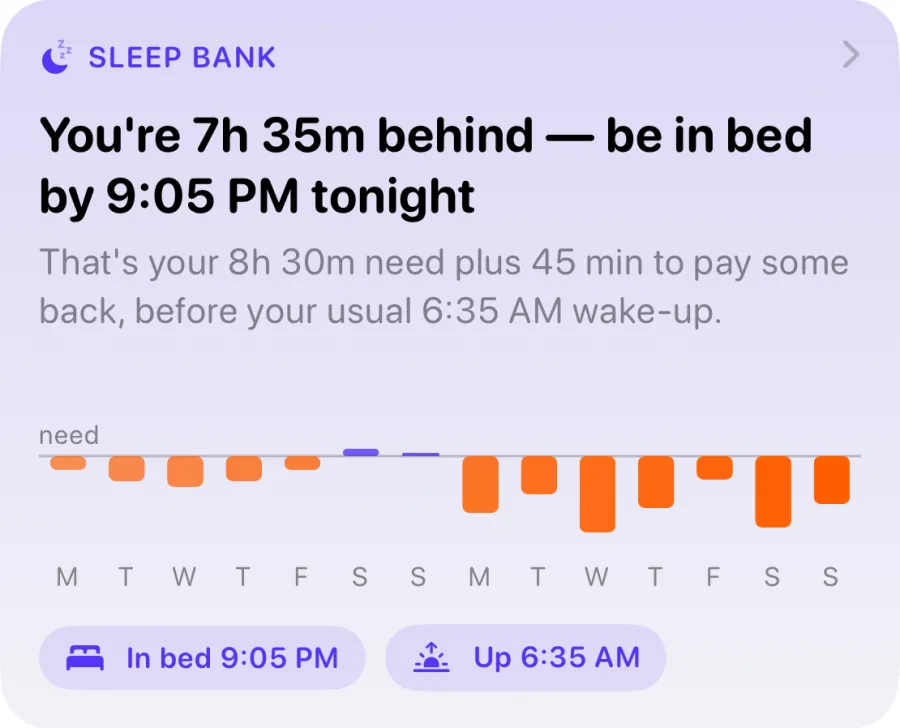
Travel tags also help in other places. If you logged Travel the evening before, the illness-pattern insight holds back, and a wrist temperature alert notes the travel you logged as a likely reason. Smart alerts can be snoozed for a trip without losing their settings. Sleep Bank shows how far behind on sleep you are over the last two weeks and suggests a bedtime to start paying it back.
Frequently asked questions
Is it jet lag or travel fatigue?
If you crossed few or no time zones, for example on a long north-south flight, it's travel fatigue: tiredness from the journey itself, which usually clears after a good night's sleep. Jet lag comes from crossing several time zones and lasts until your body clock catches up with local time.
How many days before a race should I arrive after a long flight?
A common rule of thumb is about one day per time zone crossed going east and half a day per zone going west. If you can't arrive that early, protect sleep in local night time and keep the days before the race easy.
Should I stay awake on arrival or nap?
A short nap early in the local day is fine if you're struggling, but long or late naps make it harder to sleep at local night. Try to stay up until a reasonable local bedtime and get outdoor light at the right time of day.
Does exercise help with jet lag?
Easy exercise helps you stay awake and get light at the right time, and well-timed exercise can nudge your body clock a little. It works with light and sleep timing, not instead of them, and hard sessions in the first couple of days are best avoided.
Why is my resting heart rate higher after a flight?
Short or badly timed sleep, long periods of sitting, dehydration, alcohol and the stress of travel can all raise resting heart rate for a few days. If it stays high for more than a week, or comes with symptoms like fever, chest pain or breathlessness, check with a doctor.
Related guides
- Why is my HRV so low? Causes of a sudden drop and what to check
- Should you train or rest when HRV is low?
- What lowers your HRV? Use a tag journal to find out
- Sleep debt calculator for Apple Watch: how VedaWatch's Sleep Bank works
- Why is my resting heart rate high? Causes and when to worry
- Half marathon taper: the final 7 days, day by day
Sources & further reading
- Janse van Rensburg et al. (2021). Managing Travel Fatigue and Jet Lag in Athletes: A Review and Consensus Statement. Sports Medicine
- CDC Yellow Book: Jet Lag Disorder
- Eastman & Burgess (2009). How To Travel the World Without Jet Lag. Sleep Medicine Clinics
- NCCIH: Melatonin: What You Need To Know
- Fowler et al. (2017). Greater Effect of East versus West Travel on Jet Lag, Sleep, and Team Sport Performance. Medicine & Science in Sports & Exercise
- Flatt & Howells (2022). Effects of Long-Haul Travel and the Olympic Games on Heart-Rate Variability in Rugby Sevens Medalists. International Journal of Sports Physiology and Performance
- Youngstedt, Elliott & Kripke (2019). Human circadian phase-response curves for exercise. The Journal of Physiology
This guide is educational, not medical advice, and has not been clinically reviewed. VedaWatch is not a medical device. If you have symptoms or concerns about your heart or health, contact a qualified healthcare professional.
Put your trends in perspective.
Explore HRV, sleep, and recovery with VedaWatch on your iPhone.
Download VedaWatch on the App Store →