 VedaWatch
Recovery & Apple Watch
HRV and the menstrual cycle: why it dips in the luteal phase
HRV and the menstrual cycle: how HRV, resting heart rate and wrist temperature shift by phase, how to read readiness in the luteal phase, and what's normal.
By VedaWatch editorial team · · 10 min read
The short answer
In many naturally cycling people, HRV is highest in the first half of the cycle and drifts lower in the luteal phase after ovulation, lowest in the days before a period, while resting heart rate and wrist temperature rise. It's a normal hormonal pattern, not poor recovery, and its size varies a lot between people.
Does HRV change during the menstrual cycle?
Yes, for many people it does. The largest review on the question, a 2019 meta-analysis by Schmalenberger and colleagues that pooled 37 studies and 1,004 naturally cycling participants, found that vagally mediated HRV (the beat-to-beat variation driven by the rest-and-digest side of the nervous system) was lower in the luteal phase than in the follicular phase. The average effect was moderate (d = -0.39).
The drop was biggest near the end of the cycle. Compared with the premenstrual days, HRV was clearly higher both during the period itself and in the mid-to-late follicular phase, with large effect sizes in those smaller sets of studies (d = -1.17 and d = -1.32). Menstruation and the follicular phase, on the other hand, didn't differ meaningfully from each other.
Studies with wearables tell a similar story. A study of nearly 200 women wearing the Ava bracelet and a study of 26 women wearing the Oura Ring both found nightly heart rate and skin temperature rising after ovulation, with HRV tending lower in the late luteal phase. So if your Apple Watch shows HRV sagging for a week or so before your period, then recovering once it starts, you're most likely seeing your cycle, not a recovery problem.
HRV, resting heart rate and temperature in each phase
Cycle length varies, so think of phases as relative to your own period and ovulation rather than fixed calendar days. Here's the typical pattern in naturally cycling people, using the numbers the Ava bracelet study reported for average nightly readings across almost 200 women.
- Menstrual phase (bleeding days): HRV usually back near its higher level. Nightly heart rate averaged 57.9 bpm in the Ava study, and wrist skin temperature starts falling from its luteal high.
- Follicular phase (after the period until ovulation): often the calmest stretch in the data. Nightly heart rate was lowest here, averaging 56.6 bpm, and wrist skin temperature was at its low point (33.87°C on the bracelet's sensor).
- Around ovulation: temperature is still low. The rise comes after ovulation, which is why Apple and others can only estimate ovulation looking back.
- Luteal phase (after ovulation until the next period): temperature steps up and stays up, and heart rate climbs. By the late luteal phase, nightly heart rate averaged 60.5 bpm, about 4 bpm above the follicular average, and wrist skin temperature averaged 34.32°C, roughly 0.45°C higher. Breathing rate edged up too, from 16.6 to 17.0 breaths per minute.
- Late luteal (the last days before bleeding): typically the low point for HRV and the high point for resting heart rate. In the Oura Ring study, HRV was significantly lower in the late luteal phase than during menses, while the mid-luteal difference was only a trend.
- Sleep: in the Oura Ring study, total sleep time and the share of light, deep and REM sleep didn't change significantly across the cycle, so a luteal HRV dip usually isn't a sleep-tracking artifact.
Why HRV drops in the luteal phase
After ovulation the ovary produces progesterone, and progesterone raises body temperature slightly. That temperature step is the "biphasic shift" Apple Watch looks for. A warmer body tends to run a slightly faster heart and less beat-to-beat variation, which is what HRV measures.
Hormone research points the same way. In two follow-up studies with 90 naturally cycling participants in total, the same research group found that progesterone was the only hormone linked to HRV: when someone's progesterone was higher than their usual, their HRV tended to be lower than their usual. Estradiol showed no clear link.
None of this means the luteal phase is a weaker or less recovered state in any absolute sense. Your nervous system is responding to a normal hormonal shift. The practical problem is that recovery scores compare you with your own recent nights, and a score that doesn't know where you are in your cycle can read a normal luteal drift as "below baseline".
Does everyone's HRV drop before their period?
No. The average effect is real, but individuals differ a lot. In a 2024 study of 31 naturally cycling women, about two thirds (20) showed the expected HRV decrease from ovulation to the mid-luteal phase, and the other third (11) actually showed a mid-luteal increase. Your own pattern might be large, small or reversed.
Hormonal contraception changes the picture. Most cycle-and-HRV research only includes people who aren't using it, and the 2019 meta-analysis excluded them on purpose, so its findings can't be applied directly to pill, patch, ring or hormonal IUD users. Many hormonal methods suppress ovulation, which removes the progesterone rise behind the classic luteal pattern.
The same goes for cycles that don't follow the textbook shape: irregular cycles, cycles without ovulation, pregnancy, breastfeeding, and perimenopause. Apple notes that ovulation doesn't happen every cycle and that a temperature shift can be too small to detect. In those situations the monthly wave may be weak, irregular or absent, and that alone isn't a reason for concern.
The most reliable way to know your pattern is to look at your own data over two or three cycles: note your period start dates and see whether HRV and resting heart rate move in a repeating shape.
How Apple Watch tracks your cycle with wrist temperature
Apple Watch Series 8 and later, all Apple Watch Ultra models and Apple Watch SE 3 measure wrist temperature while you sleep. It needs Sleep Focus on for at least 4 hours a night for about 5 nights to set a baseline, then shows each night as a change from that baseline in the Health app, not as an absolute body temperature. Apple lists menstrual cycles, illness, alcohol, exercise and your sleep environment among the things that move it.
If you use Cycle Tracking in the Health app, Apple can use that temperature to give retrospective ovulation estimates: it looks for the biphasic rise that often follows ovulation and combines it with your logged periods. Apple says estimates usually take about two cycles of wearing the watch to sleep, may not appear every cycle, and can also improve period predictions.
Two limits matter. Apple is clear that Cycle Tracking shouldn't be used as birth control and that its data shouldn't be used to diagnose a health condition. And the estimate is made after the fact, so it tells you where you were, not where you're heading.
For reading recovery, the useful part is simpler: if you log your periods in Health, you know roughly when your luteal phase starts and ends, and you can read your HRV, resting heart rate and temperature with that context.
How to read your readiness score in the luteal phase
Most recovery scores, including VedaWatch's, compare your HRV, resting heart rate and sleep with your recent baseline. Unless a score explicitly accounts for cycle phase, a normal luteal drift can shave a few points off it even when you slept well and feel fine.
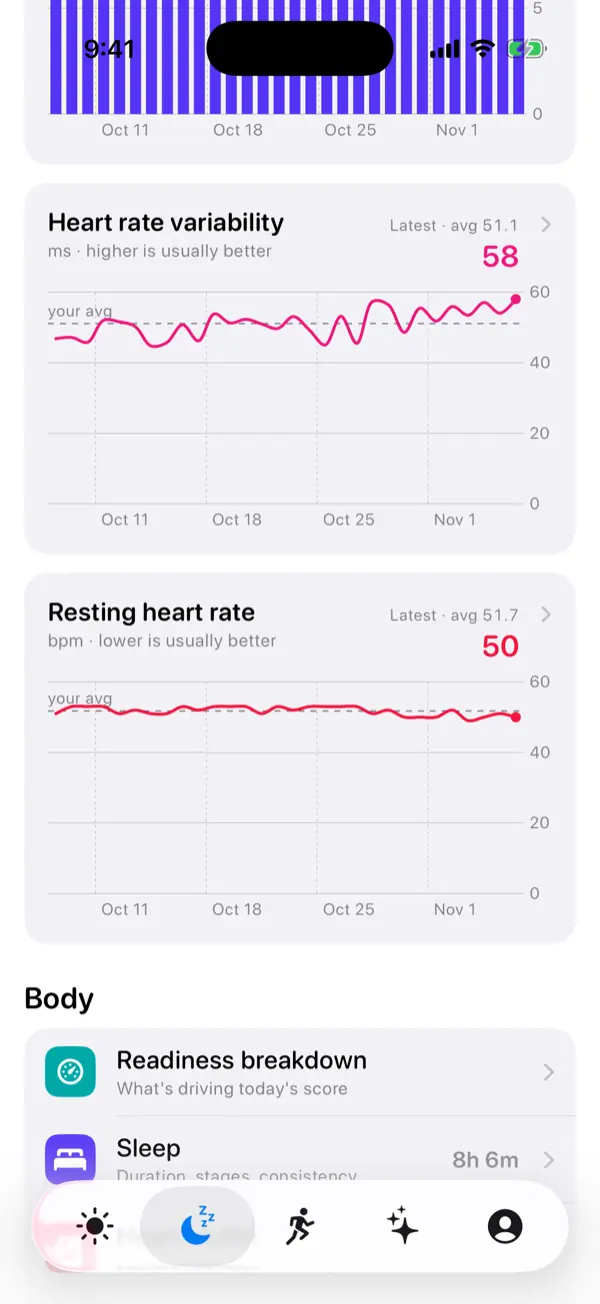
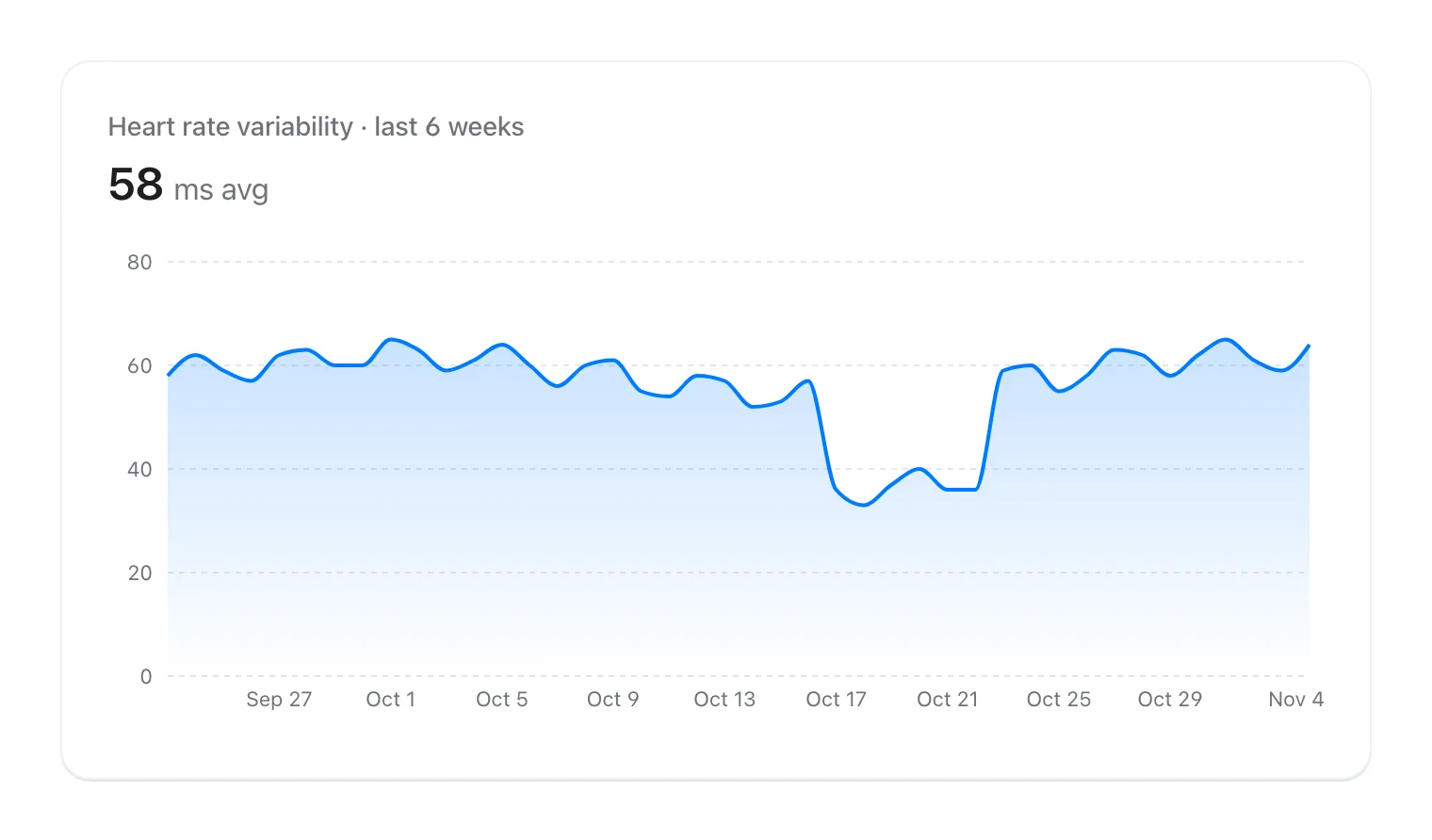
An illustrative example: you usually sit around 60 ms HRV. In the week before your period it averages in the low 50s, resting heart rate is a few beats higher and wrist temperature is a few tenths of a degree up, all gently, night after night. That is what the research pattern looks like. A sudden drop to the mid-30s over two nights, with a higher breathing rate and you feeling achy, is a different story and is more likely illness, alcohol or a very hard session.
- Find your place in the cycle first. Count days from your last period start. If you're past roughly the midpoint and your period is due within about two weeks, a modest HRV dip and higher resting heart rate are expected.
- Compare with the same phase last cycle, not with last week. A luteal week that looks like your last luteal week is normal for you.
- Look at the shape. Cycle changes are gradual and move together; illness and alcohol tend to be abrupt and come with a jump in breathing rate or a worse night's sleep.
- Check how you feel. Energy, soreness, motivation and premenstrual symptoms are real inputs. A middling score with good energy can still be a good training day.
- Treat the first days of your period as a reset point. HRV usually recovers around menstruation, and your score should follow within a few days.
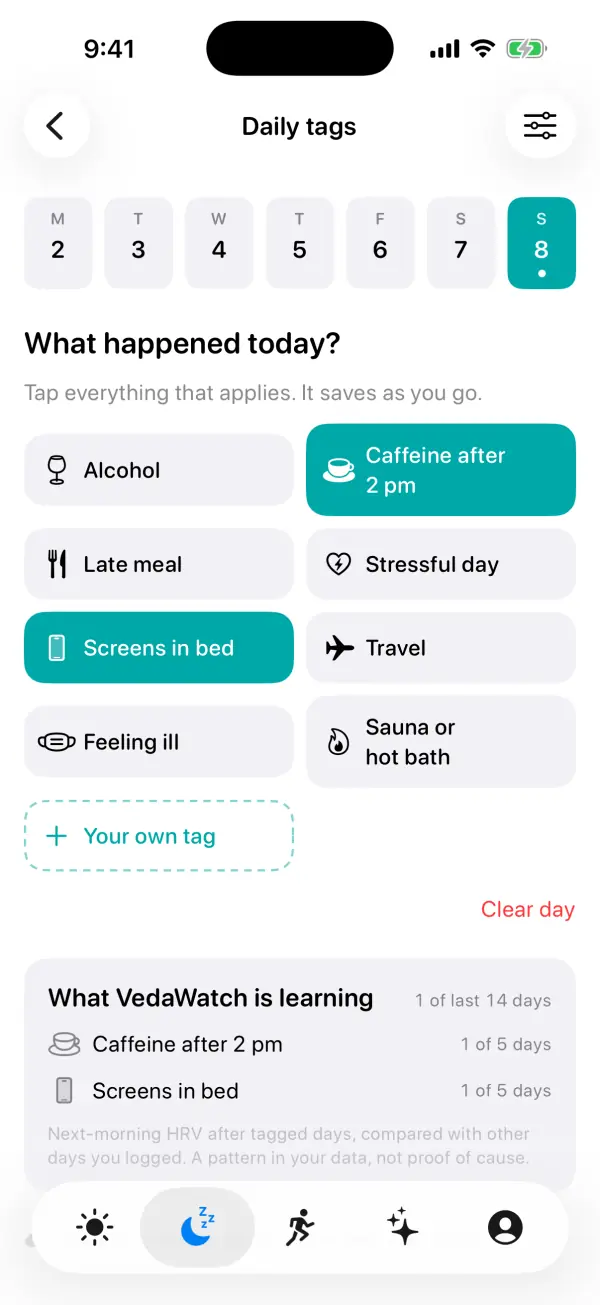
- Track it for two or three cycles. Logging a tag for period days or premenstrual days makes your own pattern visible instead of guessed.
Should you train less in the luteal phase?
Not automatically. A 2020 systematic review and meta-analysis in Sports Medicine (McNulty and colleagues, 78 studies) found that exercise performance might be trivially lower in the early follicular phase, during the period, than in other phases, with a pooled effect size of just -0.06. The evidence quality was mostly low and results varied widely between studies.
Because the average effect was so small, the authors advised against general rules for training by cycle phase and recommended a personalised approach based on how each person responds. In other words, the science doesn't support skipping hard sessions just because you're in the luteal phase.
What does help: on a luteal day with a slightly lower score, use the same rules you'd use any day. If you slept well and feel good, train as planned. If you also slept badly, feel flat or have strong premenstrual symptoms, swap intervals for an easy session, keep the volume but drop the intensity, or take a rest day.
When cycle-related changes are worth a doctor's visit
A gentle monthly wave in HRV, resting heart rate and temperature is normal. Your watch can't diagnose cycle disorders, and a missing wave isn't a diagnosis either. Some things are worth raising with a doctor or gynaecologist, though, whatever your watch shows.
Periods that stop for several months when you're not pregnant, very irregular or very heavy periods, bleeding between periods, pelvic pain that disrupts your life, or premenstrual mood changes severe enough to affect work or relationships all deserve a proper check. So does a sustained rise in resting heart rate or temperature that doesn't fall back when your period starts, especially with fever, shortness of breath, dizziness or feeling unwell.
If you're pregnant or think you might be, or you're in perimenopause and your cycle is changing, your data will shift for reasons that are best talked through with a clinician rather than interpreted from a recovery score.
How VedaWatch accounts for your cycle
VedaWatch reads the periods you log in Apple Health's Cycle Tracking, with your permission, and uses them to estimate when you're likely in the second half of your cycle: 14 to 34 days after your last logged period started. With no period logged in the last 35 days, it doesn't guess.
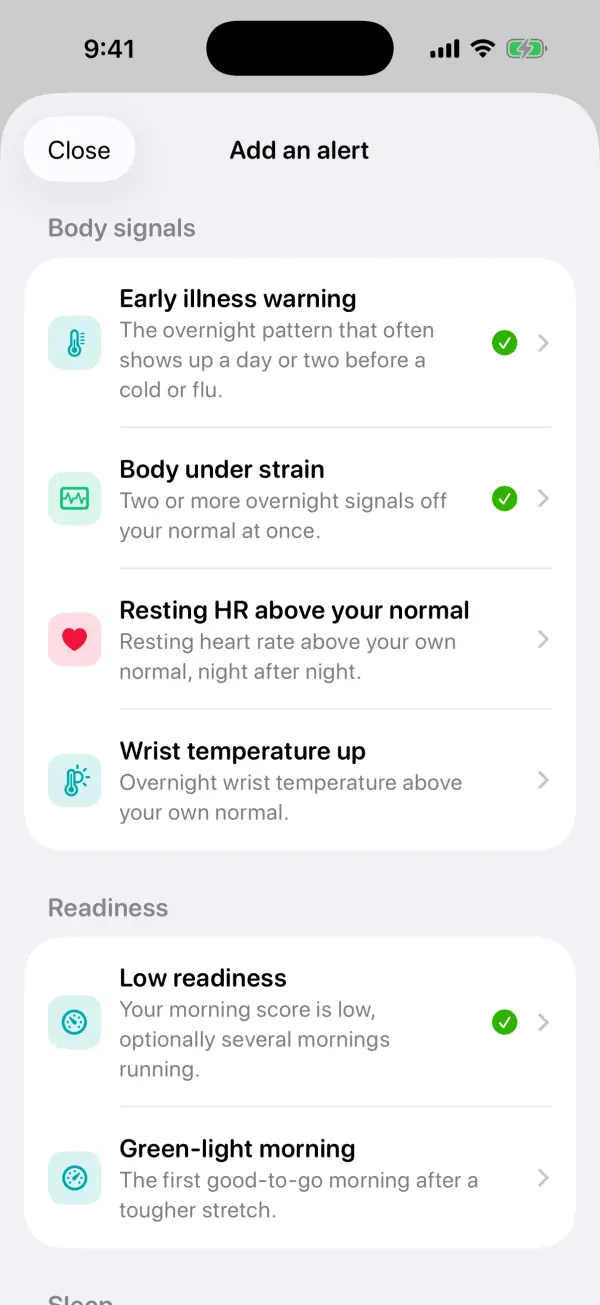
That estimate is used where temperature matters most. The Wrist temperature up alert compares last night with your median from the last 28 nights and fires at +0.5°C by default; in the likely second half of your cycle it needs an extra 0.3°C, and the alert says so under Cycle. The Early illness warning, which looks for a fever-like signal alongside resting heart rate or HRV off your normal, needs a wrist temperature rise of at least 0.6°C to count in that phase, and treats its result as less certain.
Your readiness score doesn't adjust for cycle phase. It compares HRV, resting heart rate and sleep with your recent baseline, so a luteal dip can show up as a few lower points, and the reasons under the score tell you which signal moved. Reading those reasons with the steps above is the honest way to use it.
To see your own pattern, add a tag such as "Period" in Daily tags. Once it has enough days, What VedaWatch is learning shows how next-morning HRV differs after those days compared with your other logged days. If you turn on the optional AI Coach, its data summaries include menstrual flow you've logged in Health, so you can ask it how your recent weeks compare. VedaWatch describes patterns; it doesn't diagnose, and it isn't a fertility or contraception tool.
Frequently asked questions
Does HRV go up or down during your period?
For most naturally cycling people HRV recovers around the start of the period, after its low point in the premenstrual days. In the 2019 meta-analysis, HRV during menstruation was clearly higher than in the premenstrual phase.
How much does resting heart rate rise in the luteal phase?
In the Ava bracelet study of nearly 200 women, average nightly heart rate was about 4 bpm higher in the late luteal phase than in the follicular phase. Your own change may be smaller or larger.
Does birth control affect HRV across the cycle?
It can. Most research on cycle-related HRV changes excludes people on hormonal contraception, and many methods stop ovulation and the progesterone rise behind the typical luteal pattern, so your data may look flatter or follow a different rhythm.
Can Apple Watch tell me which phase of my cycle I'm in?
Not live. With Cycle Tracking and wrist temperature, Apple Watch gives retrospective ovulation estimates after the fact and uses temperature to improve period predictions. It isn't a birth control method.
Is a low HRV before my period a sign of overtraining?
Not by itself. A gradual premenstrual dip that recovers once your period starts is a normal pattern; overtraining shows up as a downward trend that keeps going across weeks along with fatigue and stalled performance.
Should I ignore my readiness score in the luteal phase?
No, but read it in context. Compare it with the same phase in your last cycle and with how you feel, and give extra weight to sudden changes or a higher breathing rate, which point to something other than your cycle.
Related guides
- Apple Watch wrist temperature: how it works and what changes mean
- Why is my HRV so low? Causes of a sudden drop and what to check
- Why is my resting heart rate high? Causes and when to worry
- HRV when sick: what your Apple Watch shows before symptoms
- Should you train or rest when HRV is low?
- What lowers your HRV? Use a tag journal to find out
Sources & further reading
- Schmalenberger KM et al. (2019). A systematic review and meta-analysis of within-person changes in cardiac vagal activity across the menstrual cycle. Journal of Clinical Medicine, 8(11):1946
- Goodale BM et al. (2019). Wearable sensors reveal menses-driven changes in physiology and enable prediction of the fertile window. Journal of Medical Internet Research, 21(4):e13404
- Alzueta E et al. (2022). Tracking sleep, temperature, heart rate, and daily symptoms across the menstrual cycle with the Oura Ring in healthy women. International Journal of Women's Health, 14:491-503
- Schmalenberger KM et al. (2024). Associations of luteal phase changes in vagally mediated heart rate variability with premenstrual emotional changes. BMC Women's Health, 24:448
- Schmalenberger KM et al. (2020). Menstrual cycle changes in vagally-mediated heart rate variability are associated with progesterone. Journal of Clinical Medicine, 9(3):617
- McNulty KL et al. (2020). The effects of menstrual cycle phase on exercise performance in eumenorrheic women: a systematic review and meta-analysis. Sports Medicine, 50:1813-1827
- Apple Support: Receive retrospective ovulation estimates on Apple Watch
- Apple Support: Track your nightly wrist temperature changes with Apple Watch
This guide is educational, not medical advice, and has not been clinically reviewed. VedaWatch is not a medical device. If you have symptoms or concerns about your heart or health, contact a qualified healthcare professional.
Put your trends in perspective.
Explore HRV, sleep, and recovery with VedaWatch on your iPhone.
Download VedaWatch on the App Store →