 VedaWatch
Recovery & Apple Watch
How to measure blood pressure at home: cuff, posture and timing
How to measure blood pressure at home the right way: cuff size, posture, the best time of day, how many readings to take, what the numbers mean and when to see a doctor.
By VedaWatch editorial team · · 9 min read
The short answer
Use a validated upper-arm cuff that fits your arm. Sit with your back supported, feet flat and arm resting at heart level for 5 minutes, then take two readings at least 1 minute apart, every morning and evening for 7 days. Your doctor looks at the average, not any single number.
How do you measure blood pressure at home?
Home readings are only useful if they're taken the same careful way every time. The American Heart Association's 2019 scientific statement on blood pressure measurement and the CDC's home instructions agree on the basics, and they're simple once you've done them a few times:
- Use an automatic cuff that goes around your upper arm, in the right size for your arm.
- In the 30 minutes before, don't eat, drink, smoke, have caffeine or alcohol, or exercise. Empty your bladder.
- Sit in a chair with your back supported, both feet flat on the floor and legs uncrossed. Rest quietly for at least 5 minutes.
- Put the cuff on your bare upper arm, just above the bend of your elbow, not over a sleeve. Rest your arm on a table so the cuff is at about heart (chest) height.
- Don't talk, text or watch anything stressful while it measures.
- Take a second reading at least 1 minute later. Write down both, with the date and time, or log them in an app.
- Repeat every morning and evening, ideally for 7 days in a row, and share the whole log with your doctor.
What size blood pressure cuff do you need?
Cuff size matters more than most people expect. Measure around the middle of your upper arm, halfway between the shoulder and the elbow, and compare it with the range printed on the cuff. The AHA statement gives typical adult sizes: a small adult cuff for an arm of 22 to 26 cm, a standard adult cuff for 27 to 34 cm, a large adult cuff for 35 to 44 cm and an extra-large cuff for 45 to 52 cm. Exact ranges vary by manufacturer, so go by the label on yours.
A cuff that's too small reads high, and one that's too big reads low. In a 2023 randomized crossover trial of 195 adults in Baltimore, using a regular cuff on people who needed a large one raised systolic readings by an average of 4.8 mmHg, and by 19.5 mmHg in people who needed an extra-large cuff. In people who needed a small cuff, the regular one read 3.6 mmHg low. That's enough to move someone from one category into another.
Choose an upper-arm monitor that has been checked for accuracy. In the US, the free Validated Device Listing at validatebp.org, run with the American Medical Association, lists devices that have passed clinical accuracy checks. The AHA statement notes that wrist monitors bring extra challenges in everyday use, including keeping the wrist exactly at heart level, so an upper-arm cuff is the safer default. A pharmacist or someone on your care team can check your technique and the fit.
What is the correct way to sit when taking blood pressure?
Posture can move the numbers by several points, which is why the instructions are so specific. The AHA statement summarises what research has found when the standard position isn't followed:
- Back not supported, for example sitting on the edge of a bed or a stool: systolic can read 5 to 15 mmHg higher and diastolic about 6 mmHg higher.
- Legs crossed: systolic about 5 to 8 mmHg higher and diastolic 3 to 5 mmHg higher.
- Arm hanging down, below heart level, or held up by your own muscles instead of resting on a table: readings come out too high.
- Lying down instead of sitting: readings differ from seated ones, so don't mix the two in the same log.
- Cuff over clothing, or a tight sleeve rolled up above it: the cuff can't measure properly. Use a bare arm.
What is the best time to take blood pressure?
Take one set of readings in the morning and one in the evening. The AHA statement's home protocol puts the morning set before you take any blood pressure medication, and the evening set before bed. Because the 30-minute rule rules out coffee, breakfast and exercise, it's easiest to measure soon after you get up, once you've used the bathroom, and then again in the evening before you get ready for bed.
Consistency matters more than the exact clock time. The CDC advises measuring at the same times each day, so the readings in your log can be compared fairly. Blood pressure naturally varies through the day and goes up with stress, activity, pain, caffeine and a full bladder, so a reading straight after a run or a tense phone call tells you about that moment, not your usual level.
If you take blood pressure medication, don't change when or how you take it because of your readings. Ask your doctor first.
How many readings should you take, and for how long?
One reading is never enough. The AHA statement recommends two readings at least 1 minute apart in each morning and evening session, for at least 7 days if possible. That's 28 readings, and it's what clinicians prefer when they use home readings to confirm or rule out high blood pressure. If 7 days isn't possible, the statement gives 3 days (12 readings) as a minimum, ideally just before your appointment. The NHS describes a similar routine: measure, wait 1 minute, measure again, morning and evening, for as many days as your doctor or nurse asks.
Some clinicians leave out the first day, because readings are often a little higher while you get used to the routine. In that case, the AHA statement suggests 8 days instead of 7.
Don't delete or re-take readings you don't like. The point of a week of readings is to average out the ups and downs. A typical worked example: if your 28 readings average 127/78, that's what your doctor will look at, even if one evening said 141/88.
Once your doctor knows your level, you may not need to measure every day. Ask how often to check, especially if you're starting or changing treatment.
What is normal blood pressure by age?
For adults, the categories don't change with age. The 2025 AHA/ACC high blood pressure guideline kept the same adult categories as 2017, and the CDC uses them too: normal is below 120 systolic and below 80 diastolic; elevated is 120 to 129 systolic with diastolic below 80; stage 1 hypertension is 130 to 139 systolic or 80 to 89 diastolic; stage 2 is 140 or higher systolic or 90 or higher diastolic. When the two numbers fall in different categories, the higher one counts.
What does change with age is risk. Blood pressure tends to rise as people get older, and the CDC lists age as one of the factors that raise the chance of high blood pressure. So a 70-year-old and a 30-year-old are measured against the same ranges, but older adults are more likely to find themselves above them. Children and teenagers are different: their blood pressure is judged against charts for age, sex and height, so adult categories don't apply to them.
Countries also draw the line slightly differently for home readings. The NHS, for example, treats 135/85 or higher measured at home as high, compared with 140/90 in a clinic, because readings at home tend to be a little lower than in a doctor's office. Whichever system your doctor uses, the decision is made from repeated readings, not one number, and it isn't something to diagnose on your own.
How to log blood pressure in Apple Health on iPhone
Apple Health doesn't measure blood pressure, but it's a good place to keep your readings. Many connected cuffs, such as those from Omron and Withings, can save readings to Health through their own apps. You can also type them in. Apple's steps, for iPhone 11 or later on the latest iOS:
- To add a reading: open the Health app, tap Browse, then Heart, then Blood Pressure, then Add a Measurement. Enter the date, time, systolic and diastolic numbers, and tap Add.
- To set up a guided log: tap Browse, then Heart, and under Blood Pressure Log tap Get Started, then follow the prompts.
- Choose Learn About My Risk for Hypertension for 7 days of morning and evening readings, which ends after 7 wake-up and 7 bedtime readings. Or choose Monitor My Hypertension for one reading a day for 4 weeks.
- Schedule the reminders for times you'll actually be home and calm, such as after you wake up and before bed.
- When the log is complete, tap Export PDF to share your readings with your doctor.
Does this relate to Apple Watch hypertension notifications?
They're two separate things that fit together. Apple Watch Series 9 or later and Apple Watch Ultra 2 or later can, in supported regions, send a hypertension notification when 30 days of optical heart sensor data show patterns linked with high blood pressure. The watch never shows you a blood pressure number. If you get a notification, Apple's suggested next step is exactly the routine in this guide: a week of cuff readings, morning and evening, shared with your doctor. Our guide to Apple Watch hypertension notifications covers how the feature works and how accurate it was in testing.
It doesn't work the other way round. Apple says blood pressure values you log in Health don't influence the hypertension notification feature in any way, so logging normal readings won't switch off notifications, and logging high ones won't trigger them.
And no notification doesn't mean normal blood pressure. In Apple's study, most people with hypertension weren't notified. The only way to know your numbers is to measure them with a cuff.
When should you see a doctor about home readings?
Share your log with a doctor or nurse if your average sits in the elevated range or higher, if readings keep rising over weeks, or if you've been asked to check after a hypertension notification or a high clinic reading. High blood pressure usually causes no symptoms, so don't wait to feel unwell.
Some readings need action now. The CDC says a reading higher than 180 systolic and/or higher than 120 diastolic, with no symptoms, means you should call your healthcare professional. If you have such a reading along with chest pain, shortness of breath, back pain, numbness, weakness, a change in vision or difficulty speaking, call 911 or your local emergency number. If you feel well, it's reasonable to rest for a few minutes and measure again, but don't keep re-measuring instead of getting help.
Low readings matter too if they come with symptoms. Dizziness, light-headedness or fainting, especially when standing up, are worth raising with your doctor, particularly if you take blood pressure medication.
How VedaWatch helps you keep a blood pressure log
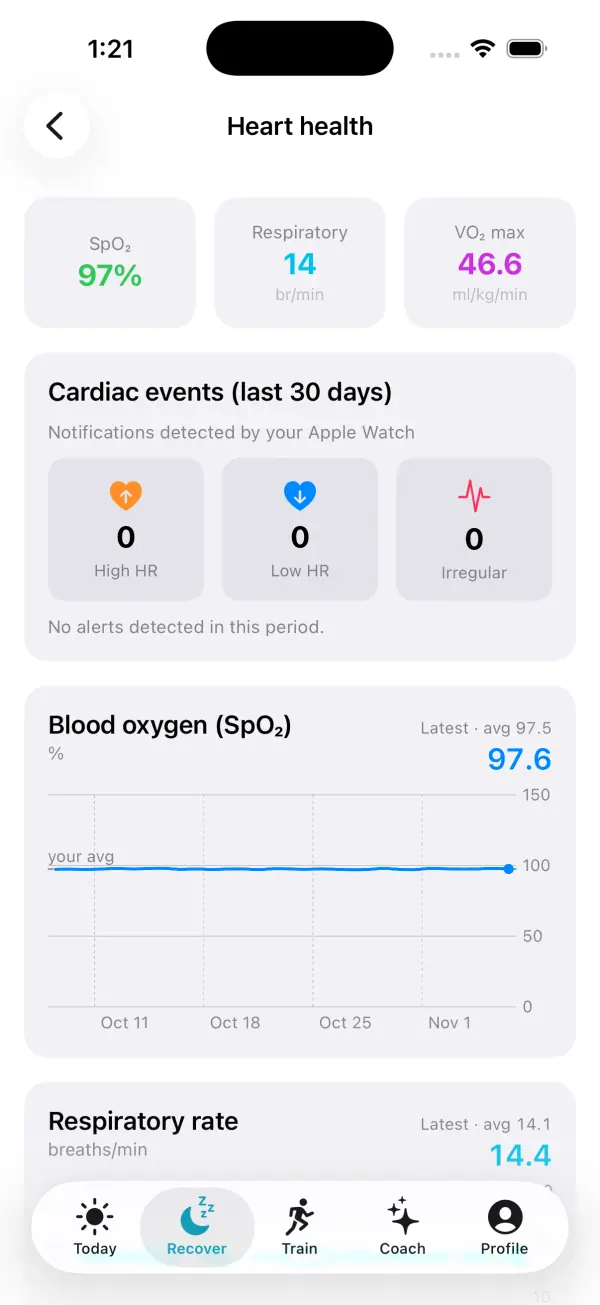
VedaWatch doesn't measure blood pressure, diagnose anything or change any treatment. It gives your cuff readings a home next to the rest of your heart data. On iPhone, under Recover, then Heart health, the Blood pressure card shows your latest reading and its AHA reference category. You can log a reading with systolic, diastolic, pulse, arm, position, a note and the time, and it's saved to Apple Health. Readings that cuff apps save to Health show up there automatically.
The Blood pressure screen shows a trend chart over 2, 4 or 12 weeks, your last 7 days split into morning and evening averages, every reading with its source, and optional morning and evening reminders. If a reading is in the crisis range, it asks you to measure again after 5 minutes and lists the symptoms that mean calling emergency services. The 7-day check sets up twice-daily reminders and a grid that fills in as you log, counting toward 14 readings, whether they come from VedaWatch or a connected cuff.
Logging is free. With VedaWatch Pro ($6.99 a month or $59.99 a year on the US App Store, November 2026), the Doctor report turns your readings into a PDF with morning and evening averages, highs and lows, category breakdown, trend and every reading, plus resting heart rate and HRV trends, Apple Watch heart notifications and ECG recordings. It's made on your iPhone from Apple Health and only leaves your phone if you share or print it. The categories are reference ranges to help you read your numbers; your clinician interprets them.
Frequently asked questions
Which arm should I use to take my blood pressure?
Either arm can be fine, but use the same one each time so your readings can be compared. If you notice that one arm is consistently higher, mention it to your doctor, who may ask you to use that arm.
Why is my blood pressure higher at the doctor's office than at home?
Many people read higher in a clinic, an effect often called white-coat hypertension. That's one reason guidelines recommend home readings to confirm a clinic result, and why the NHS uses a lower threshold, 135/85, for home readings.
Should I take my blood pressure before or after coffee?
Before. The CDC advises no caffeine, food, drinks, smoking or exercise in the 30 minutes before a reading, so measure soon after you get up or wait at least half an hour after your coffee.
Why do my two readings a minute apart differ?
Blood pressure changes from beat to beat, so a few points' difference is normal. Record both and let the average of many readings over the week give the real picture.
Are wrist blood pressure monitors accurate?
Some have been validated, but they're harder to use correctly because the wrist has to be held exactly at heart level. An upper-arm cuff that fits your arm is the safer choice for home monitoring.
Can my Apple Watch measure my blood pressure?
No. Apple Watch doesn't give systolic or diastolic numbers. Supported models can send a hypertension notification based on 30 days of sensor data, but you still need a cuff to know your actual blood pressure.
What blood pressure reading is an emergency?
A reading higher than 180 systolic and/or higher than 120 diastolic together with symptoms such as chest pain, shortness of breath, numbness, weakness, vision changes or trouble speaking means calling 911 or your local emergency number. Without symptoms, call your healthcare professional.
Related guides
- Apple Watch hypertension notification: how it works, what to do
- Resting heart rate on Apple Watch: what's high, low, and why it changes
- Apple Watch AFib History explained: what it does and doesn't do
- Apple Watch high heart rate notification: causes and what to do
- How to lower your resting heart rate: what works and how long it takes
- How to export Apple Health data (and convert it to CSV)
Sources & further reading
- Muntner P et al. (2019). Measurement of blood pressure in humans: a scientific statement from the American Heart Association. Hypertension 73(5):e35-e66. doi:10.1161/HYP.0000000000000087
- Jones DW et al. (2025). 2025 AHA/ACC/AANP/AAPA/ABC/ACCP/ACPM/AGS/AMA/ASPC/NMA/PCNA/SGIM Guideline for the Prevention, Detection, Evaluation and Management of High Blood Pressure in Adults. Hypertension 82(10). doi:10.1161/HYP.0000000000000249
- Ishigami J et al. (2023). Effects of cuff size on the accuracy of blood pressure readings: the Cuff(SZ) randomized crossover trial. JAMA Internal Medicine 183(10):1061-1068. doi:10.1001/jamainternmed.2023.3264
- CDC: Measuring Your Blood Pressure
- CDC: About High Blood Pressure
- NHS: Blood pressure test
- Apple Support: Log your blood pressure in the Health app
- American Medical Association: The validation of BP measurement devices for clinical accuracy (validatebp.org)
- American College of Cardiology (August 2025): New high blood pressure guideline emphasizes prevention, early treatment to reduce CVD risk
This guide is educational, not medical advice, and has not been clinically reviewed. VedaWatch is not a medical device. If you have symptoms or concerns about your heart or health, contact a qualified healthcare professional.
Put your trends in perspective.
Explore HRV, sleep, and recovery with VedaWatch on your iPhone.
Download VedaWatch on the App Store →