 VedaWatch
Sleep
How much deep sleep do you need? Minutes by age, Apple Watch
How much deep sleep do you need? Typical percentages and minutes by age from sleep-lab studies, how Apple Watch estimates it, and what helps or hurts it.
By VedaWatch editorial team · · 8 min read
The short answer
Most healthy adults spend roughly 10 to 20 percent of their sleep in deep (N3) sleep, which works out to about 40 to 110 minutes over 7 to 9 hours. Younger adults tend to sit near the top of that range, and older adults often get less. There's no single target, so judge your two-week average, not one night.
How much deep sleep do you need?
There's no official minimum for deep sleep. Sleep scientists haven't agreed on one ideal number, and health bodies recommend a total amount of sleep rather than a quota for any single stage. What research does give us is a picture of what's typical in healthy people.
The Sleep Foundation puts deep sleep at roughly 10 to 20 percent of total sleep in a healthy night. For someone sleeping seven to nine hours, that's about 40 to 110 minutes. Because it's a share of the night, the minutes depend heavily on how long you sleep. Here is the same 10 to 20 percent range worked out for common night lengths:
- 6 hours asleep: about 36 to 72 minutes of deep sleep.
- 7 hours asleep: about 42 to 84 minutes.
- 8 hours asleep: about 48 to 96 minutes.
- 9 hours asleep: about 54 to 108 minutes.
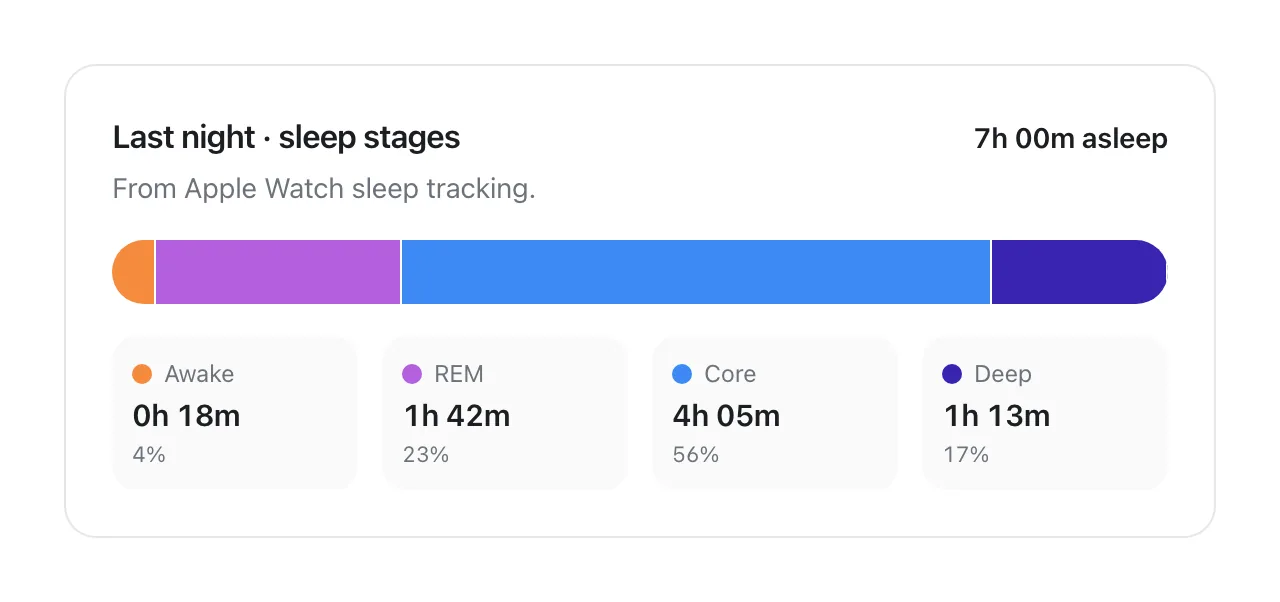
Deep sleep by age: what sleep-lab studies show
Deep sleep is highest in childhood and adolescence and falls through adulthood. The Sleep Foundation describes reduced deep sleep as a normal part of aging, with a gradual decline that levels off in your 70s. How steep that decline is depends on the study, and it's worth seeing real numbers rather than a made-up chart.
A 2015 study in the journal Sleep recorded one full night of lab sleep in 100 carefully screened healthy adults aged 19 to 77. Those 30 or younger spent a median 20.7 percent of their sleep in N3 and slept a median 413.5 minutes. Those over 60 spent 14.9 percent in N3 and slept 378.3 minutes. Multiplying those medians gives a rough sense of minutes:
- Age 30 or younger: about 20.7% of roughly 414 minutes asleep, or around 85 minutes of deep sleep.
- Over 60: about 14.9% of roughly 378 minutes asleep, or around 56 minutes of deep sleep.
- Spread between people: the study's reported range ran from 15.2 to 37.5 percent in the youngest group and from 2.4 to 35.6 percent in the oldest, so healthy people differ a lot.
What deep sleep does
Deep sleep, also called slow-wave sleep or N3, is the stage when your brain waves slow right down and you're hardest to wake. Most of it comes early in the night, so the first few hours after you fall asleep do most of the work for this stage.
Research links deep sleep to several things the body does overnight. The Sleep Foundation lists tissue, muscle and bone repair (growth hormone release is high during deep sleep), immune function, blood sugar regulation, and learning and memory. Many of these links come from studies of groups, so they don't mean that a night with less deep sleep harmed you.
How Apple Watch measures deep sleep, and where it errs
A sleep lab stages sleep from brain waves. Apple Watch has no brain-wave sensor. According to Apple's white paper, it reads the watch's accelerometer, including tiny movements from breathing, and labels every 30 seconds as Awake, REM, Core or Deep. Deep corresponds to the clinical stage N3, and Core covers N1 and N2. Full stages are only written to Apple Health when a detected sleep session lasts more than three hours.
Against lab recordings, Apple reports an average four-stage agreement (kappa) of 0.63, which is good but well short of perfect. For deep sleep specifically, the detail that matters is this: the most common mistake overall was true deep sleep being labeled as Core. So a night that looks low in deep sleep may partly be the algorithm, not your physiology. Mix-ups between very different stages, such as deep sleep shown as Awake (0.13 percent), were rare.
Apple's validation group is also a useful reality check. Their lab-scored nights averaged just 11.6 and 12.8 percent deep sleep in the two study groups, whose average age was in the late 40s and who slept a little over six hours on average. That's roughly 42 to 48 minutes. If your watch shows about 45 minutes, you're close to what experts scored in a lab for a group of ordinary adults.
Apple states that its sleep stages aren't intended for clinical use. For the full accuracy picture, see our separate guide to Apple Watch sleep tracking accuracy.
Is my Apple Watch deep sleep normal? How to read it
One night tells you very little. Deep sleep varies from night to night in real life, and the watch adds its own error on top. A more useful process looks like this:
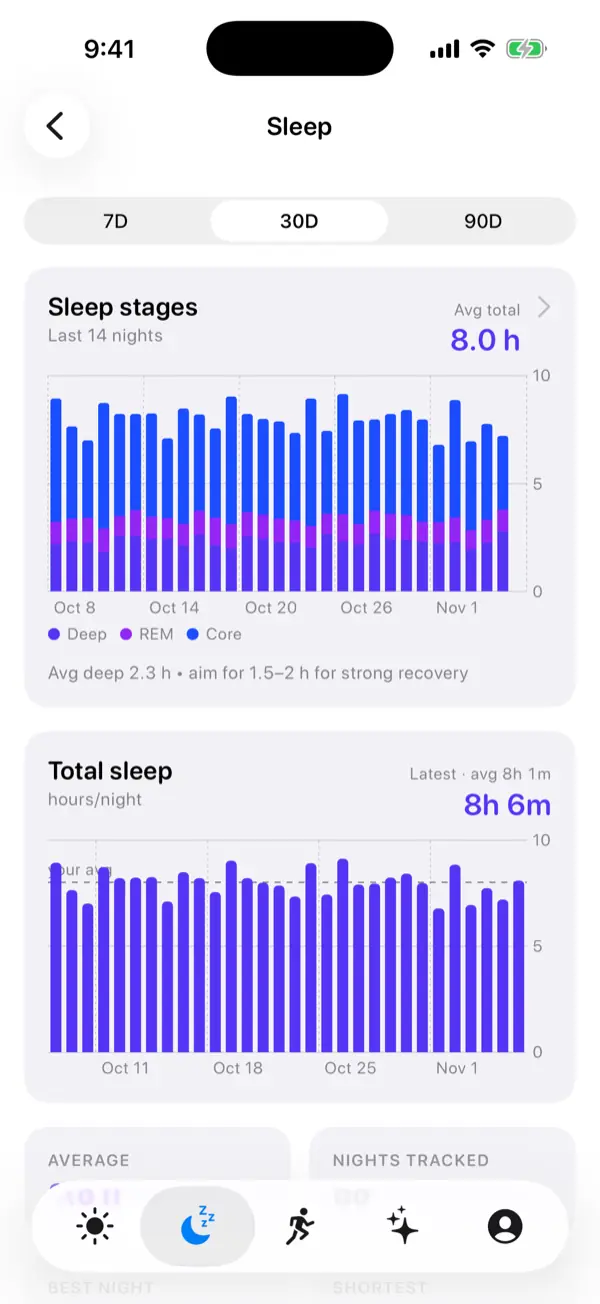
- Look at a 14-night average, not last night. In the Health app, open Browse, then Sleep, and switch to the week or month view; in VedaWatch, the Sleep stages card averages the last 14 nights.
- Turn it into a percentage: deep minutes divided by total minutes asleep. For example, 50 minutes of deep sleep in a 7-hour (420-minute) night is about 12 percent.
- Compare it with the typical range for your age, remembering how wide the spread is between healthy people.
- Compare it with your own past. A drop from your usual 60 minutes to 35 minutes that lasts a couple of weeks is more meaningful than a stranger's number.
- Check total sleep first. If you're short on total sleep, that's the bigger and more fixable problem.
What lowers deep sleep
Age is the most common reason for less deep sleep, and it isn't something to fix. Beyond that, the Sleep Foundation lists insomnia, obstructive sleep apnea (through frequent micro-awakenings), stress, anxiety and depression, chronic pain, heart disease, asthma, pregnancy, and some substances and medications.
Caffeine is one of the best-studied. A 2017 systematic review found that caffeine typically shortened total sleep, reduced slow-wave sleep and increased light sleep and awakenings, with effects depending on dose and timing. Older adults may be more sensitive. In a 2013 home study, a 400 mg dose of caffeine disrupted sleep even when taken six hours before bed.
Alcohol is more surprising. A 2013 review of studies in healthy volunteers found that alcohol tends to increase slow-wave sleep in the first half of the night, but it also increases disruption in the second half and delays and reduces REM sleep at moderate and high doses. A drink may push your early deep sleep up while making the night worse overall, so it isn't a way to improve sleep.
Short and irregular nights also matter simply through arithmetic: less time asleep means fewer minutes in every stage.
How to get more deep sleep: evidence-based steps
You can't directly order your brain to spend more time in N3, and products promising to do so deserve skepticism. What you can do is give it a longer, less disrupted night. These steps have the best support:
- Protect total sleep time. Since deep sleep is a share of the night, more sleep is the most reliable way to more deep-sleep minutes.
- Keep a regular bed and wake time, including on weekends, so you aren't cutting nights short unpredictably.
- Move caffeine earlier. Given the dose and timing effects above, stopping at least six hours before bed is a reasonable starting point; more sensitive people may need longer.
- Exercise regularly. A 2015 meta-analysis of 66 studies found that a session of exercise had small beneficial effects on slow-wave sleep, and regular exercise improved total sleep time and sleep quality.
- Keep alcohol modest and away from bedtime, because the early deep-sleep boost comes with a more broken second half of the night.
- Get sleep problems checked. Snoring, gasping, long awakenings or chronic pain can all cut into deep sleep, and they are treatable.
When low deep sleep is worth a doctor's visit
A low number on a watch is not a diagnosis, and it isn't on its own a reason for concern. It's worth talking to a doctor if low deep sleep comes with daytime sleepiness, loud snoring, pauses in breathing that someone else notices, morning headaches, trouble falling or staying asleep most nights, or a change in mood or memory. Those symptoms matter far more than the stage chart, and a doctor can arrange a proper sleep study if needed.
Tracking deep sleep in context with VedaWatch
VedaWatch reads the sleep stages your Apple Watch writes to Apple Health, with your permission. Its Sleep stages card stacks deep, REM and core sleep for the last 14 nights and shows your average deep sleep, and the Sleep screen lets you switch between 7, 30 and 90 days. That makes it easier to judge your typical amount rather than react to one night.
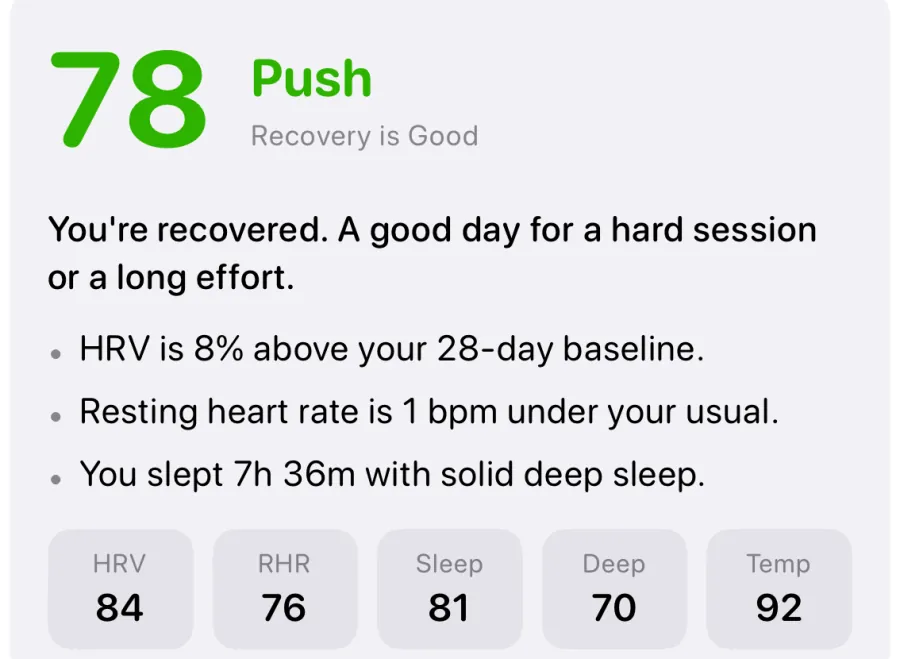
Deep sleep is also one of the parts of VedaWatch's readiness score, next to HRV, resting heart rate, total sleep and wrist temperature, each compared with your recent baseline. It carries less weight than HRV, resting heart rate or total sleep, and its sub-score rises with minutes of deep sleep up to an hour and a half. If deep sleep was under 30 minutes, the reasons under your score say so. Because one part is weighed against the others, a single light night doesn't sink the score on its own.
The Sleep stages card also shows a hint to aim for 1.5 to 2 hours of deep sleep for strong recovery. Treat that as an upper-end goal: as the studies above show, many healthy adults, especially older ones, get less, and comparing with your own trend is more useful.
Frequently asked questions
Is 30 minutes of deep sleep bad?
One night of 30 minutes isn't a concern, and Apple Watch sometimes labels true deep sleep as Core. If your two-week average stays well below the typical range for your age and you also feel unrefreshed or very sleepy in the day, mention it to a doctor.
Can you get too much deep sleep?
A high deep-sleep figure isn't usually a problem on its own; in the 2015 lab study, some healthy young adults spent over a third of their sleep in N3. What matters more is whether you wake up feeling rested.
Does Apple Watch underestimate deep sleep?
Apple doesn't publish a minutes-level bias for deep sleep, but its white paper says the most common error was true deep sleep labeled as Core. That would tend to make deep sleep look lower on some nights, so trust trends more than single values.
Is deep sleep or REM sleep more important?
Both do different jobs and both are part of normal sleep, so it isn't a contest. Getting enough total sleep on a regular schedule supports both stages better than trying to raise one.
Does exercising later in the day reduce deep sleep?
The 2015 meta-analysis found that time of day moderated exercise's effects on sleep, but overall exercise had small benefits for slow-wave sleep. If you notice worse sleep after late hard sessions, try moving them earlier and compare your averages.
Related guides
- Apple Watch sleep stages: what Awake, REM, Core, and Deep mean
- Apple Watch sleep tracking: how accurate is it, and what to do when it's wrong
- How much REM sleep do you need? Normal amounts by age
- How much sleep do I need? By age, for athletes, and for you
- How alcohol affects sleep: REM, waking at 3 am and your heart
- Sleep consistency: why a regular bedtime matters, and how much
Sources & further reading
- Sleep Foundation: How Much Deep Sleep Do You Need?
- Sleep (2015): Sleep and Respiration in 100 Healthy Caucasian Sleepers (Mitterling et al.)
- Lancet Respiratory Medicine (2019): Normal polysomnography parameters in healthy adults, a systematic review and meta-analysis (Boulos et al.)
- Apple: Estimating Sleep Stages from Apple Watch (white paper, updated October 2025)
- Sleep Medicine Reviews (2017): Coffee, caffeine, and sleep, a systematic review (Clark and Landolt)
- Journal of Clinical Sleep Medicine (2013): Caffeine effects on sleep taken 0, 3, or 6 hours before going to bed (Drake et al.)
- Alcoholism: Clinical and Experimental Research (2013): Alcohol and sleep I, effects on normal sleep (Ebrahim et al.)
- Journal of Behavioral Medicine (2015): The effects of physical activity on sleep, a meta-analytic review (Kredlow et al.)
This guide is educational, not medical advice, and has not been clinically reviewed. VedaWatch is not a medical device. If you have symptoms or concerns about your heart or health, contact a qualified healthcare professional.
Put your trends in perspective.
Explore HRV, sleep, and recovery with VedaWatch on your iPhone.
Download VedaWatch on the App Store →