 VedaWatch
Nutrition
How much creatine should I take? A beginner's dosing guide
How much creatine should you take? The ISSN's 3-5 g a day vs a loading phase, doses by body weight, real benefits, myths, and who should ask a doctor first.
By VedaWatch editorial team · · 11 min read
The short answer
Most healthy adults can take 3 to 5 g of creatine monohydrate a day, every day, at whatever time is easiest to remember. That fills your muscles in about four weeks. To get there in about a week, the ISSN describes loading with about 0.3 g/kg (roughly 20 g) a day in four doses for 5 to 7 days.
How much creatine should I take per day?
For most healthy adults the answer is 3 to 5 g of creatine monohydrate a day. That is the maintenance dose in the International Society of Sports Nutrition (ISSN) 2017 position stand on creatine, the most widely cited expert review on the supplement. It needs no loading phase and no splitting into several drinks, which makes it the simplest place for a beginner to start.
There are two routes to the same place. You can take a small daily dose and let your muscles fill up slowly, or you can load with a larger dose for a few days and then drop to the daily dose. Both raise the amount of creatine stored in muscle; loading simply gets there faster. A classic 1996 study by Hultman and colleagues found that 20 g a day for 6 days and 3 g a day for 28 days both raised muscle creatine by about 20%.
Bigger people may need a little more. The ISSN notes that some larger athletes may need as much as 5 to 10 g a day to keep their stores topped up. If you are heavier or very muscular, the top of the 3 to 5 g range is a sensible choice.
Why does a supplement help at all? Your body uses roughly 1 to 3 g of creatine a day, depending on how much muscle you carry. About half of that comes from food, mainly meat and fish, and the rest is made in the liver and kidneys. A pound of uncooked beef or salmon provides only about 1 to 2 g. A normal diet leaves muscle creatine stores roughly 60 to 80% full, and supplementing raises muscle creatine and phosphocreatine by 20 to 40%.
Do you need a creatine loading phase?
No. Loading is optional. The ISSN describes it as the quickest way to raise muscle creatine: about 0.3 g per kg of body weight a day, which works out to 5 g four times a day for most people, for 5 to 7 days. After that you drop to 3 to 5 g a day. The alternative it describes is 3 g a day for 28 days, which raises stores more gradually and may have less effect on performance in the first few weeks.
A 2021 ISSN review of common creatine questions by Antonio and colleagues comes to the same practical conclusion. Loading can make sense when you have a short timeline, such as fewer than 30 days before a competition. For longer-term use, 3 to 5 g a day is simpler and avoids the quick weight gain that loading tends to cause. The same review notes that single doses above 10 g may upset your stomach, which is why loading is split up.
If you do want to load, here is what 0.3 g/kg a day looks like by body weight, rounded and split into four roughly equal doses across the day. Weight in pounds is approximate.
- 60 kg (132 lb): about 18 g a day, as four doses of about 4.5 g, for 5 to 7 days.
- 70 kg (154 lb): about 21 g a day, as four doses of about 5 g, for 5 to 7 days.
- 80 kg (176 lb): about 24 g a day, as four doses of about 6 g, for 5 to 7 days.
- 90 kg (198 lb): about 27 g a day, as four doses of about 7 g, for 5 to 7 days.
- After loading, at any weight: 3 to 5 g once a day, every day, including rest days.
- No loading, at any weight: 3 to 5 g once a day from day one; expect stores to be full in about four weeks.
How to start taking creatine: a simple beginner plan
The plan below sticks to the dosing in the ISSN position stand and the 2021 follow-up review. It assumes you are a healthy adult; if any of the cautions further down apply to you, speak to your doctor before step one.
- Choose plain creatine monohydrate. It is the most studied form, and the 2021 review found no peer-reviewed evidence that other forms (ethyl ester, buffered, nitrate, salts and others) raise muscle creatine more. Monohydrate is also usually the cheapest.
- Pick a product that has been tested by an independent third party, because the 2021 review notes that some creatine products have been found to contain contaminants.
- Weigh or measure your dose. A kitchen scale that reads to 0.1 g is the most accurate; otherwise use the scoop and the serving size on the label, which is often 3 g or 5 g.
- Mix it into water, juice, a shake or yoghurt. Creatine breaks down slowly once dissolved, so mix it fresh rather than making a batch of drinks for the week.
- Take it at a time you will not forget, for example with breakfast or in your post-workout shake. The ISSN notes that taking creatine with carbohydrate, or with carbohydrate and protein, may increase how much muscle takes up, though the performance benefit may not be larger than creatine alone.
- Take it every day, including rest days. The goal is to keep muscle stores full, and missing the odd day matters little; missing weeks does.
- Keep training. Creatine works through the extra hard reps and sprints it lets you do, so it pays off only when paired with a training programme.
What does creatine actually do for beginners?
Creatine helps your muscles regenerate ATP, the fast energy for short, hard efforts such as a heavy set or a sprint. More stored creatine lets you do a little more work, and over weeks of training that adds up. It is not a stimulant, so you won't feel it kick in.
The effect on muscle is real but modest, and it depends on lifting. A 2022 meta-analysis by Delpino and colleagues pooled 35 randomised trials with 1,192 participants. Overall, creatine increased lean body mass by about 0.68 kg compared with placebo. With resistance training, the gain was about 1.10 kg. Without exercise, there was essentially no effect (0.03 kg). Note that lean body mass includes water held in muscle, so not every kilogram is new muscle tissue.
For strength, a 2025 meta-analysis by Kazeminasab and colleagues pooled 69 studies with 1,937 participants. Creatine plus resistance training produced small but significant gains over placebo in bench or chest press strength (about 1.4 kg) and squat strength (about 5.6 kg), along with vertical jump and sprint power. Leg press and handgrip strength did not differ significantly. Benefits were most consistent in younger adults and in men.
How long does creatine take to work?
It depends on whether you load. In the Hultman study, muscle creatine rose by about 20% after 6 days at 20 g a day, while 3 g a day reached a similar level after about 28 days. In practice, that means up to a week with loading and around a month without.
Full stores are only the start. The strength and lean mass results above come from trials that combined creatine with weeks to months of resistance training. Beginners also progress fast without any supplement, so judge creatine over a few months of steady training, by your training log rather than by how you feel on a given day.
If you stop, the effect fades slowly. In the same study, when people stopped taking creatine, muscle levels drifted back to their starting point over about 30 days. The ISSN position stand describes maintenance at 3 to 5 g a day and use for up to 5 years in healthy people, so planned breaks are a personal choice rather than a requirement.
Creatine side effects: weight gain, bloating and stomach upset
The one side effect the ISSN describes as consistently reported is weight gain. During loading, the body holds roughly 0.5 to 1.0 litres of extra fluid in the short term, which is about 0.5 to 1 kg on the scale. Most of that water is stored inside muscle cells rather than under the skin.
Longer studies show a calmer picture. The 2021 review notes that studies lasting 5 to 10 weeks often found no increase in total body water relative to muscle mass, and that randomised trials lasting from one week to two years found no increase in fat mass. If you are watching your weight, skipping the loading phase and starting at 3 to 5 g avoids most of the sudden jump.
Stomach upset is the other common complaint, and it is mostly about dose size. Splitting larger doses, taking creatine with food and staying under about 10 g per serving usually solves it. If a plain 3 to 5 g dose with a meal still bothers you, stop and ask a pharmacist or doctor.
Creatine myths: hair loss, kidneys, steroids and cramps
Is creatine a steroid? No. The 2021 review points out that it has a completely different chemical structure from anabolic steroids and is regulated as a dietary supplement.
Does creatine cause hair loss? The worry comes from one small study of college rugby players in which a blood marker called DHT rose after loading and stayed raised during maintenance. That finding has not been repeated. The 2021 review found that most other studies measuring testosterone saw no change, and concluded that the current evidence does not show creatine causes hair loss.
Does creatine damage your kidneys? In healthy people at recommended doses, the evidence says no. The ISSN found no compelling evidence that creatine harms kidney function in healthy or clinical populations. Part of the confusion is a blood test: creatine can raise serum creatinine, the marker doctors use to estimate kidney function, without the kidneys working any worse. The original case report that started the concern involved a person who already had kidney disease, was taking the immune-suppressing drug cyclosporine, and used doses well above those recommended.
Does creatine cause dehydration or cramps? Early surveys suggested so, but they did not control for other supplements or doses. In a controlled study of college football players cited in the 2021 review, creatine users had less cramping and fewer cases of heat illness and dehydration than non-users.
Is creatine only for young men? No. The 2021 review describes benefits for women across the lifespan, including a study in postmenopausal women where 5 g a day for 12 weeks with resistance training increased muscle mass and strength. Gains in women tend to be smaller and less consistent than in men, as the meta-analyses above found. In older adults, creatine paired with resistance training gave the greatest gains in muscle, strength and function.
Who should talk to a doctor before taking creatine?
Creatine has a good safety record in healthy adults. The ISSN position stand concludes that doses up to 30 g a day for up to 5 years have been safe and well tolerated in healthy people. Healthy is the key word, though, and some people should get medical advice first.
Speak to your doctor or pharmacist before you start if any of these apply to you.
- You have kidney disease, reduced kidney function on a blood test, or a single kidney. The ISSN itself notes that people with pre-existing kidney disease should consult a physician first.
- You have a condition that often affects the kidneys, such as diabetes or high blood pressure, and have not had your kidney function checked recently.
- You take any regular prescription medicine, especially one that can affect the kidneys. The case report behind the kidney myth involved a person on cyclosporine, and your pharmacist can check your own medicines.
- You are pregnant or breastfeeding. The 2021 review notes that human data on creatine in pregnancy are lacking.
- You are under 18. The ISSN considers creatine acceptable for young athletes only under conditions such as serious training, supervision, a balanced diet and recommended doses, so involve a parent and a doctor.
- You have a blood test coming up. Tell your doctor you take creatine, because it can raise serum creatinine and make kidney results look worse than they are.
Tracking creatine and your training with VedaWatch
VedaWatch does not track supplement doses or recommend supplements. What it can do is help you take creatine consistently and judge it honestly against your training.
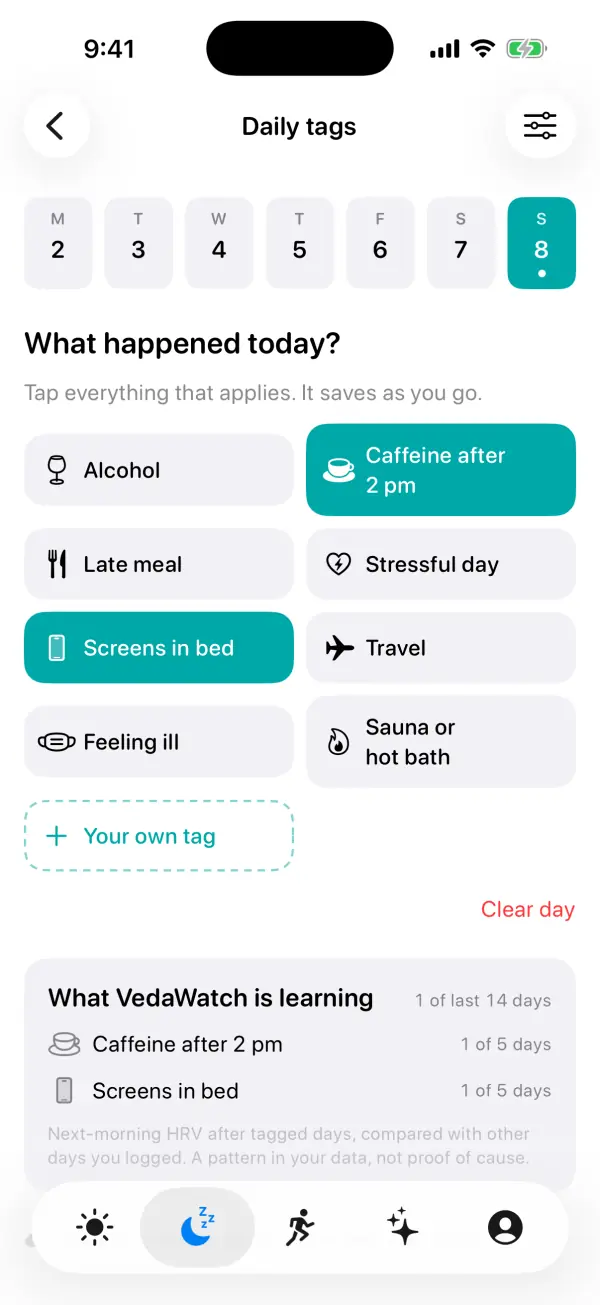
For consistency, add creatine as your own tag in Daily tags. Tap Your own tag, name it Creatine and pick a symbol, and it joins the built-in tags. Tap it each day you take your dose, on iPhone or from the Log page of the VedaWatch Watch app. You can add up to 24 of your own tags, and Tag settings can export your journal as a CSV spreadsheet with one row per logged day, which makes it easy to see any days you missed.
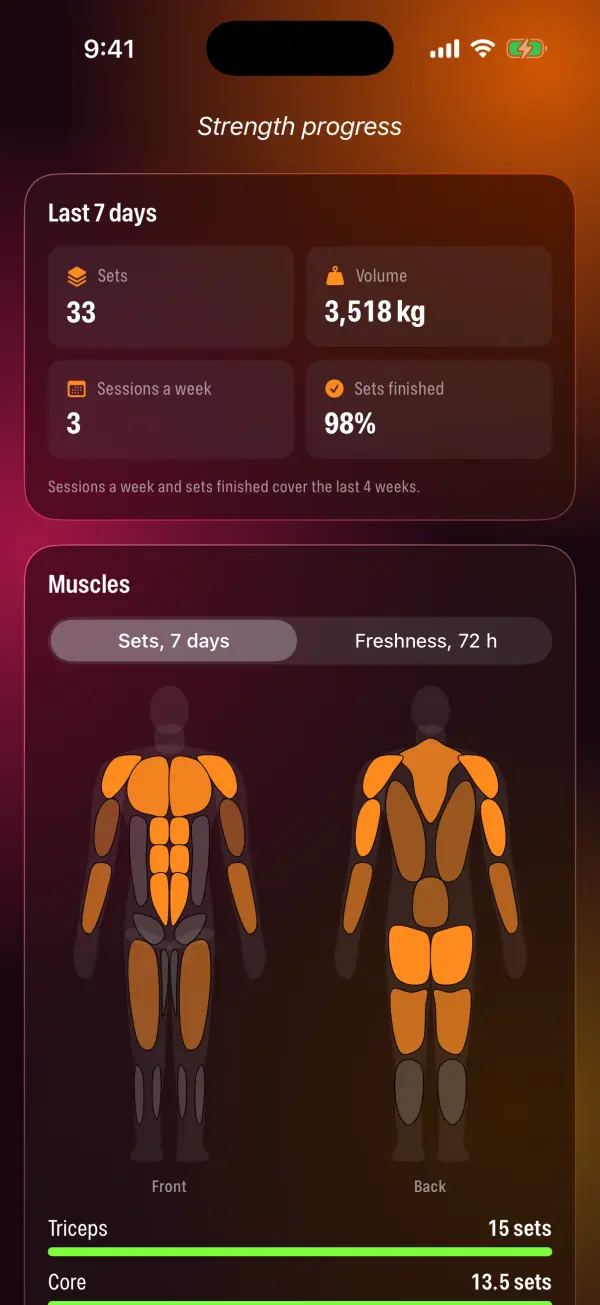
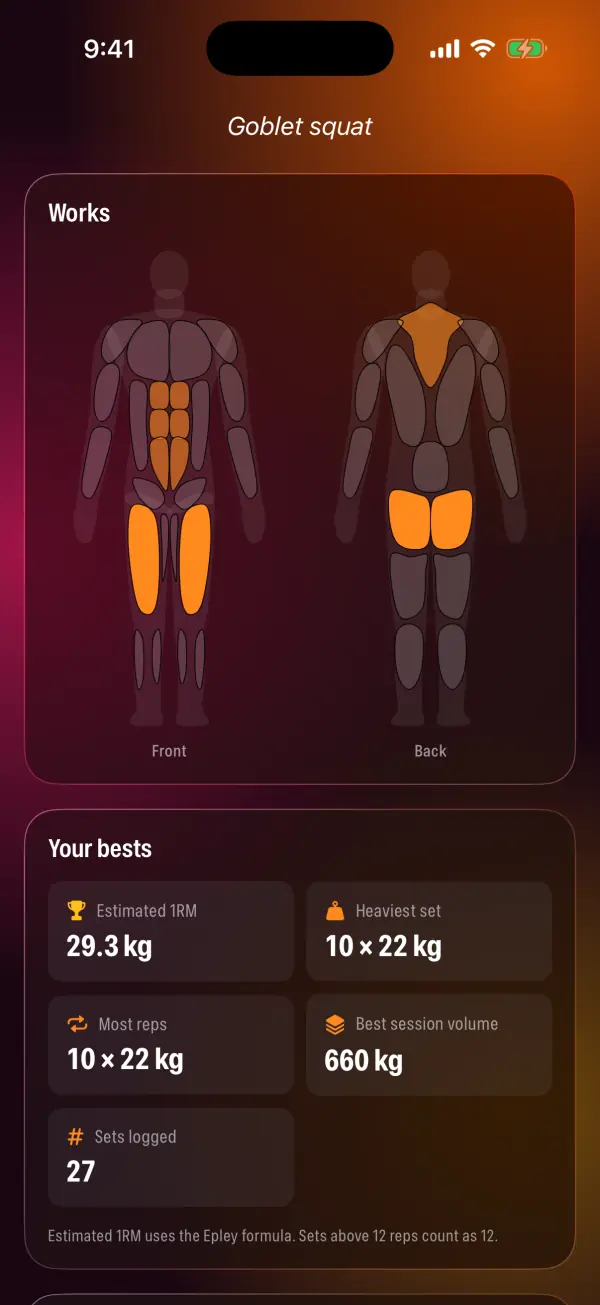
For results, guided strength sessions you finish in VedaWatch feed Strength progress on the Train tab. You'll see sets and volume per muscle each week, and each exercise has its own page with an estimated 1RM chart and your best sets. Trends flags an exercise as up when its estimated 1RM rises at least 3% over the last 4 weeks. Comparing a few months of those numbers is a far better test of creatine than the bathroom scale, which mostly shows water in the first week.
Daily tags also compare your next-morning HRV after tagged days with logged days without the tag, once there are at least 5 of each. A tag you log every single day won't have that comparison, and creatine isn't known to change HRV, so treat the tag mainly as a habit log.
Frequently asked questions
Is 10 g of creatine a day too much?
For most people it is more than needed rather than dangerous: the ISSN suggests 3 to 5 g a day, and up to 5 to 10 g only for some larger athletes. Single doses above about 10 g are more likely to upset your stomach.
Should I take creatine on rest days?
Yes. Creatine works by keeping muscle stores full, not by acting on the day you train, so take your usual 3 to 5 g on rest days too.
What happens if I miss a few days of creatine?
Very little. In the Hultman study, muscle stores took about 30 days to drift back to starting levels after people stopped completely. Take your normal dose the next day; there's no need to double up or reload.
Do vegetarians and vegans get more from creatine?
They may. The ISSN notes that vegetarians tend to start with lower muscle creatine, because creatine in food comes mainly from meat and fish, so they may see greater gains when they supplement.
Will creatine show up on a drug test?
Creatine is regulated as a dietary supplement, not as a controlled substance like anabolic steroids. The bigger risk for tested athletes is a contaminated product, so choose one tested by an independent third party and check your sport's rules.
Related guides
- How much protein per day to build muscle: g/kg by body weight
- Beginner full body workout plan: 3 days a week for 8 weeks
- Progressive overload explained: how to progress every lift
- How to track strength training progress with Apple Watch: volume, 1RM and muscle balance
- What to eat after a workout: protein, carbs and timing
- How much water should I drink when working out?
Sources & further reading
- Kreider RB et al. (2017). International Society of Sports Nutrition position stand: safety and efficacy of creatine supplementation in exercise, sport, and medicine. J Int Soc Sports Nutr 14:18
- Antonio J et al. (2021). Common questions and misconceptions about creatine supplementation: what does the scientific evidence really show? J Int Soc Sports Nutr 18:13
- Hultman E et al. (1996). Muscle creatine loading in men. J Appl Physiol 81(1):232-237
- Delpino FM et al. (2022). Influence of age, sex, and type of exercise on the efficacy of creatine supplementation on lean body mass: a systematic review and meta-analysis. Nutrition 103-104:111791
- Kazeminasab F et al. (2025). The effects of creatine supplementation on upper- and lower-body strength and power: a systematic review and meta-analysis. Nutrients 17(17):2748
This guide is educational, not medical advice, and has not been clinically reviewed. VedaWatch is not a medical device. If you have symptoms or concerns about your heart or health, contact a qualified healthcare professional.
Put your trends in perspective.
Explore HRV, sleep, and recovery with VedaWatch on your iPhone.
Download VedaWatch on the App Store →