 VedaWatch
Strength Training
Home dumbbell workout plan: 3 days a week with one pair
A home dumbbell workout plan for one pair of dumbbells: two full-body workouts, 3 days a week, how to choose your weight and how to progress when it gets light.
By VedaWatch editorial team · · 11 min read
The short answer
Train full body 3 days a week, alternating two workouts: goblet squat, floor press, one-arm row and Romanian deadlift, then split squat, overhead press, row and carry. Do 3 sets of 8 to 12 reps, stop with 2 to 3 reps left, and add reps before weight. When the pair gets light, slow down and go one-sided.
A simple home dumbbell workout plan for the week
If you own one pair of dumbbells and have about 35 to 45 minutes three times a week, a full-body plan is the most practical setup. You train every major muscle group in each session, so each muscle gets worked two or three times a week, and missing a day doesn't leave a body part untouched for a fortnight.
This fits the evidence for beginners. The American College of Sports Medicine (ACSM) recommends 2 to 3 resistance sessions a week for novices, with loads you can lift for 8 to 12 reps. The CDC says adults need muscle-strengthening activity on at least 2 days a week that works the legs, hips, back, abdomen, chest, shoulders and arms. And a meta-analysis of training frequency found that training each muscle at least twice a week produced more muscle growth than once a week.
The plan uses two workouts, A and B, that you alternate. Over two weeks you do each one three times, which keeps the sessions fresh without making you learn a long list of exercises.
- Week 1: Monday Workout A, Wednesday Workout B, Friday Workout A.
- Week 2: Monday Workout B, Wednesday Workout A, Friday Workout B.
- Keep at least one rest day between sessions. Any three non-consecutive days work, such as Tuesday, Thursday and Saturday.
- Rest days can be walks, easy cycling or mobility. Nothing on rest days is required for the plan to work.
- Run the plan for 8 to 12 weeks before changing the exercises, so you have time to see real progress on the same lifts.
Workout A: goblet squat, floor press, row and Romanian deadlift
Start every session with 5 minutes of warm-up: marching or easy jumping jacks, then bodyweight squats, hip hinges and arm circles. Then do one or two light sets of the first exercise before your work sets.
Do the exercises in this order. ACSM advises putting large-muscle, multi-joint exercises before smaller ones, so the lifts that need the most effort come first while you are fresh. Rest 60 to 90 seconds between sets, which sits inside the 1 to 2 minutes ACSM suggests for muscle-building work.
- Goblet squat: 3 sets of 8 to 12 reps. Hold one dumbbell vertically against your chest. If one dumbbell is too light, hold both at your shoulders.
- Dumbbell floor press: 3 sets of 8 to 12 reps. Lie on the floor, knees bent, and press both dumbbells up. The floor limits the range so you don't need a bench.
- One-arm dumbbell row: 3 sets of 10 to 12 reps per side. Brace one hand on a chair or sofa arm and pull the dumbbell toward your hip.
- Romanian deadlift: 3 sets of 10 to 12 reps. Hold both dumbbells, soften the knees and push your hips back until you feel the hamstrings stretch, then stand up.
- Plank: 3 holds of 20 to 40 seconds, with a straight line from shoulders to heels.
- Finish with 3 minutes of easy stretching for the hips, hamstrings and chest.
Workout B: split squat, overhead press, row and carry
Workout B trains the same muscles with different movements. Using one leg or one arm at a time makes a light pair of dumbbells feel much heavier, which is exactly what a home setup needs later on.
- Dumbbell split squat: 3 sets of 8 to 12 reps per leg. Hold the dumbbells at your sides, step one foot forward and lower the back knee toward the floor.
- Standing overhead press: 3 sets of 8 to 12 reps. Press both dumbbells from your shoulders to straight arms without leaning back.
- Bent-over two-arm row: 3 sets of 10 to 12 reps. Hinge forward with a flat back and row both dumbbells to your ribs.
- Hip thrust or glute bridge: 3 sets of 10 to 15 reps. Rest your upper back on a sofa edge (or lie on the floor for a bridge) with a dumbbell on your hips.
- Farmer's carry: 3 walks of 30 to 40 seconds, a dumbbell in each hand, standing tall. Walk laps of a hallway or garden.
- Finish with 3 minutes of easy stretching for the quads, shoulders and back.
What weight dumbbells should you use?
There is no correct weight for your age or sex. The right weight is the one that makes the target reps hard but clean. A practical way to judge that is reps in reserve: how many more good reps you could have done when you stopped. Researchers developed this scale because it adjusts the load to how you feel on the day.
For this plan, aim to finish most sets with 2 or 3 reps in reserve. If you're new to lifting, start nearer 3, because learning the movement matters more than the load in the first few weeks.
- Do a light warm-up set of the exercise with the dumbbell you think is easy.
- Do one set of 10 reps with your best guess. Stop at 10 even if you feel good.
- Ask yourself how many more clean reps you had. If it's 2 to 4, that's your weight.
- If you had 5 or more left, use a heavier dumbbell next set, or move the exercise to a one-sided version.
- If you couldn't finish 8 clean reps, go lighter or shorten the range for now.
- Write the weight and reps down. You'll use those numbers to progress next session.
Making one pair of dumbbells work for every exercise
With a single pair, the same weight will feel very different from one exercise to the next. Your legs and hips can handle far more than your shoulders, so a pair that's right for the overhead press may be easy for goblet squats and Romanian deadlifts. That's the main problem every home dumbbell plan has to solve, and most sample plans skip it.
Pick the pair to suit your upper-body pressing and rowing, because those are hard to make heavier with technique. The legs have more ways to get harder without more weight: one-leg versions, slower lowering and pauses. If you're buying, adjustable dumbbells solve much of this, but the plan works with a fixed pair.
Higher reps are not wasted reps. A 2017 meta-analysis that compared light loads (60% of a one-rep max or less) with heavier loads, with all sets taken to failure, found similar muscle growth, while maximal strength improved more with heavy loads. A 2021 network meta-analysis found no difference in muscle growth between low loads (more than 15 reps), moderate loads (9 to 15) and high loads (8 or fewer) when sets went to failure. So if building muscle and general strength is your goal, a light pair used with hard sets can still work. If maximal strength is the goal, you'll eventually need heavier weights.
One caution: those studies took sets to failure. At home, without a spotter, take the last set of an exercise close to failure only on safe movements such as rows, split squats and floor presses, not overhead.
How to progress: add reps first, then weight
Progress with double progression. Keep the same weight and add a rep or two per set each session until you hit the top of the range on every set. Then move up in weight and drop back to the bottom of the range. ACSM's guidance is similar: increase the load by 2 to 10% once you can do one or two reps more than your target.
Dumbbells make this tricky, because the next pair up is often a bigger jump than 10%. Going from 10 kg to 12 kg is a 20% increase. That's why the rep range matters: the extra reps bridge the gap until the heavier pair becomes manageable.
Here's a worked example for the goblet squat with a 12 kg dumbbell and a target of 3 sets of 8 to 12 reps.
- Session 1: 12 kg for 9, 8 and 8 reps. Not every set reached 9, so keep the weight.
- Session 2: 12 kg for 10, 9 and 9 reps.
- Session 3: 12 kg for 11, 11 and 10 reps.
- Session 4: 12 kg for 12, 12 and 12 reps. You hit the top of the range on every set.
- Session 5: 14 kg for 8, 8 and 7 reps. Back near the bottom of the range with the heavier weight, and the cycle starts again.
- If you miss your reps two sessions running at the same weight, drop about 10% and build back up, or check your sleep and stress before blaming the program.
What to do when your dumbbells get too light
Sooner or later you'll hit 12 clean reps on an exercise with your heaviest dumbbells and have nothing heavier to pick up. Before buying more weight, work through these ways to make the same dumbbell harder, roughly in this order. Change one thing at a time and go back to the bottom of the rep range each time you make an exercise harder.
- Go one-sided. Goblet squat becomes split squat, then rear-foot elevated split squat with your back foot on a chair. Romanian deadlift becomes single-leg Romanian deadlift. Two-arm press becomes one-arm press. Each side now carries the whole load.
- Slow the lowering. Take 3 seconds to lower each rep. The same weight becomes noticeably harder, and you'll likely do fewer reps.
- Add a pause. Hold for 2 seconds at the hardest point, such as the bottom of the squat or with the dumbbell touching your ribs in a row.
- Use 1.5 reps. Go all the way down, come halfway up, go back down, then stand up fully. That counts as one rep.
- Extend the rep range. Work up to 15 to 20 reps per set and take the last set close to failure. As the studies above show, light loads can still build muscle when sets are hard.
- Add a set. Go from 3 to 4 sets per exercise. A meta-analysis of training volume found a graded dose-response: more weekly sets were linked to more muscle growth.
- Shorten the rest to 45 to 60 seconds once the other options run out. This adds more conditioning than strength, so use it last.
- When every exercise has hit the top of its hardest version, it's time for heavier dumbbells or an adjustable pair.
Staying safe and knowing when to check with a doctor
Most people can start a beginner strength plan safely, but check with a doctor or physiotherapist first if you have a heart condition, high blood pressure that isn't controlled, a recent injury or surgery, are pregnant, or haven't exercised in years and have other health concerns.
Use a clear floor space, wear shoes with grip, and put dumbbells down rather than dropping them. Some muscle soreness a day or two after a new exercise is normal. Sharp pain, joint pain that gets worse with each session, chest pain, dizziness or unusual shortness of breath are reasons to stop and get checked.
Breathe out on the effort, keep movements controlled, and don't hold your breath through long sets. Good form on a lighter weight beats a heavier weight you have to swing.
Following a dumbbell plan with VedaWatch on Apple Watch
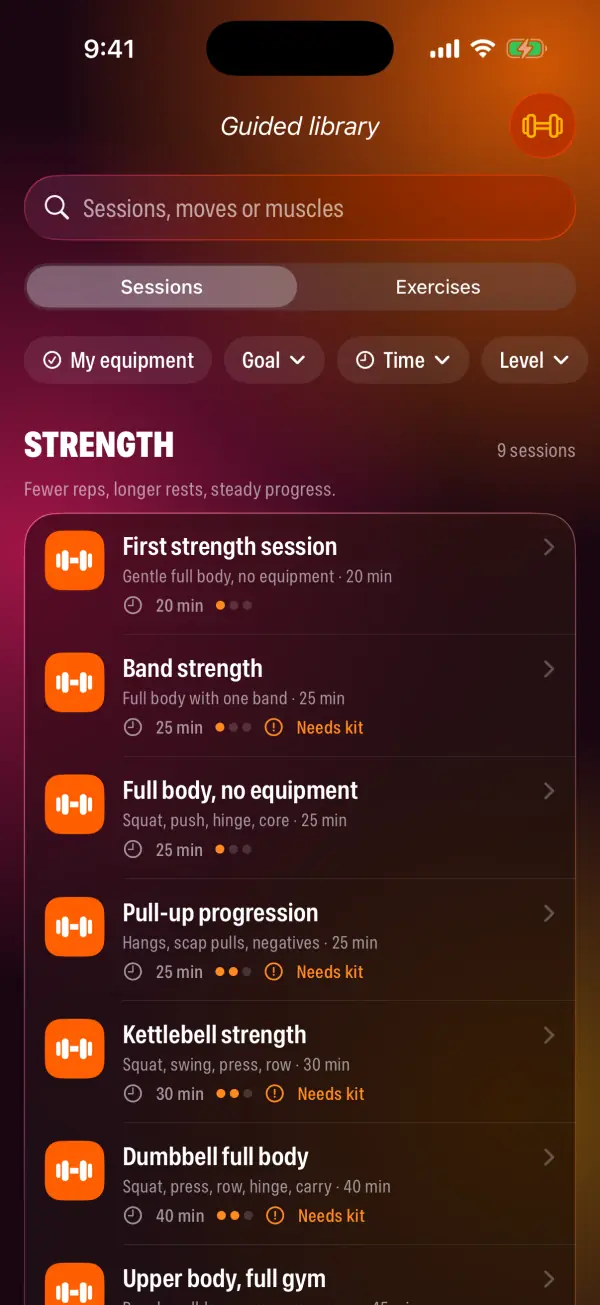
If you'd rather not track sets on paper, VedaWatch can run dumbbell sessions for you. In the Train tab's Guided library you can tap the dumbbell button to tell the app you own dumbbells, then use the My equipment filter to hide anything you can't do at home. The library includes a 40-minute Dumbbell full body session built from goblet squats, floor presses, rows, Romanian deadlifts, overhead presses and farmer's carries, and a 30-minute Dumbbell conditioning circuit. Two other dumbbell sessions, for legs and glutes and for upper body, also use a bench.
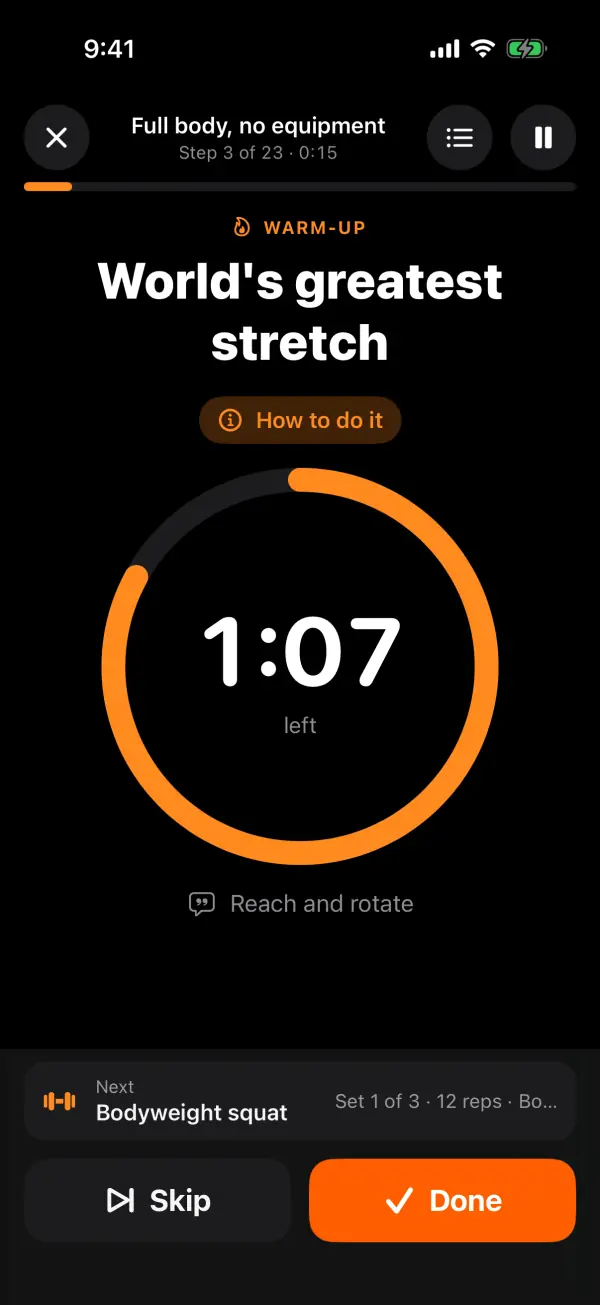
Sessions play on your Apple Watch or iPhone with timers for rests, spoken cues and a weight row on each loaded set. On the Watch, VedaWatch can count reps for many dumbbell moves from your wrist motion, and you can correct the count with the Digital Crown.
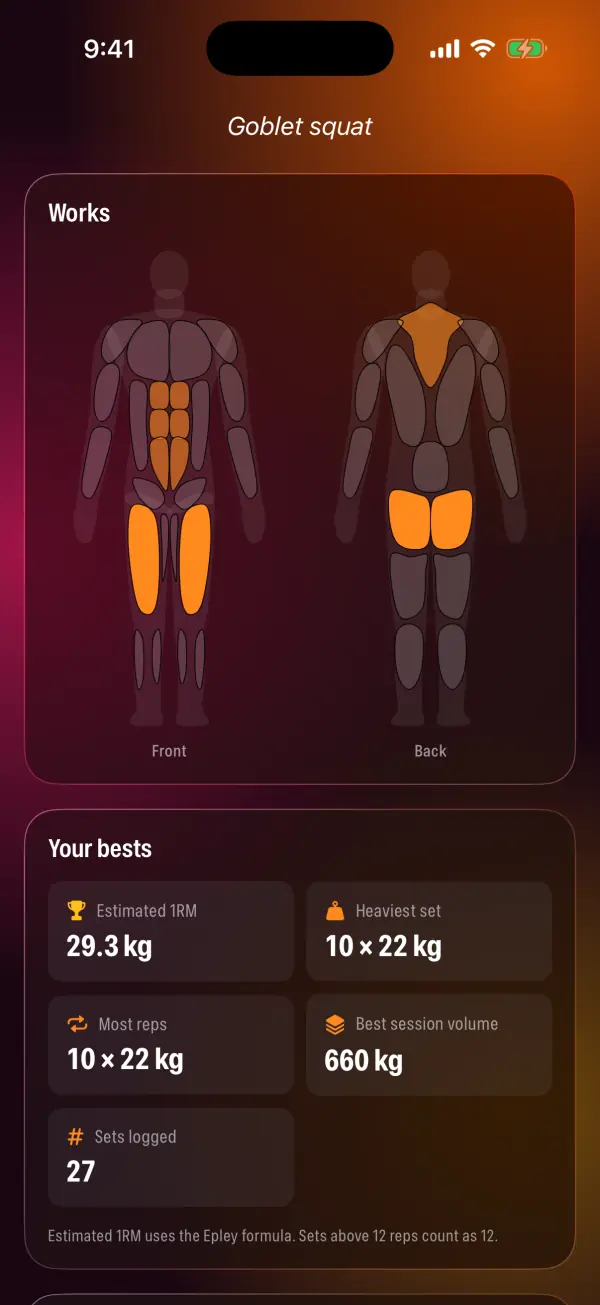
The daily coach uses double progression too. The first time you do a loaded exercise it asks you to pick a weight you could lift 2 to 3 more times. After that it adds a rep when you hit every rep, and adds weight (2 kg steps for most dumbbell moves, or 5 lb if you use pounds) once you reach the top of the range. If you miss reps twice in a row at the same weight, it suggests about 10% less. On low-readiness days it holds the load instead of adding more. Strength progress then shows your estimated 1RM, heaviest set and records for each exercise.
Like any app, it doesn't know which dumbbells you own beyond the fact that you have some, so if the next step up doesn't exist in your set, use the ideas above to make the exercise harder instead.
Frequently asked questions
Can you build muscle with only dumbbells at home?
Yes, for most people, especially in the first year or two of training. Research comparing light and heavy loads found similar muscle growth when sets were taken close to failure, so one-sided exercises, slower reps and higher rep ranges can keep a modest pair useful for a long time.
Is 3 days a week enough for a dumbbell workout plan?
For beginners, yes. ACSM recommends 2 to 3 sessions a week for novices, and a full-body plan on 3 days trains each muscle more than twice a week. After 6 months or more of consistent training, you can move to 4 days, for example with an upper and lower split.
Should I do the workouts as a circuit to save time?
You can pair two exercises that use different muscles, such as a floor press with a Romanian deadlift, and alternate them with shorter rests. Full circuits with little rest feel harder but usually mean less weight per set, so keep straight sets for the first few exercises if strength is your main goal.
How long until I see results from a home dumbbell plan?
Most beginners notice the weights getting easier within a few weeks, largely because they get better at the movements. Visible changes in muscle usually take longer and depend on sleep, protein intake and consistency, so judge the plan after 8 to 12 weeks, not one.
Do I need a bench for a home dumbbell workout?
No. Floor presses replace bench presses, a sturdy chair or sofa arm supports one-arm rows, and a sofa edge works for hip thrusts. A bench adds incline pressing and chest-supported rows, which is handy but not required.
Related guides
- Progressive overload explained: how to progress every lift
- Beginner full body workout plan: 3 days a week for 8 weeks
- Bodyweight workout plan (no equipment): 12 weeks of progressions
- How long to rest between sets: rest times by goal
- Guided strength workouts on Apple Watch: step-by-step sessions with spoken cues and rep counting
- How to track strength training progress with Apple Watch: volume, 1RM and muscle balance
Sources & further reading
- Medicine & Science in Sports & Exercise (2009): American College of Sports Medicine position stand. Progression models in resistance training for healthy adults
- CDC: Adult Activity, An Overview (Physical Activity Guidelines for Americans)
- Sports Medicine (2016): Effects of resistance training frequency on measures of muscle hypertrophy, a systematic review and meta-analysis (Schoenfeld, Ogborn, Krieger)
- Journal of Strength and Conditioning Research (2017): Strength and hypertrophy adaptations between low- vs. high-load resistance training, a systematic review and meta-analysis (Schoenfeld et al.)
- Medicine & Science in Sports & Exercise (2021): Resistance training load effects on muscle hypertrophy and strength gain, systematic review and network meta-analysis (Lopez et al.)
- Strength and Conditioning Journal (2016): Application of the repetitions in reserve-based rating of perceived exertion scale for resistance training (Helms et al.)
- Journal of Sports Sciences (2017): Dose-response relationship between weekly resistance training volume and increases in muscle mass (Schoenfeld, Ogborn, Krieger)
This guide is educational, not medical advice, and has not been clinically reviewed. VedaWatch is not a medical device. If you have symptoms or concerns about your heart or health, contact a qualified healthcare professional.
Put your trends in perspective.
Explore HRV, sleep, and recovery with VedaWatch on your iPhone.
Download VedaWatch on the App Store →