 VedaWatch
Strength Training
Bodyweight workout plan (no equipment): 12 weeks of progressions
A 12-week bodyweight workout plan with no equipment: two full-body workouts, exercise ladders from wall push-ups to pistols, and rules for when to level up.
By VedaWatch editorial team · · 11 min read
The short answer
Train your full body 3 days a week, alternating two workouts that cover squat, hinge, push, pull and core. For each move, pick the version you can do for 8 to 15 good reps. Add reps each session, and once every set reaches 15, switch to the next harder version and start again at 8.
What is a good bodyweight workout plan?
A good bodyweight workout plan does three things. It trains every major muscle group, it fits a schedule you can keep, and it has a built-in way to get harder. That third part is what most home routines miss. Doing the same 3 sets of 10 push-ups for months feels productive, but your body adapts and progress stalls.
The plan in this guide is full body, 3 days a week, alternating Workout A and Workout B (for example Monday, Wednesday and Friday). Each workout has five slots: a squat or lunge, a push, a hinge, a pull and a core move. You don't do a fixed exercise in each slot. You do a level on a ladder of variations, and the plan tells you when to climb.
That structure lines up with mainstream guidance. The CDC recommends at least 2 days a week of muscle-strengthening activity that works all the major muscle groups, and the American College of Sports Medicine (ACSM) suggests 2 to 3 days a week for people new to resistance training, with loads that allow about 8 to 12 reps. With bodyweight, you control the load by choosing the variation.
Each session takes about 30 to 40 minutes, including a 5-minute warm-up. All you need is floor space, a wall, a sturdy chair or bench, and a sofa or step. A sturdy table helps for rows, and a pull-up bar is a nice extra but not required.
Can you build muscle and strength with bodyweight only?
Yes, as long as the exercises stay challenging. A 2017 meta-analysis of 21 studies by Schoenfeld and colleagues found that muscle growth was similar with light and heavy loads when sets were taken to muscular failure. Heavy loads gave bigger gains in one-rep max strength. In practice, bodyweight training can build muscle well, but if your goal is the biggest possible barbell lift, you'll eventually need to lift heavy.
Push-ups are the best-studied example. In an 8-week study, Kikuchi and Nakazato had young men do either bench press or push-ups adjusted to a similar load (about 40% of their bench press max), 3 sets to failure, twice a week. Both groups gained similar chest and triceps thickness and similar bench press strength. It was a small study (9 people per group), so treat it as encouraging rather than definitive.
The catch with bodyweight is that you can't add 2 kg to a push-up. Instead you change leverage, range of motion, tempo or the number of limbs doing the work. That's what the exercise ladders below are for.
How to find your starting level
Before week 1, spend one session testing. The goal is to find, for each slot, the hardest variation you can do for at least 8 clean reps while stopping with 2 or 3 reps still in the tank. Clean means full range, steady tempo and no sagging hips or collapsing knees.
- Warm up for 5 minutes: march or jog in place, then 10 bodyweight squats, 10 arm circles each way and 5 slow inchworms.
- Push: start with incline push-ups with your hands on a kitchen counter. If 15 feel easy, try a sturdy chair seat, then the floor. Stop at the first level where 8 to 12 reps feel hard.
- Squat: start with a box squat to a chair. If 15 feel easy, try a free bodyweight squat, then a split squat.
- Hinge: start with a two-leg glute bridge. If 15 feel easy, try a single-leg glute bridge.
- Pull: try a table row (see the pull ladder). If you can't do 8, use prone Y raises on the floor instead.
- Core: hold a forearm plank. If you can't hold 20 seconds with a flat back, use dead bugs; if 60 seconds is easy, try a hollow hold.
- Write down each level and rep count. That's your week 1 starting point.
The two workouts: exercises, sets, reps and rest
Alternate the two workouts with at least one day between them, so a week looks like A, B, A and the next week B, A, B. Rest 60 to 90 seconds between sets of the same exercise. The ACSM suggests 1 to 2 minutes of rest for muscle-building work, and 60 seconds is enough for the core holds. Each line below shows the default starting level. Swap in your own level from the test.
- Workout A, slot 1 (squat): bodyweight squat, 3 sets of 8 to 15 reps.
- Workout A, slot 2 (horizontal push): push-up at your level, 3 sets of 8 to 15 reps.
- Workout A, slot 3 (hinge): glute bridge, 3 sets of 8 to 15 reps, with a 1-second squeeze at the top.
- Workout A, slot 4 (pull): table row or prone Y raise, 3 sets of 8 to 15 reps.
- Workout A, slot 5 (core): plank, 3 holds of 20 to 60 seconds.
- Workout B, slot 1 (lunge): split squat, 3 sets of 8 to 15 reps per leg.
- Workout B, slot 2 (vertical push): pike push-up (or incline push-up if pikes aren't possible yet), 3 sets of 8 to 15 reps.
- Workout B, slot 3 (hinge): single-leg glute bridge, 3 sets of 8 to 15 reps per leg.
- Workout B, slot 4 (pull): the same pull variation as Workout A, 3 sets of 8 to 15 reps.
- Workout B, slot 5 (core): dead bug, 3 sets of 8 to 12 slow reps per side, or a hollow hold for 20 to 60 seconds.
- Finish both workouts with 3 minutes of easy stretching for the hips, chest and shoulders.
Bodyweight exercise progressions, from easiest to hardest
Each ladder runs from easiest to hardest. Move up one rung at a time. When you step up, start back at the bottom of the rep range.
Push-ups are the one ladder where we have measured numbers. A force-plate study by Wurm, Ebben and colleagues found that a regular push-up puts about 64% of your body weight through your hands. With hands raised on a 61 cm (24 in) box it was about 41%, with hands on a 30 cm (12 in) box about 55%, and from the knees about 49%. With the feet raised on a 30 cm box it was about 70%, and on a 61 cm box about 74%. So lowering your hands, step by step, is a smooth way to add load, and raising your feet keeps it climbing after the floor.
- Push ladder: wall push-up, then incline push-up on a counter, then incline on a chair seat or low step, then full push-up, then feet raised on a step, then feet raised on a chair, then archer push-up.
- Vertical push ladder: incline pike (hands on a step), then pike push-up on the floor, then pike push-up with feet on a chair.
- Squat ladder: box squat to a chair, then bodyweight squat, then split squat, then rear-foot-elevated (Bulgarian) split squat with your back foot on a sofa, then pistol squat to a box, then a full pistol squat.
- Hinge ladder: glute bridge, then single-leg glute bridge, then hip thrust with your shoulders on a sofa, then single-leg hip thrust.
- Pull ladder: prone Y raise on the floor, then table row with knees bent under a sturdy table, then table row with straight legs, then table row with feet raised. With a pull-up bar: dead hangs, then slow negative pull-ups, then full pull-ups.
- Core ladder: dead bug, then plank, then hollow hold with bent knees, then hollow hold with straight legs.
How to make bodyweight exercises harder over time
Use double progression. First add reps, then make the exercise harder and drop the reps back down. The ACSM describes the weight-room version: when you can do 1 to 2 reps more than your target, increase the load by 2 to 10%. With bodyweight, the next rung on the ladder is your increase.
Here's the rule for this plan. If you hit your target reps on every set, add 1 or 2 reps per set next time. Once all 3 sets reach 15 with good form, move to the next variation and start at 8. If you miss your target two sessions in a row, drop back a rung for a week. For holds, add 5 seconds per session up to 60 seconds, then move to the harder hold.
Here's a worked example with push-ups. Week 1: chair-seat incline push-ups, 3 × 8. Session 2: 3 × 10. Session 4: 3 × 12. By week 3 or 4: 3 × 15. Next session, full push-ups from the floor, 3 × 8, likely with fewer reps on the last set. That's fine. Keep the target at 8 until every set lands, then climb again.
When there's no next rung (no table, no chair, or the next step is a big jump), use these other levers. Slow the lowering to 3 seconds. Pause for 2 seconds at the bottom. Increase the range, for example push-ups with hands on two books so your chest drops lower. Cut rest from 90 to 60 seconds. Or add a fourth set. Change one lever at a time so you can tell what's working.
Effort matters as much as the variation. The muscle-building evidence above comes from sets taken close to failure. A set of 15 that leaves 10 more reps in the tank won't do much. Aim to finish most sets with only 1 to 3 good reps left.
The 12-week bodyweight plan, week by week
The progression rules do most of the work. This calendar adds structure on top so the volume builds gradually and you get a planned easy week before the hardest block.
- Weeks 1 and 2 (learn the moves): 2 sets per exercise, stop every set with 3 reps in the tank, and focus on form and tempo.
- Weeks 3 to 6 (build): 3 sets per exercise. Apply the double-progression rule every session. Most people climb at least one rung on push and squat in this block.
- Week 7 (lighter week): keep your current variations but do 2 sets and stop well short of failure. Use the spare time for a walk or mobility work.
- Weeks 8 to 11 (push): 3 sets, and add a 3-second lowering to every rep exercise. Add a fourth set to any slot where you're stuck on the same rung.
- Week 12 (retest): repeat the starting test and compare. Then start a new 12-week cycle from your new levels, or swap in variations such as Bulgarian split squats and feet-raised push-ups as your new default.
Common mistakes and when to get advice
The most common mistake is skipping the pull slot. Push-ups, squats and planks are easy to do at home. Rows aren't, so many home routines are all push. Prone Y raises and table rows are less exciting, but they balance your shoulders and upper back. Before you use a table, check that it can take your weight and won't tip, and keep your hands near the legs. If in doubt, stick with floor work.
Other common mistakes: chasing reps with half-range reps, changing exercises every week so nothing progresses, and doing the plan every day. Muscles adapt between sessions, which is why the plan leaves a rest day between workouts. Walking, cycling or easy runs on the off days are fine.
Some muscle soreness in the first two weeks is normal. Sharp or joint pain isn't. Stop that exercise and use an easier rung. Talk to a doctor or physiotherapist before you start if you have a heart condition, high blood pressure, a recent injury or surgery, or are pregnant, and stop right away if you feel chest pain, dizziness or unusual shortness of breath. This plan is general fitness guidance, not a treatment or rehab program.
How VedaWatch can guide a bodyweight plan on Apple Watch
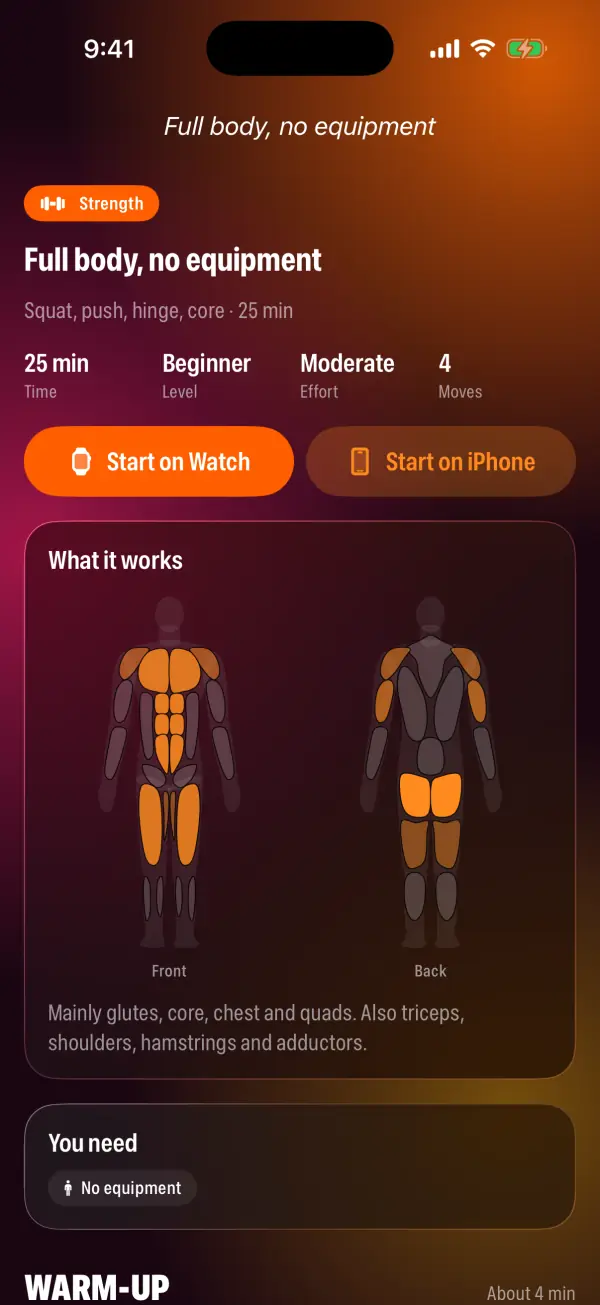
If you'd rather not track rungs and reps on paper, VedaWatch can do much of it. Its Guided library on the Train tab includes no-equipment sessions such as First strength session (20 min), Full body, no equipment (25 min), Bodyweight muscle builder (35 min) and Bodyweight circuit (20 min). The My equipment filter hides anything you can't do with what you own, and bodyweight moves and a mat are always counted as available. Each exercise page has Easier and Harder swaps, so the ladders above are a tap away.
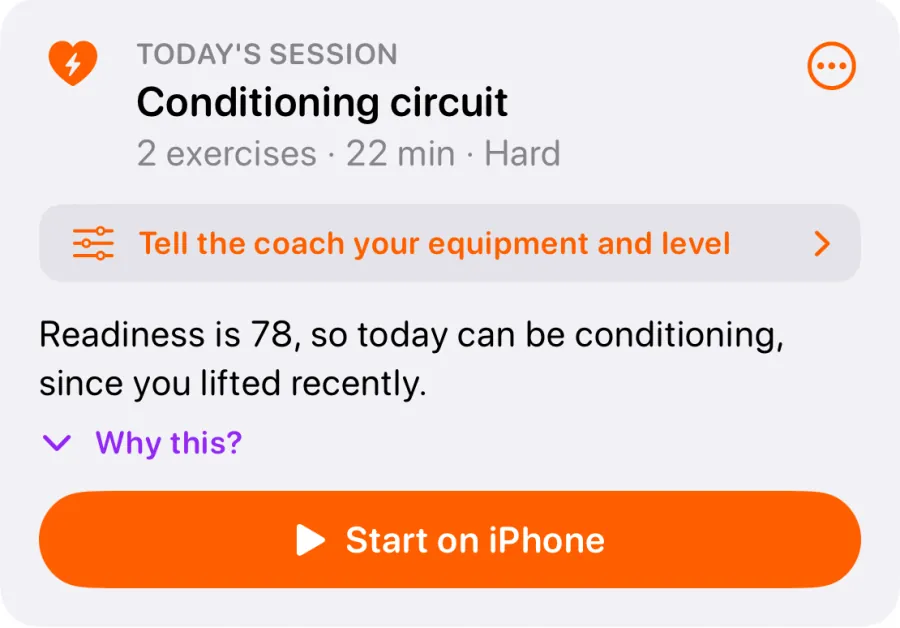
The daily coach card, Today's session, applies the same double-progression idea for you. If you hit all your reps on a bodyweight move last time, it adds 2 reps. Once you reach the top of the range, it moves you up to the harder variation, but only if that variation fits your equipment and level. If a move was a grind twice in a row, it steps you down to the easier version. When the next variation needs kit you don't have, it keeps adding reps up to a cap and then tells you to slow the lowering to 3 seconds. Timed holds go up 5 seconds at a time. On low-readiness days it holds your reps instead of adding more. Each change comes with a one-line reason.
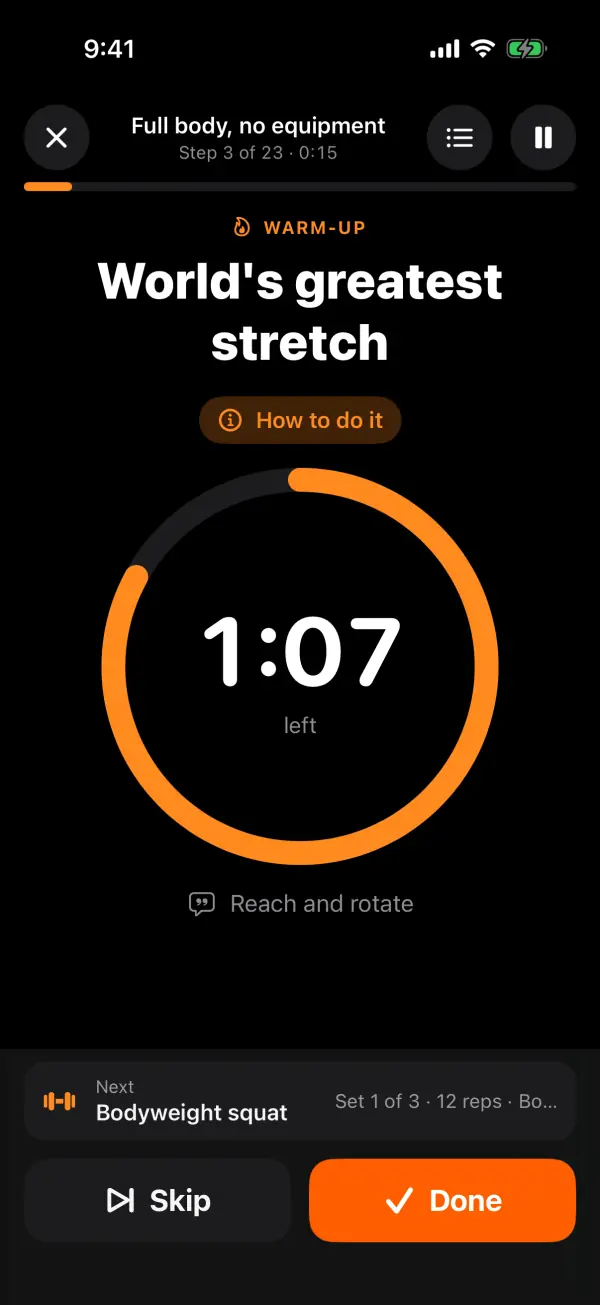
Start a session on your Apple Watch and the player runs your rest timers with spoken cues. It can count many reps from your wrist motion, including squats, lunges and push-ups, and you can fix any count with the Digital Crown. Planks and other holds use a timer instead. Finished sessions are saved to Apple Health as workouts, so they count toward your training load. The guided library, the coach and strength progress don't require VedaWatch Pro.
Frequently asked questions
Can I do a bodyweight workout every day?
You can move every day, but it's better not to train the same muscles hard on back-to-back days. Alternate strength days with walking, easy cardio or mobility, or split the plan so you're not working the same muscles two days running.
What if I can't do a single push-up?
Start with wall push-ups or incline push-ups on a counter. Measured loads for those are well below a floor push-up's. Lower the incline step by step as you reach 15 reps, and the floor version usually follows.
Do I need a pull-up bar?
No. Prone Y raises and table rows cover the pull slot. A doorway pull-up bar does make it easier to keep progressing your back and arms past the beginner stage, though.
How long until I see results from bodyweight training?
Rep counts usually climb within the first few weeks as you learn the moves. Visible muscle changes take longer. Training studies on push-ups measured gains over 8 weeks, and results depend on effort, sleep and how much you eat.
Should I add cardio to a bodyweight plan?
It's a good idea for general health. Adult guidelines from the CDC and WHO pair muscle-strengthening work with weekly aerobic activity. Easy walks or rides on rest days add it without getting in the way of recovery.
Related guides
- Beginner full body workout plan: 3 days a week for 8 weeks
- Progressive overload explained: how to progress every lift
- Home dumbbell workout plan: 3 days a week with one pair
- How long to rest between sets: rest times by goal
- Guided strength workouts on Apple Watch: step-by-step sessions with spoken cues and rep counting
- Train by readiness: how VedaWatch picks today's workout from your Apple Watch data
Sources & further reading
- Medicine & Science in Sports & Exercise (2009): American College of Sports Medicine position stand. Progression models in resistance training for healthy adults
- Journal of Strength and Conditioning Research (2017): Strength and hypertrophy adaptations between low- vs. high-load resistance training: a systematic review and meta-analysis (Schoenfeld et al.)
- Journal of Exercise Science & Fitness (2017): Low-load bench press and push-up induce similar muscle hypertrophy and strength gain (Kikuchi and Nakazato)
- ISBS Conference Proceedings (2010): Kinetic analysis of several variations of push-ups (Wurm, Ebben et al.)
- CDC: Adult Activity: An Overview (Physical Activity Guidelines for Americans)
- British Journal of Sports Medicine (2020): World Health Organization 2020 guidelines on physical activity and sedentary behaviour (Bull et al.)
This guide is educational, not medical advice, and has not been clinically reviewed. VedaWatch is not a medical device. If you have symptoms or concerns about your heart or health, contact a qualified healthcare professional.
Put your trends in perspective.
Explore HRV, sleep, and recovery with VedaWatch on your iPhone.
Download VedaWatch on the App Store →