 VedaWatch
Workouts & Training
HIIT vs steady state cardio: fitness, fat loss and recovery
HIIT vs steady state cardio: what research says on VO2 max and fat loss, how long each takes to recover from, and how to mix both weekly by heart rate zone.
By VedaWatch editorial team · · 10 min read
The short answer
Neither wins outright. HIIT raises VO2 max a little more per hour and saves time, while fat loss is similar when total training is similar. Steady cardio is easier to recover from and to do often. Most people do best with mostly easy Zone 2 sessions plus one or two hard interval sessions a week.
HIIT vs steady state cardio: which is better?
It depends on what you want, how much time you have and how well you recover. Research comparing the two finds that both improve aerobic fitness and both reduce body fat. HIIT tends to give a slightly bigger boost to VO2 max and gets similar fat loss in less time. Steady-state cardio costs far less recovery, so you can do more of it, more often, with less risk of feeling run down.
That is why the question is a little misleading. Endurance athletes, who have tested this for decades, don't choose one. They do most of their training easy and a small part of it hard. Recreational exercisers can borrow the same idea at a smaller scale: a base of steady sessions, with one or two well-placed interval sessions on top.
The rest of this guide shows the evidence for each goal, how much recovery each type of session costs, and how to build a week from them using your heart rate zones.
What counts as HIIT and steady state, in heart rate zones
Steady-state cardio means holding one even effort for the whole session, usually 20 to 60 minutes or more: an easy jog, a ride, a brisk walk, a swim or a row. Most of it sits in Zone 2, where you can still talk in full sentences. Researchers often call this moderate-intensity continuous training.
HIIT (high-intensity interval training) alternates short hard efforts with easy recoveries. The hard parts reach roughly Zone 4 to 5, close to your maximum heart rate, and last anywhere from 15 seconds to 4 minutes. Sprint interval training is the extreme end: all-out efforts of 30 seconds or less.
Heart rate zones make the difference concrete. Here is a worked example for someone with a resting heart rate of 60 bpm and a maximum of 185 bpm, using the heart rate reserve method (resting heart rate plus a share of the 125-beat gap between resting and maximum). Your own numbers will differ, so check them against how the effort feels.
- Zone 2, steady state (60-70% of reserve): about 135-148 bpm. You can chat in full sentences and could keep going for an hour or more.
- Zone 3, tempo (70-80%): about 148-160 bpm. Short phrases only. Useful, but easy to drift into when you mean to go easy.
- Zone 4, hard intervals (80-90%): about 160-173 bpm. A few words at a time. This is where efforts of 2 to 4 minutes usually settle.
- Zone 5, very hard (90-100%): about 173-185 bpm. Short efforts only, 30 seconds to a couple of minutes.
- Recoveries between intervals: back down to Zone 1-2 (below about 148 bpm) before the next effort.
Which is better for VO2 max and cardio fitness?
HIIT has a modest edge. A 2015 meta-analysis of 28 controlled studies in healthy adults aged 18 to 45 found that steady endurance training raised VO2 max by about 4.9 mL/kg/min compared with no exercise, and HIIT by about 5.5 mL/kg/min. Both are large improvements. The gap between them is small, and HIIT's advantage was bigger for people who started less fit and for programmes that ran longer.
A well-known 2007 study made the comparison fairer by matching total work. Moderately trained men trained three days a week for 8 weeks with one of four methods. The two interval groups improved VO2 max significantly more than the long, slow distance (70% of maximum heart rate) and lactate-threshold groups: by 5.5% with 15-second intervals and 7.2% with 4 x 4-minute intervals at 90-95% of maximum heart rate.
The best results, though, tend to come from combining the two. In a 2014 study of 48 well-trained endurance athletes, a 9-week polarized programme (mostly easy work plus some hard intervals) improved peak VO2 by 11.7%, more than programmes built on high volume alone, threshold work, or HIIT alone. Those were trained athletes, so the exact number won't transfer to everyone, but the pattern matches what coaches see.
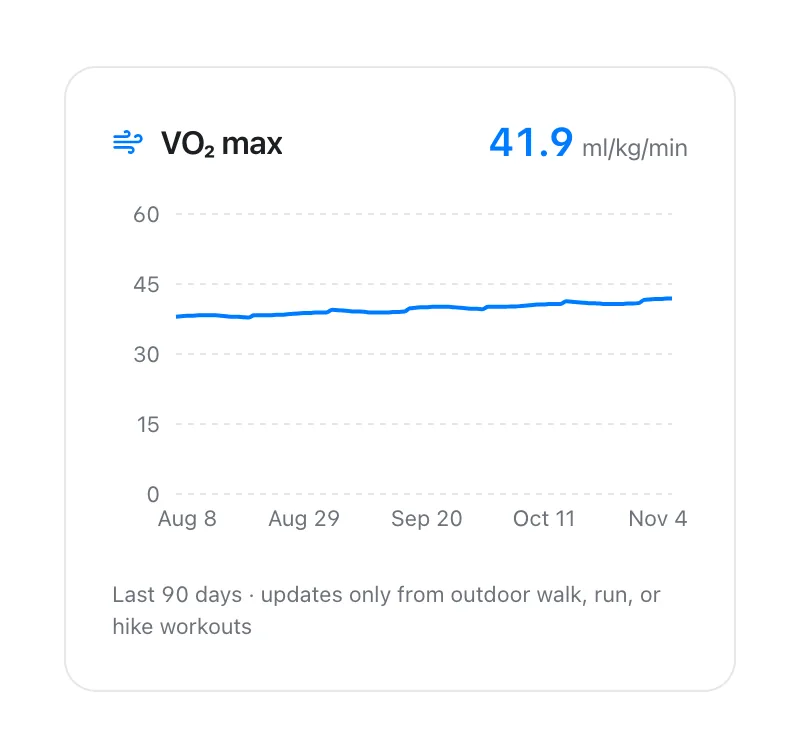
On Apple Watch you can follow the trend in Cardio Fitness, which estimates VO2 max from outdoor walks, runs and hikes. Expect it to move over weeks, not days.
Which burns more fat: HIIT or steady state?
Much less difference than the marketing suggests. A 2017 meta-analysis of 13 trials in adults with overweight or obesity (averaging 10 weeks at 3 sessions a week) found that HIIT and moderate continuous training reduced whole-body fat mass and waist size by similar amounts, with no significant difference between them. HIIT took about 40% less training time to get there.
A larger 2019 meta-analysis of 36 studies found the same for body fat percentage: interval training and moderate continuous training lowered it by almost the same amount (about 1.5 percentage points each). Interval training did show a 28.5% greater reduction in absolute fat mass in kilograms, with sprint interval training doing best. In practice that is a small difference on top of an already modest change.
Two practical details stand out. In the 2017 analysis, running produced clear fat loss with either method, while cycling did not. And neither type of cardio does much for fat loss without attention to food: these studies saw modest changes over a few months, often without much change in body weight.
So if fat loss is your goal, pick the mix you will actually keep doing. HIIT suits a tight schedule. Steady sessions suit people who want to train more days a week without accumulating fatigue. The total amount of exercise you sustain week after week, plus your diet, matters more than the format.
The recovery cost: how long each takes to bounce back from
This is where the two differ most. A 2013 review of how the heart's parasympathetic (rest-and-digest) activity recovers after aerobic exercise found that full recovery took up to 24 hours after low-intensity exercise, 24 to 48 hours after threshold-intensity exercise, and at least 48 hours after high-intensity exercise. Fitter people recovered faster, and session length mattered less than intensity.
In plain terms, a Zone 2 session is usually absorbed by the next morning, while a hard interval session can take two days or more. That's why stacking HIIT on consecutive days tends to backfire: each session starts before you've recovered from the last, and the quality of the hard efforts drops.
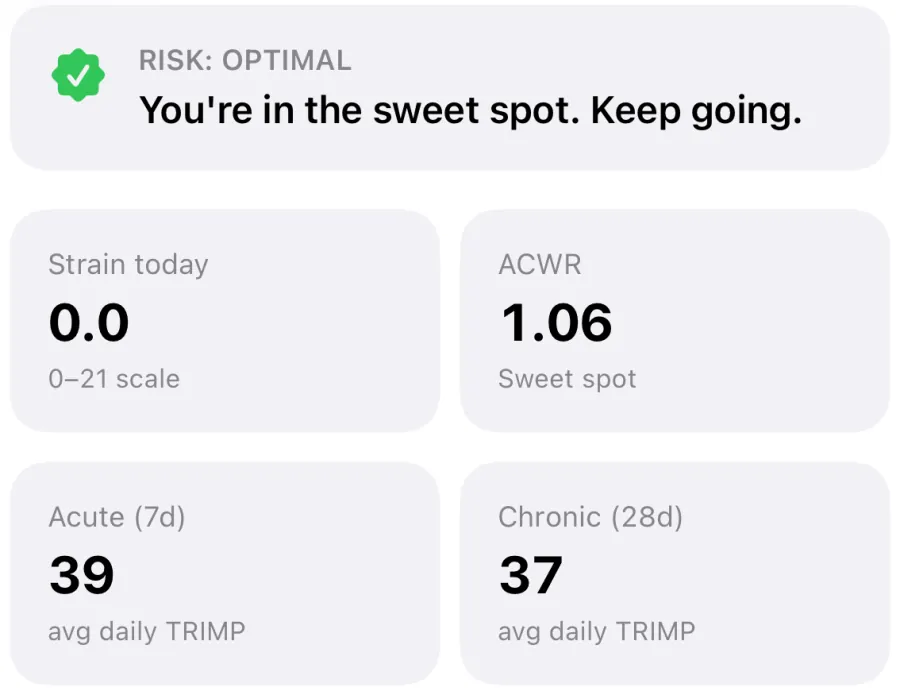
You can often see this in your own data. A dip in overnight HRV and a slightly higher resting heart rate the morning after a hard session are common and normal. They become a concern only when they stay off for several days in a row. Training load scores show the same thing from the other side: methods such as Banister's TRIMP weight minutes at high heart rate far more heavily than easy minutes, so 25 minutes of hard intervals can count for as much load as a much longer easy session.
How to combine HIIT and steady state cardio in a week
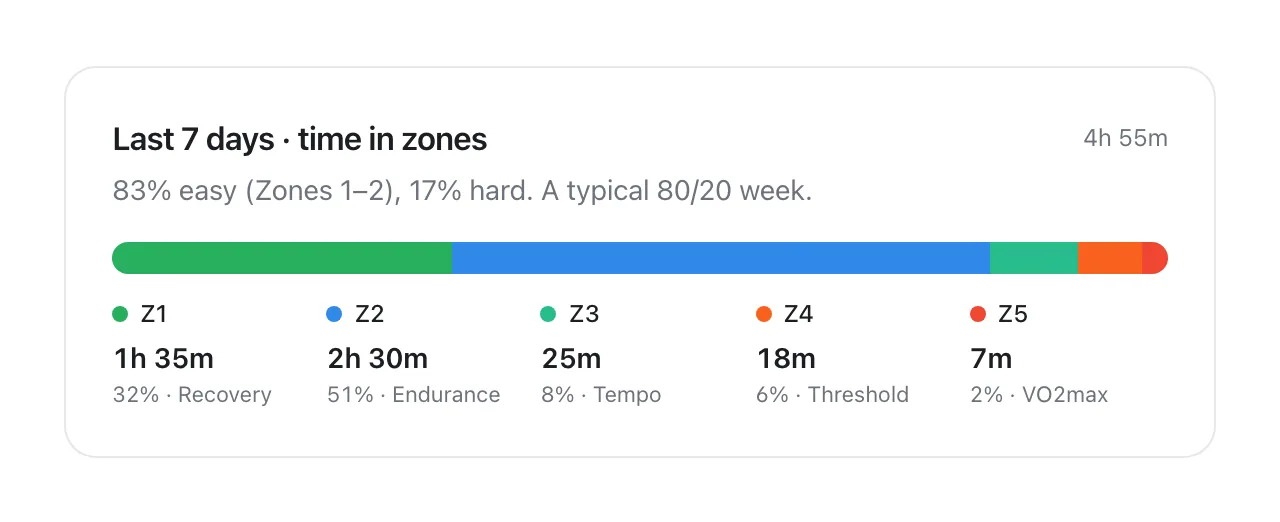
Studies of national and international level endurance athletes show a typical split of about 80% of sessions at low intensity and about 20% hard. You don't need their volume to use the same proportions. For most people that means one or two interval sessions a week, at least 48 hours apart, with steady sessions or rest between them.
For health, the WHO recommends 150 to 300 minutes of moderate activity a week, or 75 to 150 minutes of vigorous activity, or an equivalent mix, plus muscle-strengthening activity. Because the vigorous range is half the moderate one, each vigorous minute counts roughly double. A 30-minute interval session with 15 minutes of hard work does a lot of that job in a short time.
Some sample weeks, depending on how many days you train:
- 3 days a week: Monday intervals (e.g. 30/30s, about 30 minutes), Wednesday steady Zone 2 for 40-45 minutes, Saturday a longer Zone 2 session of 50-60 minutes.
- 4 days a week: Tuesday intervals, Thursday Zone 2 for 40 minutes, Saturday a longer Zone 2 session, Sunday an easy 30 minutes or a strength session.
- 5 days a week: Monday intervals, Tuesday easy Zone 2, Wednesday strength, Thursday a second interval or tempo session, Saturday long Zone 2. Keep the other two days easy or off.
- Beginners: start with 3 or 4 weeks of steady cardio only, then add one gentle interval session (such as walk-jog intervals) before progressing to harder efforts.
- Each week, check the totals rather than single workouts: most minutes in Zones 1-2, a small share in Zones 4-5, and not much in Zone 3.
Three interval sessions to try, by heart rate zone
Always warm up for 8 to 10 minutes of easy movement first and cool down for 5 minutes after. Because wrist heart rate lags behind sudden changes in effort, don't chase a number at the start of a hard effort; go by feel and let your heart rate catch up. For short efforts, a chest strap paired with your watch reads changes faster.
- Walk-jog intervals (beginner): 1 minute of easy jogging in Zone 2-3, then 2 minutes of brisk walking, repeated 6 times. A gentle first step toward intervals.
- 30/30s (intermediate): 30 seconds fast in Zone 4-5, then 30 seconds of easy jogging, 8 times. Jog easily for 2 minutes, then do a second block of 8.
- 4 x 4 minutes (experienced): 4 minutes hard at about 90-95% of maximum heart rate, then 3 minutes of easy jogging, 4 times. This is the format used in the 2007 study above. Aim for hard and steady, not a sprint, so the fourth effort matches the first.
- On a bike or rower the same structures work. Bike sprints of 30 to 40 seconds suit the higher end; rowing efforts of 1 to 4 minutes suit Zone 3-4.
Who should be careful with HIIT
HIIT is hard on purpose, and that has a cost beyond recovery. If you're new to exercise, returning after a long break, injured, pregnant, or living with a heart, lung or metabolic condition, start with steady cardio and speak with a doctor before doing near-maximal efforts. Steady Zone 2 work gives large health benefits on its own.
Stop and get medical help if you have chest pain or pressure, fainting or near-fainting, unusual breathlessness for the effort, or a racing or irregular heartbeat during or after exercise. Watch data and recovery scores are wellness tools, not a diagnosis.
Signs you are doing too much HIIT include hard sessions that feel harder at the same pace, poor sleep, lasting soreness, low motivation, and a resting heart rate that stays above your normal or HRV that stays below it for more than a few days. The fix is usually simple: fewer hard sessions and more easy ones for a week or two.
How VedaWatch helps you balance hard and easy days
VedaWatch is an iPhone and Apple Watch app that reads your workouts, heart rate, HRV and sleep from Apple Health. Each workout shows time in each heart rate zone, worked out with the heart rate reserve method from your resting heart rate, so you can check whether your easy days were really easy and your intervals were really hard. Its zones assume a maximum of 190 bpm unless a workout went higher, so if your real maximum is lower, read them as a guide and use the talk test.
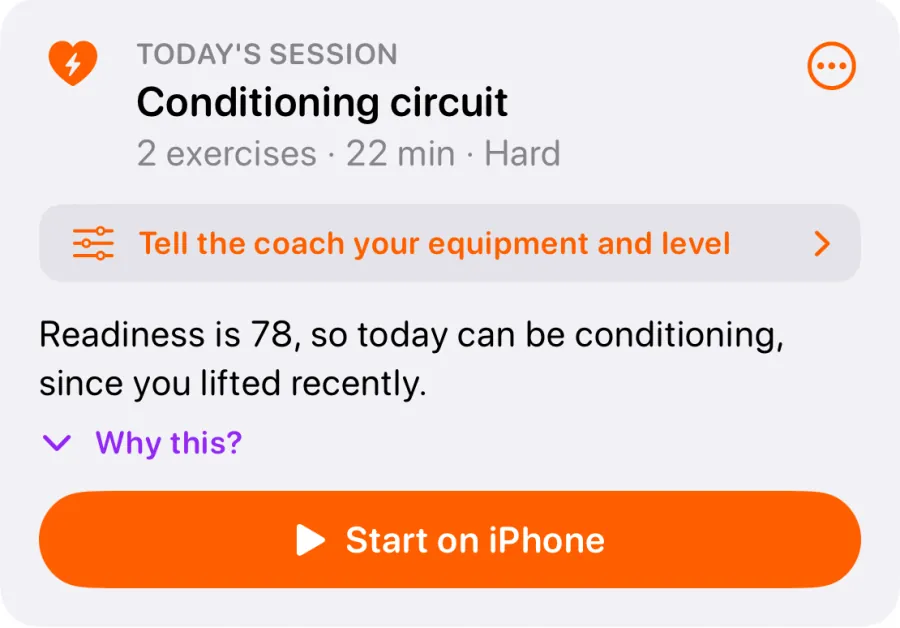
Its daily readiness score compares your HRV, resting heart rate and sleep with your recent baseline: 70 or more is a Push day, 50 to 69 Hold, and below 50 Rest. Today's session on the Train tab follows that call. On a Push day after recent lifting, it can suggest intervals if you've been running, or a conditioning circuit if not. If your training load (the 7-day vs 28-day ratio) is spiking, it swaps a hard day for easy Zone 2.
The Guided library has interval sessions with heart rate zone targets, including Heart-rate HIIT (45 seconds hard, 45 seconds easy), Walk-jog intervals, 30/30 run intervals, Bike sprints, a Rowing pyramid and 4x4 run intervals, alongside steady Zone 2 sessions. Played on Apple Watch, a session taps your wrist when you drift out of the target zone for a while. You can plan your usual week with a mix of interval, Zone 2 and strength days, or add your own activities such as a HIIT class.
Frequently asked questions
Can I do HIIT every day?
It isn't a good idea for most people. Recovery after high-intensity exercise often takes 48 hours or more, so daily HIIT means starting each session tired. Two, at most three, hard sessions a week with easy days between is a more sustainable ceiling.
Is walking steady state cardio?
Yes, if it's brisk enough to raise your breathing, it counts as moderate activity. For fitter people a flat walk may sit in Zone 1, so hills or a faster pace can bring it into Zone 2.
Should I do HIIT before or after weights?
If strength is your priority, lift first or do them on separate days, since hard intervals beforehand can leave your legs tired. A short easy cardio warm-up before lifting is fine.
Is HIIT better for people short on time?
Often, yes. The 2017 fat loss meta-analysis found similar results with about 40% less training time. Just keep the hard efforts genuinely hard and the number of sessions small.
Does HIIT count toward my Apple Watch Exercise ring?
Yes. Apple Watch counts minutes of activity at or above a brisk walk toward the Exercise ring, so the hard and moderate parts of an interval session count just as steady cardio does.
Related guides
- Zone 2 training with Apple Watch: find your heart rate range and stick to it
- Apple Watch heart rate zones explained: what each zone means and how to set them
- How to improve your VO2 max, and get Apple Watch to show it
- Apple Watch Training Load and ACWR, explained (and why sports scientists argue about it)
- 80/20 running: polarized training made simple for 3 to 5 runs
- HRV after a workout: the normal dip and how long recovery takes
Sources & further reading
- Milanovic Z, Sporis G, Weston M. Effectiveness of high-intensity interval training (HIT) and continuous endurance training for VO2max improvements: a systematic review and meta-analysis. Sports Medicine, 2015
- Helgerud J, et al. Aerobic high-intensity intervals improve VO2max more than moderate training. Medicine & Science in Sports & Exercise, 2007
- Stoggl T, Sperlich B. Polarized training has greater impact on key endurance variables than threshold, high intensity, or high volume training. Frontiers in Physiology, 2014
- Wewege M, et al. The effects of HIIT vs. moderate-intensity continuous training on body composition in overweight and obese adults: a systematic review and meta-analysis. Obesity Reviews, 2017
- Viana RB, et al. Is interval training the magic bullet for fat loss? A systematic review and meta-analysis. British Journal of Sports Medicine, 2019
- Stanley J, Peake JM, Buchheit M. Cardiac parasympathetic reactivation following exercise: implications for training prescription. Sports Medicine, 2013
- Seiler S. What is best practice for training intensity and duration distribution in endurance athletes? International Journal of Sports Physiology and Performance, 2010
- Bull FC, et al. World Health Organization 2020 guidelines on physical activity and sedentary behaviour. British Journal of Sports Medicine, 2020
This guide is educational, not medical advice, and has not been clinically reviewed. VedaWatch is not a medical device. If you have symptoms or concerns about your heart or health, contact a qualified healthcare professional.
Put your trends in perspective.
Explore HRV, sleep, and recovery with VedaWatch on your iPhone.
Download VedaWatch on the App Store →