 VedaWatch
Recovery & Apple Watch
Heart rate recovery: normal values, Apple Watch Cardio Recovery
What heart rate recovery after exercise means, normal values from research, how Apple Watch Cardio Recovery works, how to improve it and when to see a doctor.
By VedaWatch editorial team · · 9 min read
The short answer
Heart rate recovery is how many beats per minute your heart rate falls in the first minute or two after you stop exercising. Faster is better. In clinical studies, a one-minute drop of 12 bpm or less was linked to higher risk. Apple Watch reports it as Cardio Recovery, an estimate made in the three minutes after a workout.
What is heart rate recovery?
Heart rate recovery (HRR) is the drop in your heart rate after you stop exercising, usually measured as your peak heart rate minus your heart rate one minute later. If you finish a hard effort at 165 bpm and you're at 140 bpm a minute later, your one-minute heart rate recovery is 25 bpm.
It matters because of what drives it. During exercise, the calming branch of your nervous system (the vagus nerve) steps back so your heart can speed up. When you stop, that brake comes back on. The quicker it returns, the faster your heart rate falls. Researchers think that is why a slow recovery tracks with poorer heart health and lower fitness, and a quick one with better conditioning.
Heart rate recovery is different from resting heart rate and from heart rate variability (HRV). Resting heart rate is your pulse at rest, HRV is the variation between beats, and heart rate recovery is how fast you come down from effort. They often move together, but each tells you something slightly different.
How to calculate your heart rate recovery
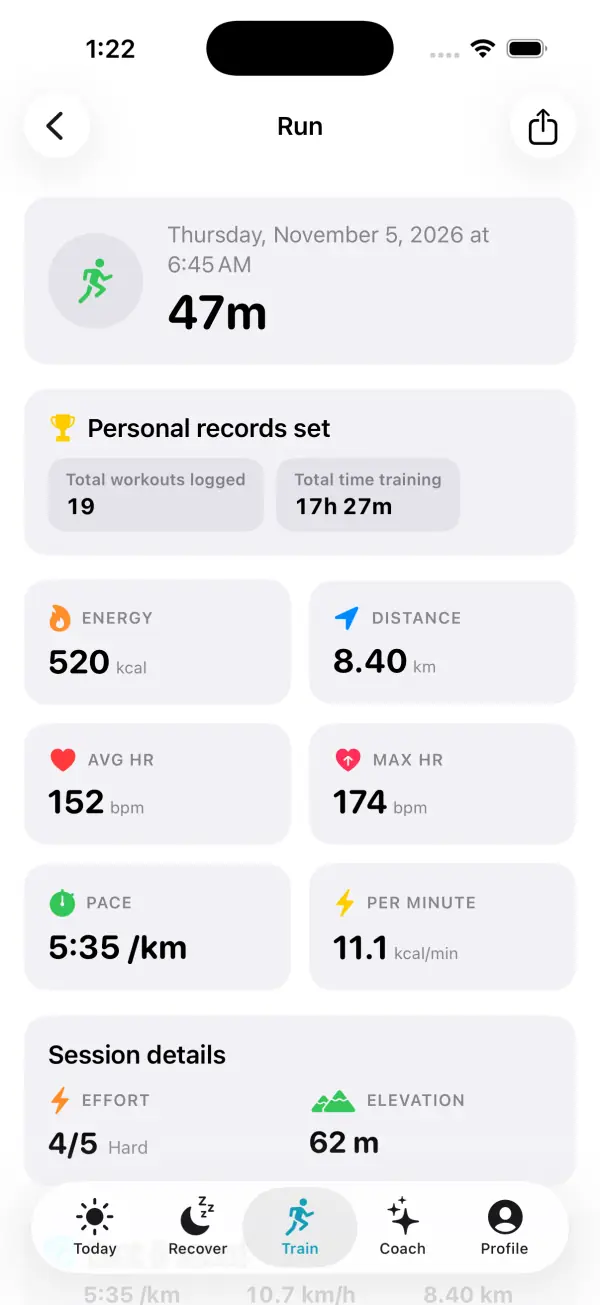
You can measure it yourself with any heart rate monitor, including an Apple Watch running a workout. The method below follows the steps Cleveland Clinic describes. The key is to take your peak at the end of the hardest part of the workout, not after a cool-down.
Worked example: you run your last hard interval and your Watch shows 172 bpm as you stop. You stand still for one minute and read 146 bpm. 172 minus 146 gives a one-minute heart rate recovery of 26 bpm. If you also read 118 bpm at two minutes, your two-minute recovery is 54 bpm.
- Warm up, then work hard enough to raise your heart rate well above easy pace, for example the last few minutes of a tempo run or a hard interval.
- Note your heart rate the moment you stop. That is your peak.
- Stop and stay in the same position for one minute. Standing still, sitting and slow walking all give different numbers, so pick one and keep it the same every time.
- Read your heart rate again at exactly one minute, and at two minutes if you want the second number too.
- Subtract: peak minus the one-minute reading is your one-minute heart rate recovery, in bpm.
- Repeat after similar workouts over a few weeks. Comparing like with like matters more than any single result.
What is a normal heart rate recovery?
There's no single normal number, because results depend on how hard you worked, how long you waited, and what you did while recovering. Cleveland Clinic gives a general guide: a one-minute recovery of 18 bpm or more is considered good. The thresholds researchers use to flag a slow recovery come from clinical treadmill tests:
Two things to keep in mind. First, these are associations in groups of patients, not a diagnosis for an individual: a single low number doesn't mean anything is wrong. Second, they were measured in a lab with an ECG and a set protocol, so a reading from your wrist after a casual workout isn't directly comparable. Use them as context, and compare yourself mostly with your own past readings.
- One minute, 12 bpm or less: flagged as abnormal in a 1999 study of 2,428 adults having exercise tests. 26% fell in this range, and after adjusting for age, medications and fitness they had about twice the risk of death over six years (adjusted relative risk 2.0).
- Two minutes, less than 22 bpm: in 2,193 men referred for chest pain testing, the two-minute value predicted death better than other time points, with a hazard ratio of 2.6.
- Two minutes after a submaximal test, 42 bpm or less: in 5,234 adults without heart disease followed for 12 years, this still predicted death after adjusting for fitness and other risk factors (adjusted relative risk 1.55).
- Every 10 bpm slower: a 2017 meta-analysis of prospective studies found each 10 bpm lower heart rate recovery went with a 13% higher risk of cardiovascular events and a 9% higher risk of death from any cause (hazard ratios 1.13 and 1.09).
- One minute, 18 bpm or more: Cleveland Clinic's general guide for a good result.
How Apple Watch Cardio Recovery works
Apple Watch calls this metric Cardio Recovery. According to Apple's technical paper on heart rate features, after you end a workout you started yourself, the Watch keeps measuring your heart rate for three minutes to estimate it.
The important detail: it's not simply your peak minus your heart rate a minute later. Apple describes Cardio Recovery as a prediction of your 60-second heart rate recovery after submaximal exercise at 85% of your predicted maximum heart rate, designed to be robust to how hard each workout was. Reported values are capped at 55 bpm. In plain terms, Apple tries to make an easy walk and a hard run comparable, which a raw peak-minus-one-minute number can't do. Apple notes that higher values can indicate better cardiovascular health.
That makes Cardio Recovery useful as a trend, but don't expect it to match a number you work out by hand from the same workout, and don't hold it directly against the clinical cutoffs above. To see your readings on iPhone, open the Health app and search for Cardio Recovery.
To get readings more often: start your workouts as workouts on the Watch, wear it snug so it can read your heart rate well, and keep it on your wrist for at least three minutes after you end the workout instead of taking it off straight away.
What affects heart rate recovery?
A 2012 systematic review of heart rate recovery in athletes found it was related to training status, but also named several things that make readings hard to compare: age, the temperature around you, and how hard and how long you exercised just before. Cleveland Clinic adds whether you have heart disease, whether you rest actively (slow walking or cycling) or passively (sitting or lying down), and how long you wait before you check.
From day to day, the usual suspects are the ones that affect any recovery signal: a hot or humid session, not drinking enough, a short night, accumulated fatigue from a heavy training block, or ending a workout at a very different intensity than usual. Medications that slow the heart can also change the numbers, so if you take one, ask your clinician what to expect.
This is why one low reading after a sweaty summer run means little. A pattern over several weeks of similar workouts, measured the same way, is what tells you something.
How to improve your heart rate recovery
The most consistent lever is regular aerobic training. In the 2012 review, most of the studies that followed people over time saw heart rate recovery rise as fitness improved. In people with established heart disease, a 2013 systematic review found aerobic training improved heart rate recovery more than usual care, with gaps of 9 and 5 bpm in the two highest-quality trials. Gains in healthy, untrained adults are less well measured, so treat any target as personal rather than guaranteed.
A practical approach that fits most people:
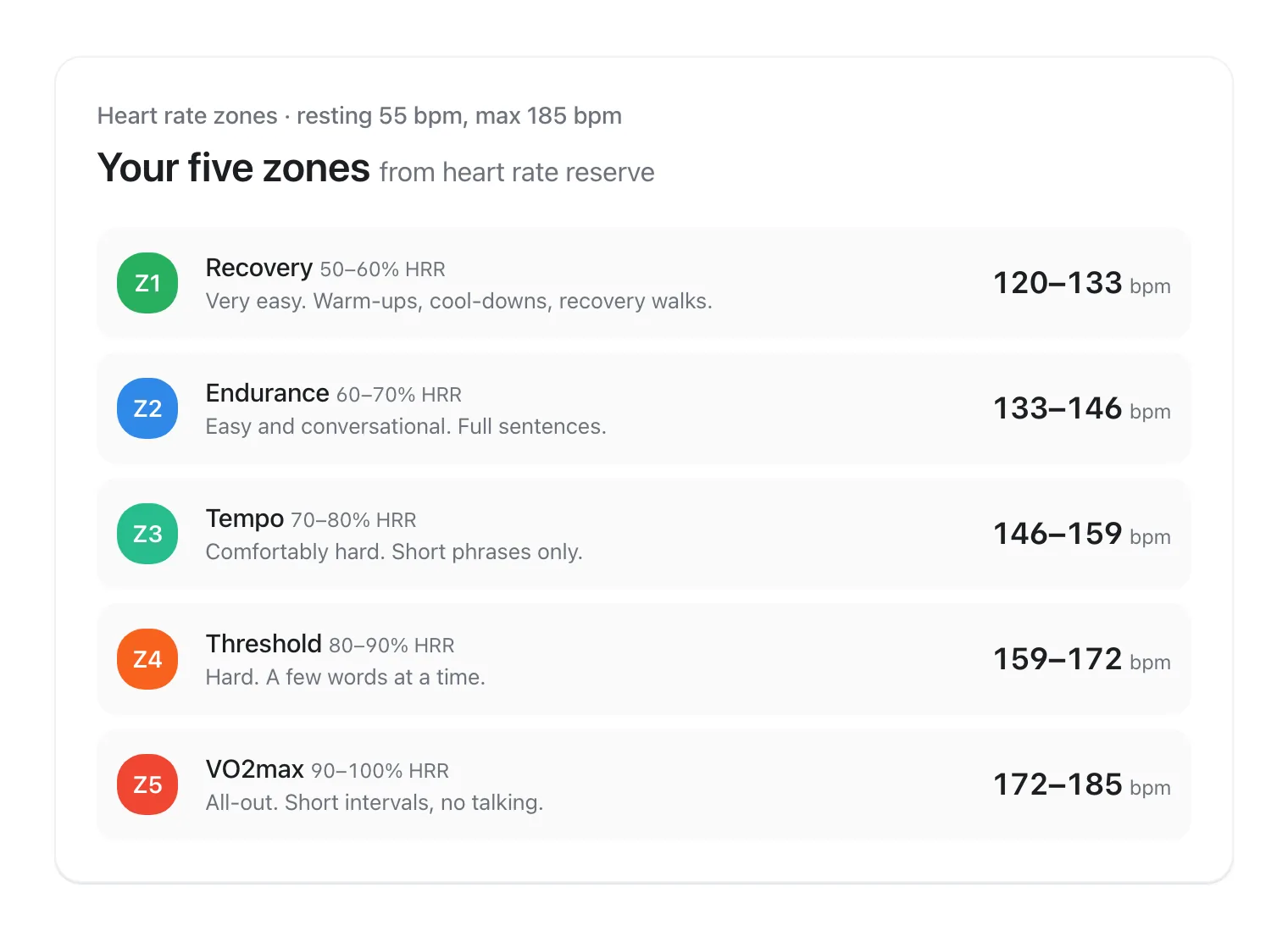
- Build an aerobic base: most of your weekly cardio at an easy, conversational effort (zone 2), done on most days rather than in one big session.
- Add one or two harder sessions a week, such as intervals or a tempo run, once easy training feels routine.
- Increase total training gradually, and take an easier week when you feel run-down.
- Protect sleep and drink enough, especially around hot or long sessions.
- If you have a heart condition, have had a heart attack or heart surgery, or are starting exercise after a long break, talk to your clinician first. Cardiac rehab is the supervised version of this plan.
- Re-check every few weeks with the same workout and the same cool-down routine, so changes reflect fitness rather than method.
Does low heart rate recovery mean you're overtrained?
Not on its own. Heart rate recovery can dip during a hard training block, but the research on using it to monitor training is still mixed, and the 2012 review concluded that better standardization is needed before it becomes a dependable monitoring tool. Day-to-day differences of a few beats are usually noise.
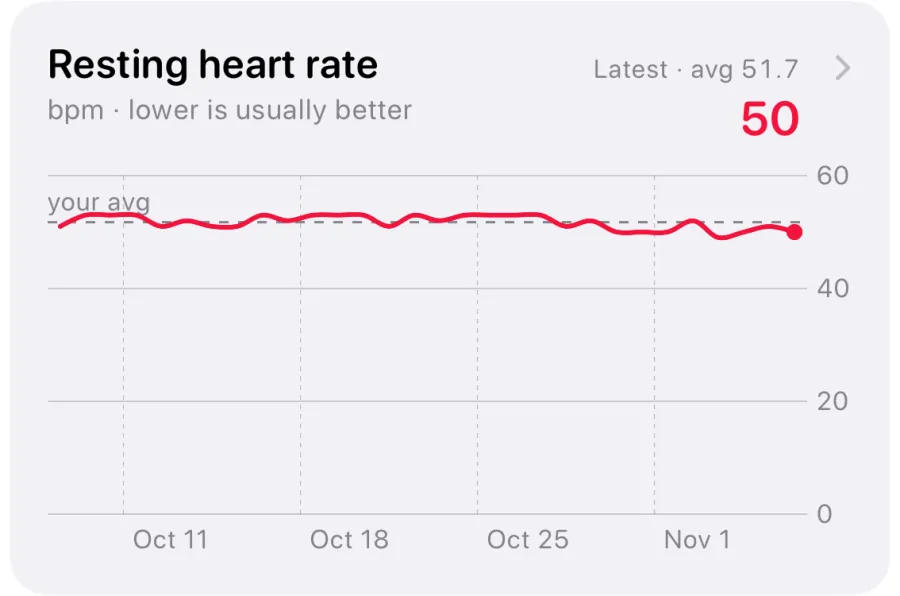
What's more telling is agreement between signals. If your Cardio Recovery has slid below your usual range for a couple of weeks, your resting heart rate is creeping up, your overnight HRV is down and workouts feel harder than they should, that's a reasonable cue to ease off for a few days and prioritize sleep. If recovery is lower but everything else looks normal, check the obvious first: heat, a different workout type, or a cool-down you skipped.
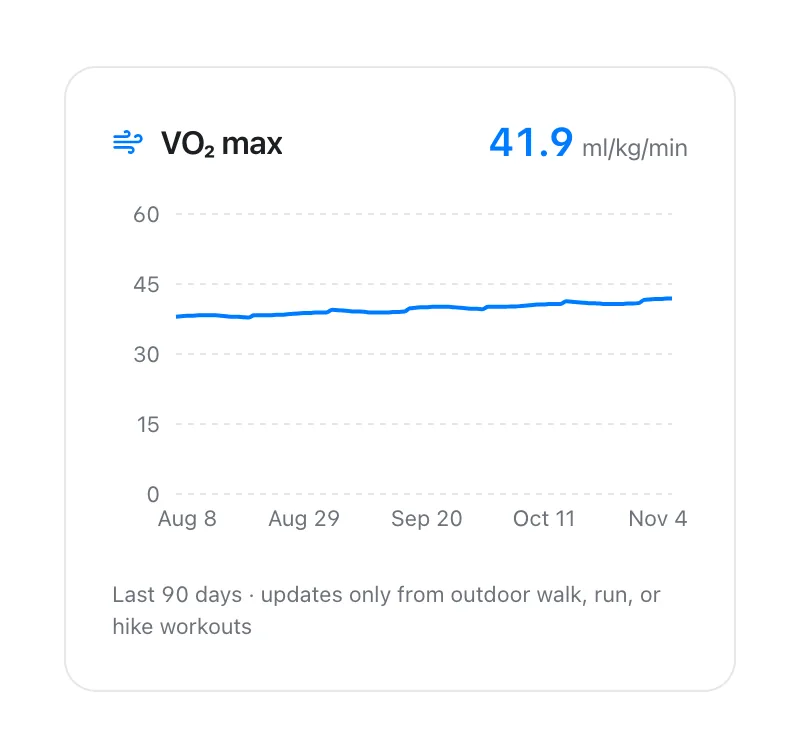
As fitness improves, expect the opposite pattern over months: a slowly rising Cardio Recovery alongside a steady or falling resting heart rate and, for outdoor walkers and runners, a rising VO2 max estimate.
When to see a doctor about heart rate recovery
A wearable reading isn't a diagnosis, and a slow recovery on its own isn't an emergency. But it's worth bringing up with a clinician if you notice any of the following. Cleveland Clinic suggests sharing your own numbers with your provider and asking which measurement method and range make sense for you.
Get help right away, rather than waiting for an appointment, if you have chest pain or pressure, fainting or near-fainting, or severe shortness of breath during or after exercise. If your clinician wants to look further, the usual test is a supervised exercise stress test, which is where the research cutoffs in this guide come from.
- Your heart rate stays high or keeps rising after you stop exercising.
- Your recovery is consistently at or below about 12 bpm at one minute when you measure it carefully after hard efforts.
- Your Cardio Recovery has fallen clearly below your usual range for weeks with no explanation such as illness, heat or a heavy training block.
- You feel palpitations, unusual breathlessness, dizziness or chest discomfort when you exercise.
- You have heart disease, diabetes or high blood pressure, which Cleveland Clinic notes are linked with a slower recovery, and want to know what's safe for you.
How VedaWatch shows your heart rate recovery
VedaWatch reads the Cardio Recovery values your Apple Watch saves to Apple Health. Once there are readings from the last two weeks, a Heart rate recovery card appears on the readiness breakdown (Recover, then Readiness breakdown), showing bpm dropped in one minute as daily bars.
Tap it for the detail screen. It compares your average over the last 14 days with your usual, the average of your earlier readings from the last 90 days, and shows your normal range around it. It only calls a change Better or Below your usual when the difference is bigger than both 3 bpm and half of your usual day-to-day spread. A simple scale places your latest reading as Slow (12 bpm or less, the classic clinical cutoff), Typical (12 to 25) or Fast (above 25), and you can browse history over 7, 30 or 90 days with your average, highest and lowest readings.
On Pro, if you turn on Health sync and AI processing, which both stay off until you choose them, your daily heart rate recovery is one of the signals the AI Coach can see when you ask how your training is going. Heart rate recovery isn't part of the VedaWatch readiness score; that draws on HRV, resting heart rate and sleep compared with your recent baseline. Treat it as a fitness trend to read alongside them, not a medical measurement.
Frequently asked questions
Is a heart rate recovery of 20 bpm good?
At one minute, 20 bpm is above the 12 bpm clinical cutoff and above Cleveland Clinic's 18 bpm guide, so it's generally a reassuring result. Whether it's good for you depends on how you measured it and how it compares with your own past readings.
Why does my Apple Watch not show Cardio Recovery after every workout?
The Watch needs a clean heart rate signal during the three minutes after you end a workout, so taking it off, wearing it loosely or moving it around can leave a gap. Not every workout produces a reading.
Is one-minute or two-minute heart rate recovery better?
Both are used in research, and a 2017 meta-analysis found similar links to mortality for each. One study of men referred for testing found the two-minute value predicted death best, but Apple Watch reports a one-minute estimate.
Does heart rate recovery get worse with age?
Age is one of the factors researchers name as affecting heart rate recovery, which is one reason a single cutoff doesn't fit everyone. Tracking your own trend makes age matter less, because you're always compared with yourself.
Can my Cardio Recovery be higher than 55 bpm?
Not as reported by Apple Watch. Apple caps Cardio Recovery at 55 bpm, so very fit people may see the same top value even if their measured drop by hand is larger.
Related guides
- Resting heart rate on Apple Watch: what's high, low, and why it changes
- Apple Watch VO2 max (Cardio Fitness): what it measures and how accurate it is
- Apple Watch heart rate zones explained: what each zone means and how to set them
- Zone 2 training with Apple Watch: find your heart rate range and stick to it
- Signs of overtraining: what your Apple Watch can and can't show
- How to improve your VO2 max, and get Apple Watch to show it
Sources & further reading
- Cole CR et al. Heart-rate recovery immediately after exercise as a predictor of mortality. N Engl J Med, 1999
- Cole CR et al. Heart rate recovery after submaximal exercise testing as a predictor of mortality in a cardiovascularly healthy cohort. Ann Intern Med, 2000
- Shetler K et al. Heart rate recovery: validation and methodologic issues. J Am Coll Cardiol, 2001
- Qiu S et al. Heart rate recovery and risk of cardiovascular events and all-cause mortality: a meta-analysis of prospective cohort studies. J Am Heart Assoc, 2017
- Daanen HAM et al. A systematic review on heart-rate recovery to monitor changes in training status in athletes. Int J Sports Physiol Perform, 2012
- Snoek JA et al. Effect of aerobic training on heart rate recovery in patients with established heart disease; a systematic review. PLoS One, 2013
- Apple: Using Apple Watch to measure heart rate, calorimetry, and activity (November 2024)
- Cleveland Clinic: Heart rate recovery, what it is and how to calculate it
This guide is educational, not medical advice, and has not been clinically reviewed. VedaWatch is not a medical device. If you have symptoms or concerns about your heart or health, contact a qualified healthcare professional.
Put your trends in perspective.
Explore HRV, sleep, and recovery with VedaWatch on your iPhone.
Download VedaWatch on the App Store →