 VedaWatch
Comparisons
Best running training plan apps for Apple Watch (2026)
The best running training plan apps for Apple Watch, compared as of November 2026: how plans adapt, whether they use recovery, what runs on the wrist, and cost.
By VedaWatch editorial team · · 10 min read
The short answer
As of November 2026, Runna is the most complete paid pick for structured 5K to marathon plans with pace coaching on the Watch. Nike Run Club is the best free plan. ASICS Runkeeper is a cheaper paid middle ground. For sessions that change with your HRV, sleep and training load, pick an app that reads recovery, such as VedaWatch.
What is the best running training plan app for Apple Watch?
There isn't one best app for everyone, because running plan apps differ on four things that matter more than the logo: how the plan adapts, whether it knows how recovered you are, what actually shows up on your wrist during the run, and how you pay. This comparison looks at apps that build a plan for a 5K, 10K or half marathon and work with Apple Watch, using each company's own help pages and App Store listings as of November 2026.
Here is the quick version, one line per app. Prices are US prices where the company publishes them; check your own App Store for local pricing.
- Runna: plans for every distance from first 5K upward, Apple Watch app with structured workouts and live pace coaching, pace targets that adjust when you accept a suggestion. Does not use sleep or recovery data. $19.99 a month or $119.99 a year, with a 7-day free trial.
- Nike Run Club: free plans of 4 weeks (getting started), 8 weeks (5K and 10K), 14 weeks (half marathon) and 18 weeks (marathon), with plan runs startable on Apple Watch. Plans follow a set schedule.
- ASICS Runkeeper: Train for a Race plans for 5K, 5 miles, 10K, 10 miles, half marathon and marathon, built from your goal time and race date, available on Apple Watch. Race plans need the Runkeeper Go subscription.
- TrainingPeaks: plans written by coaches, with structured workouts sent into Apple's own Workout app on the Watch. Good if you follow a coach or a bought plan; not an automatic plan builder.
- Apple's Workout app: no multi-week plan, but free custom workouts with warmup, intervals and cooldown that you build yourself.
- VedaWatch: plans for a first 5K, faster 5K, 10K and half marathon that change each morning with your readiness (HRV, resting heart rate and sleep) and training load. Today's session is a one-tap start on the Watch. Part of Pro, $6.99 a month or $59.99 a year.
What to look for in a running plan app
Adaptivity. Almost every app now says its plan adapts, but the word covers very different things. Some apps let you move sessions and change your race date. Some adjust pace targets after you hit or miss them. A few change today's session based on how your body looks this morning. Ask what the app actually changes, and what triggers the change.
Recovery awareness. Your Apple Watch records overnight HRV, resting heart rate and sleep, and these can hint that you're carrying fatigue or coming down with something. Most plan apps don't read them. That's fine if you're good at judging your own tiredness; it matters more if you tend to push through bad days.
Workouts on the wrist. There are three levels: the Watch just records a run while the plan lives on your phone; the Watch shows a duration or distance target for today; or the Watch guides you step by step through warmup, intervals and recoveries with pace or heart rate cues. Interval sessions are much easier at the third level.
Price model. Free plans, monthly subscriptions, yearly subscriptions and one-off plan purchases all exist. A 12-week half marathon block is a fixed length of time, so do the maths for your block rather than assuming yearly is cheaper.
Runna: the most complete paid running coach
Runna is the app most people mean when they ask for a running plan app, and it's now published by Strava. Its pricing page lists plans for any distance, plans built by coaches, and support for Apple Watch, Garmin, COROS and others. As of November 2026, Runna Premium costs $19.99 a month or $119.99 a year in the US, which works out to $9.99 a month on the yearly plan, with a 7-day free trial.
On Apple Watch, Runna's help centre says your upcoming workouts appear on the watch and guide you through every step with live pace coaching, vibration prompts and audio cues. The Watch app can start and record a run on its own, and runs sync back to Runna afterwards. One detail worth knowing: Runna's personalised pace coaching isn't available if you start the run in Apple's own Workout app instead of Runna's.
Runna's main adaptive feature is Pace Insights. It compares how you run your speed sessions (intervals, tempo runs, time trials and some long runs) with their targets, and if it sees a consistent pattern it suggests faster or slower paces. Nothing changes until you accept, and accepting changes your pace targets, not the structure of the plan. Runna's own article says the feature can't yet account for things like weather, terrain, poor sleep or fuelling.
Best for: runners who want a polished, structured plan with strong on-wrist guidance and are happy to judge recovery themselves.
Nike Run Club: the best free running plan
Nike Run Club (NRC) is free to download, and its training plans are the strongest free option from a major brand. Nike's help page lists Get Started (4 weeks, for new or returning runners), Go Beyond (4 weeks), 5K (8 weeks), 10K (8 weeks, with optional strength workouts), Half Marathon (14 weeks) and Marathon (18 weeks). Each week mixes speed, long and recovery runs.
You start a plan in the NRC iPhone app, and after that you can start individual plan runs on your Apple Watch. NRC is also known for audio-guided runs with Nike coaches. Nike doesn't describe its plans as adapting to your performance or recovery, so treat them as a well-built fixed schedule that you adjust yourself.
Best for: beginners and budget-minded runners who want a proven schedule and don't need the plan to react to them.
ASICS Runkeeper: a middle ground with race-date plans
ASICS Runkeeper's Train for a Race plans cover 5K, 5 miles, 10K, 10 miles, half marathon and marathon. You give it a goal time, distance and race date, and the plan is built around them. Runs you complete in Runkeeper count toward the plan, and Runkeeper's help centre says this type of plan is also available on Apple Watch. Race plans are part of the Runkeeper Go subscription.
Runkeeper doesn't describe its race plans as reading sleep, HRV or other recovery data. It's a good fit if you want a plan anchored to a race date without paying top-tier prices; check the App Store for the current Runkeeper Go price in your country.
Best for: runners who want a dated race plan and Watch support at a lower price than the premium coaching apps.
TrainingPeaks and Apple's Workout app: the do-it-yourself route
With watchOS 10, TrainingPeaks announced that it would turn planned workouts into custom workouts that import directly into Apple's own Workout app on the Watch. You follow the steps in the Workout app, and the completed workout can go back to TrainingPeaks with your permission. That's useful if a human coach writes your plan or you've bought a plan from a coach on TrainingPeaks. The plan itself is whatever the coach wrote; it doesn't change on its own.
If you'd rather not use any plan app, Apple's Workout app lets you build custom workouts yourself: an optional warmup, as many work and recovery intervals as you need, and an optional cooldown, each set by time, distance or open. You can set a pace for outdoor workouts and add heart rate alerts, and during the run the Up Next view shows what's left in this interval and what comes next. What it won't do is plan the weeks for you, so you'd pair it with a plan from a book, a coach or a free schedule.
Best for: runners with a coach, and runners who like full control and a written plan.
Do adaptive or recovery-based plans actually work better?
The research is encouraging but not conclusive. A 2020 systematic review in the Scandinavian Journal of Medicine and Science in Sports (Düking and colleagues) looked at running studies that compared fixed, predefined training with training adjusted day by day based on HRV. It found five studies, with six interventions and 166 participants.
Both approaches improved fitness, including peak oxygen uptake. HRV-guided training usually meant less moderate and hard training, and in five of the six interventions performance improved more with HRV guidance. The authors still describe the evidence as limited and inconsistent. In plain terms: adjusting hard days to how your body looks seems to give similar or slightly better results with less hard running, but it isn't magic.
That has a practical meaning for choosing an app. A fixed plan that you follow sensibly, taking an easy day when you feel rough, can work very well. A recovery-aware plan mostly helps people who find that hard to do, and people whose sleep and stress vary a lot from week to week. Neither replaces common sense: if you have pain, feel unwell, or notice symptoms like chest pain, dizziness or unusual breathlessness while running, stop and see a doctor. A plan app is general training guidance, not medical advice.
Which running plan app should you choose? Worked examples
Work out the cost for your block. A 12-week half marathon block is about three months. At US prices as of November 2026, three months of Runna on the monthly plan is 3 x $19.99 = $59.97, while the yearly plan is $119.99 up front, which only pays off if you keep training with Runna for more than about six months. Three months of VedaWatch Pro is 3 x $6.99 = $20.97. Nike Run Club's plans cost nothing.
Then match the app to the runner. These examples are illustrations, not rules.
- First 5K, tight budget: start with Nike Run Club's Get Started plan, then its 8-week 5K plan. Use the Watch to start each run and take an extra rest day whenever your legs or breathing tell you to.
- Half marathon with a time goal, loves structured intervals: Runna is strong here, because the Watch walks you through every rep with pace coaching. Accept or reject Pace Insights suggestions honestly, and watch your sleep yourself, since the plan won't.
- 10K while working shifts or with a new baby: a recovery-aware plan suits you, because sleep will vary week to week. VedaWatch swaps hard days for easy ones on poor mornings and moves the hard session later in the week.
- Already coached: stay with your coach's TrainingPeaks plan and let the workouts flow into Apple's Workout app.
- Marathon or ultra: choose Runna, Nike Run Club or Runkeeper, which all offer marathon plans. VedaWatch's race plans currently stop at the half marathon.
How VedaWatch builds a plan around your recovery
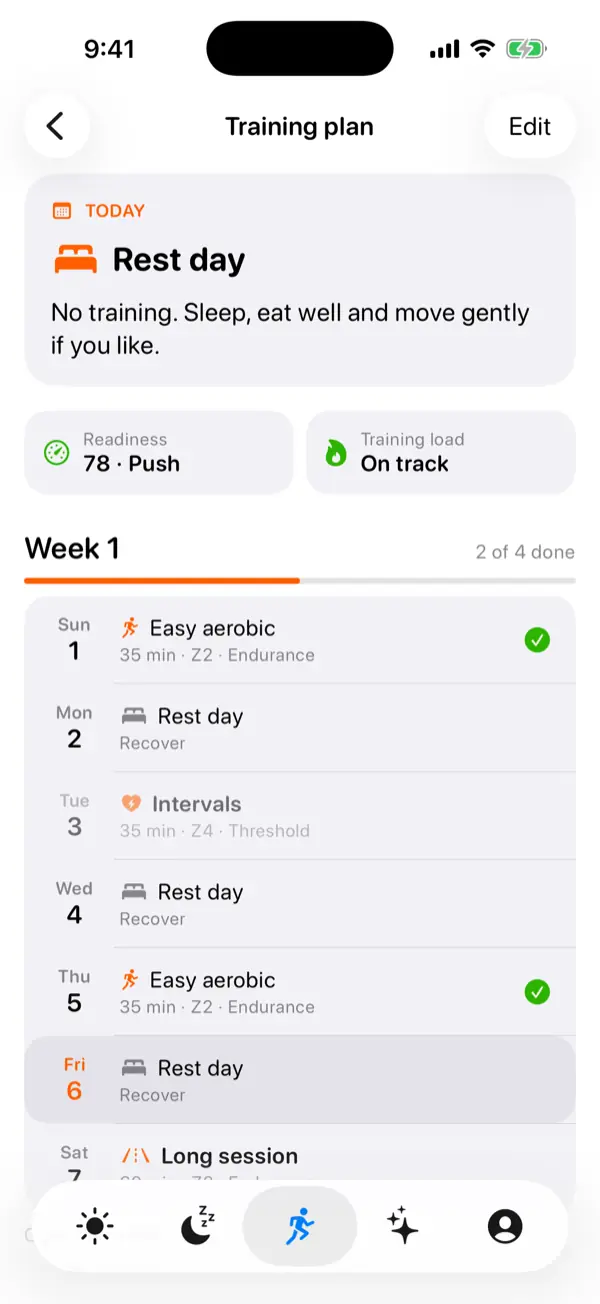
VedaWatch takes a different angle from the apps above: it starts from your Apple Health data. Its Training plan offers Run my first 5K, Run a faster 5K, Run a 10K and Finish a half marathon, plus two ongoing goals, Build Zone 2 base and Get stronger. You pick a race day and 3 to 6 days a week, and it recommends 8 weeks for a 5K, 10 for a 10K and 12 for a half, split into base, build, peak, taper and race week.
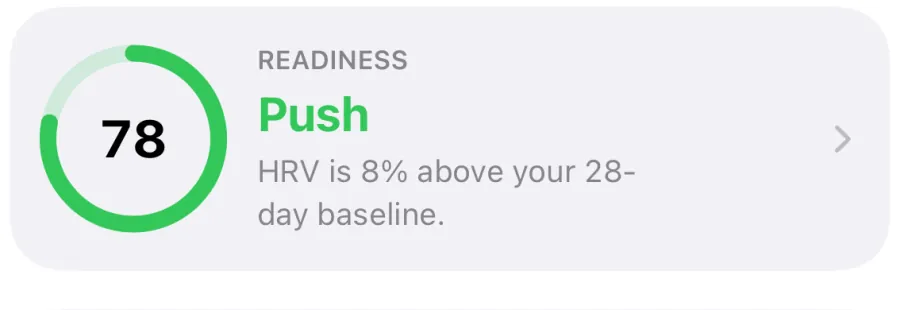
Each morning the plan checks your readiness verdict, built from your HRV, resting heart rate and sleep against your recent baseline, along with your training load. On a Rest day any session becomes very easy recovery. On a Hold day intervals or a tempo become an easy run and a long run is cut by a quarter. If your load is spiking well above your usual, key sessions become easy. A swapped hard session isn't lost: it moves to a later easy or rest day that week, and you can still choose the original session if you'd rather.
On Apple Watch, today's session appears at the top of the VedaWatch workout picker as a one-tap start, and the Watch taps your wrist when you reach the session's duration target. From today's card on iPhone you can also open a guided version with every step, and start it on the Watch or iPhone. Paces come from your target time or recent runs, or heart rate zones until you've logged a few runs.
Being honest about the limits: VedaWatch has no marathon or ultra plans, doesn't send workouts into Apple's Workout app, and its quick start on the Watch is a duration target rather than rep-by-rep pace coaching like Runna's. The core app is free; the Training plan is part of Pro, which is $6.99 a month or $59.99 a year on the US App Store as of November 2026.
Frequently asked questions
What is a good free alternative to Runna?
Nike Run Club is the strongest free option, with plans from a 4-week starter plan up to an 18-week marathon plan and runs you can start on Apple Watch. Its plans follow a set schedule rather than adjusting pace targets for you.
Does Runna use my Apple Watch sleep or HRV data?
Runna's Pace Insights adjust pace targets based on how you run your speed sessions, and Runna's own help article says the feature can't yet account for poor sleep. If you want recovery data to shape your sessions, you'd need to judge it yourself or use a recovery-aware app alongside.
Can I use two running apps at once?
Yes, but follow only one plan. Two plans stacked on top of each other usually means too much hard running. Using a plan app plus a separate app that only reads recovery is fine.
Do I need an Apple Watch Ultra for a running plan app?
No. The apps here work with regular Apple Watch models; each one lists its minimum watchOS version on the App Store.
How long before a race should I start a plan?
Many plans run about 8 weeks for a 5K, 8 to 10 weeks for a 10K and 12 to 14 weeks for a half marathon, depending on the app. If you're starting from no running at all, add a few weeks of easy running or a beginner plan first.
Related guides
- Training for a 5K, 10K or half marathon with Apple Watch: a plan that adapts to your recovery
- Train by readiness: how VedaWatch picks today's workout from your Apple Watch data
- Couch to 5K on Apple Watch: the 9-week plan, week by week
- Apple Watch Training Load and ACWR, explained (and why sports scientists argue about it)
- Easy run pace: how slow should easy runs be?
- Half marathon taper: the final 7 days, day by day
Sources & further reading
- Runna: Pricing (plans, prices and free trial)
- Runna Help Centre: What are Pace Insights and how do they work?
- Runna Help Centre: Using Runna with Apple Watch
- Nike Help: Does the NRC App have training plans?
- ASICS Runkeeper Help Center: Runkeeper Training Plans
- Apple Support: Create a Custom Workout on Apple Watch
- Peaksware: TrainingPeaks to adopt new Custom Workout APIs for Apple Watch Workout app
- Düking et al. 2020, Scandinavian Journal of Medicine & Science in Sports: Predefined vs data-guided training prescription based on autonomic nervous system variation: a systematic review
This guide is educational, not medical advice, and has not been clinically reviewed. VedaWatch is not a medical device. If you have symptoms or concerns about your heart or health, contact a qualified healthcare professional.
Put your trends in perspective.
Explore HRV, sleep, and recovery with VedaWatch on your iPhone.
Download VedaWatch on the App Store →