 VedaWatch
Comparisons
Fitbit Daily Readiness vs Apple Watch: how to get a readiness score
Fitbit Daily Readiness vs Apple Watch: what Fitbit's score uses, if it needs Premium, what Apple Watch has built in, and how to get a similar score on any model.
By VedaWatch editorial team · · 10 min read
The short answer
Fitbit's Daily Readiness is a once-a-morning 0-100 score built from HRV, resting heart rate and recent sleep, and the basic score no longer needs Premium. Apple's own 0-10 Readiness score only runs on Apple Watch Series 12 and Ultra 4. On older Apple Watches, a third-party app can build a comparable score from Apple Health data.
Fitbit Daily Readiness vs Apple Watch: the quick comparison
Both ecosystems now try to answer the same morning question: how recovered does my body look compared with my own normal? They answer it differently, and which one you can use depends on the watch on your wrist.
Here is how they line up as of November 2026, based on Google's and Apple's own help pages. Read each line as Fitbit first, then Apple Watch.
- Name and app: Fitbit's Daily Readiness Score now lives in the Google Health app, which replaced the Fitbit app in May 2026. Apple's Readiness score lives in the Readiness app on Apple Watch.
- Scale: Fitbit uses 0-100, with Low (29 or below), Moderate (30-64) and High (65 or above). Apple uses 0-10 with four labels: Recover (0-1), Pace Yourself (2-4), Ready (5-7) and Go For It (8-10).
- Inputs: Fitbit uses heart rate variability (HRV), resting heart rate and your sleep over the past week. Apple uses activity (active calories, workout effort and Training Load), daytime and overnight vitals including HRV, and your sleep score and recent sleep history.
- Timing: Fitbit calculates the score once a day, shortly after you get up from at least 3 hours of sleep. Apple's score can change during the day as your activity and vitals change.
- Getting started: Fitbit needs 7 nights of wear before your first score and recommends a month for a more accurate baseline. Apple also asks for at least 7 nights of sleep with the watch, plus Sleep, Activity and overnight vitals set up.
- Hardware: Fitbit's score works on a wide range of Fitbit trackers and every Pixel Watch generation. Apple's works only on Apple Watch Series 12 and Apple Watch Ultra 4.
- Cost: neither score itself needs a subscription. Google Health Premium adds coaching that adjusts your training around the score.
How does Fitbit Daily Readiness work?
Google describes the current score as a reflection of how your body is responding to recent strain, not a tally of what you did yesterday. It compares three signals with your personal baseline: overnight HRV, resting heart rate, and your recent sleep, reviewed over the past week. Higher HRV and lower resting heart rate than your usual generally push the score up; a run of short nights pulls it down.
That is a change from the original design. When Fitbit announced Daily Readiness in August 2021, the three inputs were activity, HRV measured during deep sleep, and recent sleep. Since then, resting heart rate has replaced the activity component. If you read an older review that says a big workout directly lowers your Fitbit score, it describes the earlier version.
The score is calculated once per day, about 20 seconds after you get out of bed following a sleep of at least 3 hours. Google says you must wear your device for 7 nights to get a first score, and to wear it consistently for a month to build a more accurate baseline. Next to the number you get a breakdown, a personalized daily activity goal and suggested workouts or recovery sessions.
Google's guidance on what to do with it is sensible and modest: if HRV drops, consider easing the intensity; a resting heart rate that stays raised for a few days can mean your body is working to recover or fight off illness, so lighter training makes sense; and a Low score is a cue to prioritize rest and active recovery.
Does Apple Watch have a readiness score like Fitbit?
Yes, but only on the newest models. Apple announced Readiness in September 2026 alongside watchOS 27, and its support page names Apple Watch Series 12 and Apple Watch Ultra 4 as the models with the Readiness app. Apple calls it a general wellness feature that should not be used as a substitute for professional medical judgment.
Apple's design differs from Fitbit's in one important way: activity is an input. Active calories, workout effort ratings and Training Load all feed the score, along with vitals and sleep. So on Apple Watch, a hard afternoon workout can lower your score the same day, while Fitbit waits to see how your HRV and resting heart rate respond overnight.
If you have a Series 11, Ultra 3, any SE, or an older watch, there is no built-in readiness number. Your watch still records the raw ingredients in Apple Health: overnight HRV, resting heart rate, sleep and sleep stages, and on supported models wrist temperature. What's missing is the step that compares them with your baseline and turns them into one daily answer. That gap is what third-party apps fill. Our guide to the Apple Readiness score covers Apple's version in more depth.
Why the two scores won't match, even on the same morning
People who switch from a Fitbit to an Apple Watch often want to translate one number into the other. It doesn't work, for three reasons.
Different scales and cut-offs. A Fitbit 65 is the bottom of High; an Apple 6 is mid-Ready. Multiplying Apple's score by ten does not give you a Fitbit score, because the bands are drawn in different places and the formulas weigh different things.
Different HRV numbers. HRV can be calculated several ways, with SDNN and RMSSD the two most common time-based measures, and both the method and the length of the recording change the value. A review of HRV metrics in Frontiers in Public Health stresses that values measured over different lengths of recording shouldn't be compared directly. So an HRV of 45 ms on one device and 45 ms on another aren't necessarily the same physiology. Only compare a device with itself.
Different timing. Fitbit gives you one morning verdict. Apple's can move during the day as you train and as daytime vitals shift. Neither approach is wrong; they just answer slightly different questions: how did I recover overnight, versus how ready am I right now.
The useful part both share is the personal baseline. Whatever the scale, the score is really saying: compared with your own normal, today looks better, similar or worse.
How to get a Fitbit-style readiness score on any Apple Watch
If your watch doesn't have Apple's Readiness app, you can still get a daily, baseline-based score. The quality of any score depends mostly on the data going in, so set that up first.
- Wear the watch to bed. Overnight HRV, resting heart rate and sleep are the core inputs of almost every readiness score. A snug but comfortable fit helps the sensor.
- Turn on sleep tracking. In the Health app on iPhone, set up Sleep with a schedule so the watch records sleep and sleep stages each night.
- Charge before bed, not overnight. A short top-up while you shower or get ready keeps the battery from cutting off a night of data.
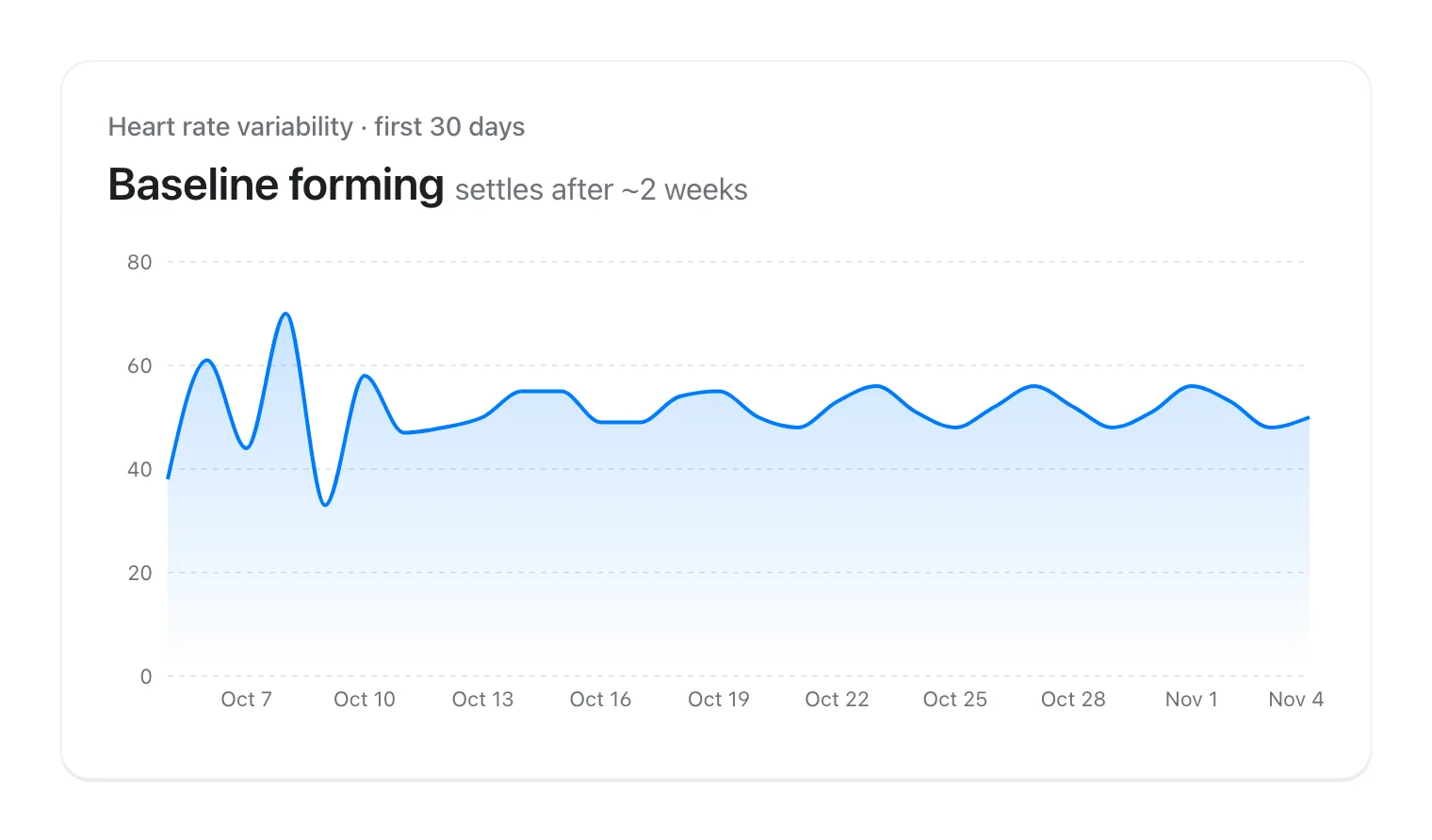
- Give it time. Like Fitbit's 7 nights, any baseline needs history. Expect the first week to be noisy, and remember Google suggests a month of consistent wear for a more accurate baseline.
- Pick an app that reads Apple Health and shows its reasons. A good readiness app tells you which signal moved, not just a number, so you can sanity-check it against how you feel.
- Or do a quick manual check. Open Health, compare this morning's HRV and resting heart rate with your average for the past two weeks, and look at last night's sleep. For example: HRV 46 ms against a usual 52 ms is about 12% lower; resting heart rate 4 bpm above usual; 6 hours of sleep instead of your normal 7.5. Three signals pointing the same way is a reasonable cue for an easier day.
Can you use Google Health's readiness score with an Apple Watch?
Not in a way Google documents, as of November 2026. The Google Health app on iPhone can now read Apple Health data, including heart rate, HRV, resting heart rate, sleep sessions and stages. Google says synced data may be used to power Google Health features, but its readiness help page lists Fitbit and Pixel Watch devices as the compatible hardware, and coaching is limited to people with a Fitbit or Pixel Watch.
Google has signalled that wider device support may come later; if it does, Google's support pages are the place to check. For now, an Apple Watch owner who wants a Fitbit-like morning score is better served by Apple's Readiness on a Series 12 or Ultra 4, or by an app built around Apple Health.
How VedaWatch gives any Apple Watch a readiness score
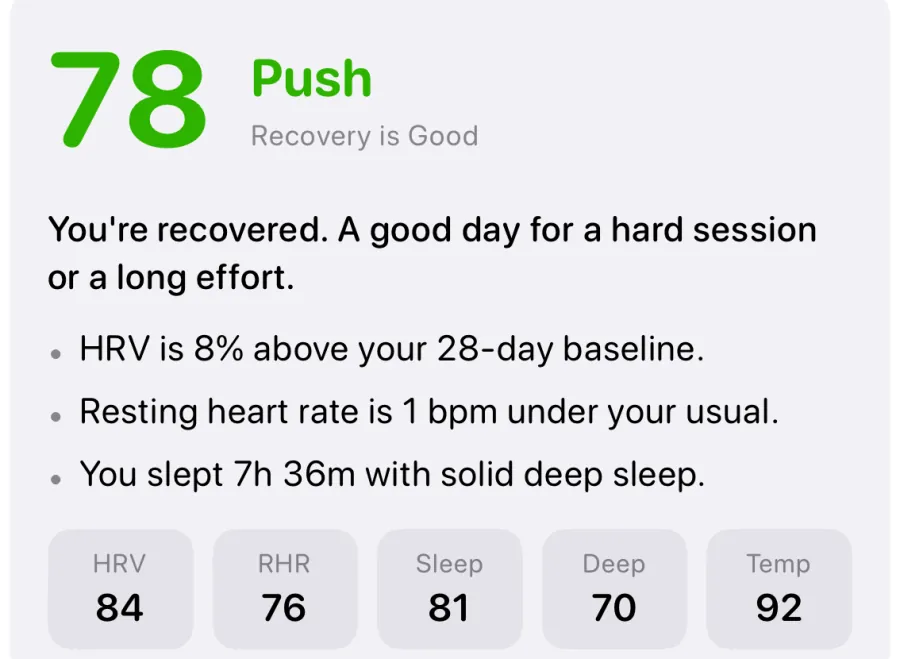
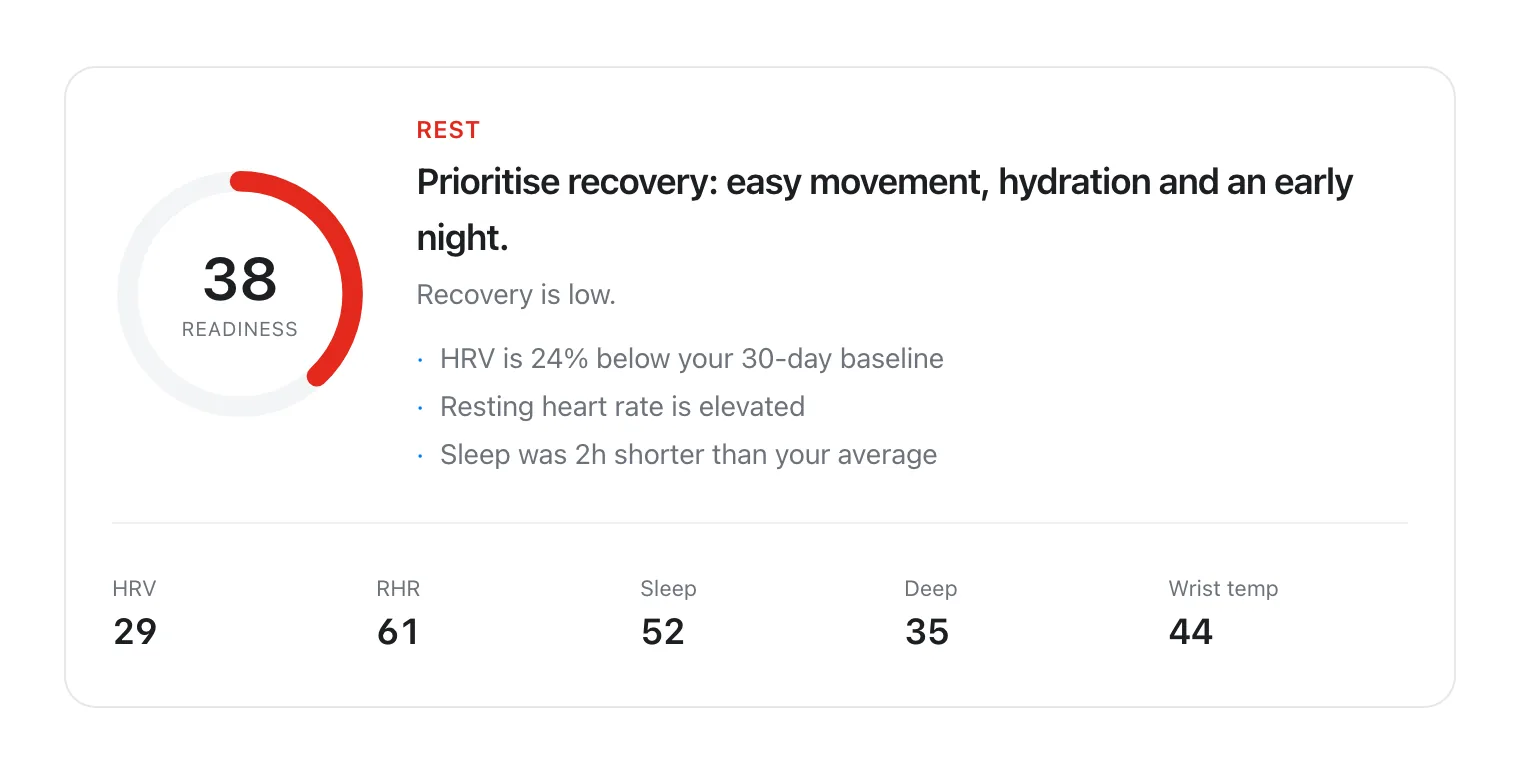
VedaWatch is one way to close the gap on older watches. It reads the HRV, resting heart rate and sleep your Apple Watch already writes to Apple Health and turns them into a 0-100 readiness score with a verdict: Push at 70 and above, Hold from 50 to 69, and Rest below 50. It works with Apple Watch Series 4 and later, so it doesn't need Series 12 hardware.
The method is close in spirit to Fitbit's current design: no activity input, just how your body looks this morning against your recent baseline. HRV is compared with your recent baseline and counts for 30% of the score; resting heart rate against its baseline counts for 25%; last night's sleep duration 25%; and deep sleep 10%. Missing inputs are left out and the rest re-weighted. A resting heart rate more than 3 bpm above baseline caps the day at Hold even when the number is high, because that pattern often comes before illness.
A worked example: HRV 8% below baseline gives an HRV sub-score of 30, resting heart rate 2 bpm up gives 50, 7.5 hours of sleep gives 83, and an hour of deep sleep gives 70. Weighted together, that's a score of 55, a Hold day: fine for steady training, not the day to chase a personal best.
On the free plan the score is calculated on your iPhone and your health data stays there. With Pro and cloud health sync switched on, the score also includes wrist temperature (10%), a large deviation from your baseline caps the day at Hold too, and the score feeds the AI Coach. Every score lists the reasons behind it, and you can see it on a Watch complication and iPhone widgets.
How to use any readiness score sensibly
Readiness scores are summaries of a few noisy signals, so treat them as a prompt, not an order. Research on HRV monitoring in endurance athletes supports watching trends in your own data over time rather than reacting to any single morning. One low score after a late dinner or a bad night is normal; several low days in a row, with HRV down and resting heart rate up together, is the pattern worth acting on.
Check the score against how you actually feel. A Push day when you're sore and flat is still a good day to go easy, and a Rest day when you feel great can mean a quieter session rather than none at all. Apple, for its part, says Readiness should not be solely relied on to decide whether it is safe to exercise.
None of these scores can diagnose anything. If a raised resting heart rate or low HRV comes with symptoms such as chest pain, unusual shortness of breath, dizziness, fever or a racing heartbeat at rest, or if a change lasts more than a few days without an obvious reason, talk to a doctor rather than waiting for the score to recover.
Frequently asked questions
Is Fitbit Daily Readiness more accurate than Apple Watch?
There's no head-to-head validation study of the two scores, and they measure different things on different scales. Both rely on how consistently you wear the device to bed, so consistency matters more than brand.
Can I see my Fitbit readiness score in Apple Health?
Google Health can now write many data types to Apple Health, but the readiness score itself isn't a standard Apple Health data type. You'd see underlying data such as heart rate and sleep, not the score.
Why did my Fitbit readiness score stop counting my workouts?
Google changed the formula so resting heart rate replaced the old activity component. The score now reflects how your body responds to training, showing up through HRV and resting heart rate, rather than the workout itself.
Will Apple bring Readiness to older Apple Watch models?
As of November 2026, Apple lists only Series 12 and Ultra 4. Apple hasn't announced support for older models, so a third-party app is the way to get a readiness score on them.
How many nights before a readiness score is useful?
Fitbit and Apple both give a first score after about 7 nights, and Google suggests a month for a more accurate baseline. Treat the first one to two weeks as calibration whichever app you use.
Related guides
- Apple Watch Readiness score: what Recover, Pace Yourself, Ready, and Go For It mean
- Apple Watch Readiness score missing or not updating: what to check
- Apple Watch vs Whoop: do you need a separate recovery band?
- How long it takes to establish your HRV baseline
- Should you train or rest when HRV is low?
- Best recovery app for Apple Watch: an honest 2026 roundup
Sources & further reading
- Google Health Help: Understanding your readiness score in the Google Health app
- Google Health Help: What is new with the redesigned Google Health app
- Google Health Help: How do I use Apple Health with the Google Health app?
- Google Blog (2021): Rebuild stronger with Fitbit Premium and Daily Readiness
- Apple Support: Understand your readiness score on Apple Watch
- Apple Newsroom: Apple advances health and fitness capabilities using Apple Intelligence (September 2026)
- Shaffer F, Ginsberg JP. An Overview of Heart Rate Variability Metrics and Norms. Front Public Health. 2017
- Plews DJ et al. Training Adaptation and Heart Rate Variability in Elite Endurance Athletes: Opening the Door to Effective Monitoring. Sports Med. 2013
This guide is educational, not medical advice, and has not been clinically reviewed. VedaWatch is not a medical device. If you have symptoms or concerns about your heart or health, contact a qualified healthcare professional.
Put your trends in perspective.
Explore HRV, sleep, and recovery with VedaWatch on your iPhone.
Download VedaWatch on the App Store →