 VedaWatch
Recovery & Apple Watch
Apple Watch low heart rate notification: what it means
What an Apple Watch low heart rate notification means, how to change the threshold, why 40 bpm asleep can be normal, and the symptoms that mean see a doctor.
By VedaWatch editorial team · · 8 min read
The short answer
An Apple Watch low heart rate notification means your heart rate stayed below the threshold you chose (40 bpm by default) while you seemed inactive for about 10 minutes. In fit people and during sleep, that is often normal. A low heart rate with dizziness, fainting, breathlessness or chest pain needs medical care straight away.
What does a low heart rate notification on Apple Watch mean?
It means your Apple Watch saw your heart rate stay below a number you picked, at a time when you seemed to be still. Apple's user guide says the Watch can notify you if your heart rate remains below a chosen threshold after you've been inactive for at least 10 minutes. It isn't a single low reading, and it isn't a diagnosis.
Doctors call a resting heart rate under 60 beats per minute (bpm) bradycardia. That word sounds alarming, but a slow heart is often a healthy one. The NIH's heart institute notes that some people, especially those who are young or physically fit, may normally have slower heart rates, and Cleveland Clinic says it's normal for heart rate to drop a bit during sleep.
So the useful question isn't just how low the number was. It's whether the low rate is normal for you, and whether you had any symptoms with it. This guide covers that low side. For alerts about a fast heart rate at rest, see the guide to the Apple Watch high heart rate notification.
How the low heart rate alert works
Apple's technical paper on heart rate explains the process. In the background, the Watch measures your heart rate while you're still. If your rate drops below the low threshold while you appear to have been inactive for 10 minutes, and several other conditions are met, it runs a second, beat-to-beat measurement for up to one minute. You only get a notification if the two methods agree. That double check is there to cut down on false alarms.
Apple says the default threshold is 40 bpm for low heart rate notifications (and 120 bpm for high). The Watch's optical sensor and algorithms support heart rate measurement from 30 to 210 bpm.
A few rules decide whether you get alerts at all. Heart rate notifications need an Apple Watch Series 1 or later and are for ages 13 and up. Apple notes that with Low Power Mode on you won't receive high or low heart rate notifications, or irregular rhythm notifications.
Each alert is also saved to Apple Health: Apple's HealthKit documentation says a low heart rate event record is created whenever Apple Watch produces a low heart rate notification. That's what lets you, and apps you allow, look back at them later.
How to turn on or change the low heart rate threshold
You can turn on heart rate notifications the first time you open the Heart Rate app on your Watch, or at any time later. You pick from a short list of preset values rather than typing any number, and the exact list can vary by watchOS version, so choose from what your Watch shows.
- On Apple Watch: open the Settings app, tap Heart, tap Low Heart Rate Notifications, then choose a threshold.
- On iPhone: open the Apple Watch app, tap the My Watch tab, tap Heart, tap Low Heart Rate, then choose a threshold.
- To stop the alerts, choose Off in the same place. If they keep firing and you're not sure why, mention them to your doctor rather than only switching them off.
- Make sure Low Power Mode is off on the Watch when you want alerts, because it stops them.
- To look back at past alerts, open the Health app on iPhone and find the low heart rate notifications entry under Heart. Each one shows when it happened.
Is a heart rate of 40 while sleeping normal?
For many healthy people, yes. Heart rate falls during sleep, and it often reaches its lowest point of the day overnight. Note that Apple deliberately leaves sleep out of your resting heart rate: its paper says readings recorded during Sleep Focus, scheduled Bedtime or sleep are excluded, so resting heart rate estimates your lowest rate while awake. Your sleeping heart rate can sit well below the resting figure in the Health app.
Large studies with 24-hour ECG monitors show how low normal can go. In a 2024 Swedish study of 3,942 healthy people aged 50 to 65, the lowest one-minute heart rate over 24 hours averaged 48 bpm in men and 51 bpm in women, with a typical spread of about 7 bpm either way.
Put together: if you're fit, your daytime resting heart rate is in the 40s or 50s, you feel well, and the alerts come mostly during sleep, a dip to around 40 bpm is often just your normal. If you're not especially fit, if this is new, or if it comes with symptoms, it's worth checking with a doctor.
Bradycardia in athletes: when slow is a sign of fitness
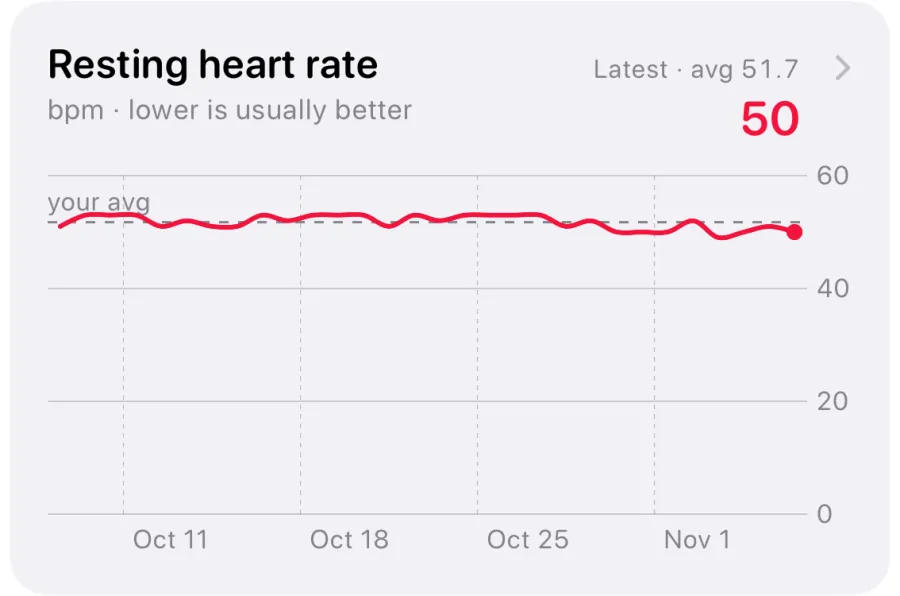
Regular intensive training, of around 4 to 8 hours a week, strengthens the calming, vagal influence on the heart, so it beats more slowly at rest. Cleveland Clinic notes that athletes naturally have a lower heart rate that's not a cause for concern.
Sports cardiologists set the line very low. A review summarising the international recommendations for interpreting athletes' ECGs describes sinus bradycardia as slow as 30 bpm as a recognised finding in trained athletes that doesn't need further investigation, and lists only rates under 30 bpm, or pauses of 3 seconds or more, as profound bradycardia. The review notes these changes are proportional to the level of conditioning and most marked in endurance athletes.
That's why the low heart rate alert can be noisy for runners, cyclists, rowers and swimmers. If your awake resting heart rate is already in the 40s, a 40 bpm threshold may go off most nights. A doctor who knows you can tell you whether a lower setting or turning it off makes sense.
Fitness doesn't make you immune, though. The same review says these slow, vagally driven findings need no further tests unless they come with symptoms. A fit person who faints, feels faint during exercise, or notices a sudden drop in performance with breathlessness should get checked, whatever their usual heart rate.
Symptoms that mean a low heart rate needs a doctor
A slow heart rate becomes a problem when the heart isn't pumping enough blood for your body's needs. Cleveland Clinic lists the symptoms as dizziness or lightheadedness, fainting, confusion, shortness of breath, chest pain, fatigue and palpitations, and notes that many people with bradycardia have no symptoms at all.
Call emergency services if a low heart rate comes with chest pain, palpitations, trouble breathing or dizziness, or if someone faints. Cleveland Clinic also advises calling if your heart rate falls below 40 bpm and this isn't usual for you.
Book an appointment with your doctor if alerts are new, keep happening while you're awake and not especially fit, or come with tiredness that you can't explain. Things a doctor will usually consider include medicines that slow the heart, such as beta-blockers and calcium channel blockers, an underactive thyroid, and age-related changes to the heart's electrical system, which Cleveland Clinic notes are more common after 70.
And the reverse: Apple says that if you're not feeling well, you should talk to your doctor even if you don't get a notification.
Can a low heart rate notification be wrong?
It can. Apple's two-step check makes false alerts less likely, but the optical sensor still depends on light reaching blood vessels in your wrist and coming back. Apple's accuracy guidance says skin perfusion varies a lot between people, that in the cold it might be too low for the sensor to get a reading, and that the ink, pattern and saturation of some tattoos can block light from the sensor.
Fit matters too. Apple recommends a fit that's not too tight and not too loose, on the top of your wrist. A Watch that's loose in bed, or pressed awkwardly against the wrist while you sleep on that arm, records poorer readings.
A sensor glitch is more likely if you felt completely fine, the alert came once, and a manual reading in the Heart Rate app a few minutes later, with the band snug, shows your usual number. A real slow rhythm is more likely if alerts keep coming at similar times, or if you notice symptoms.
If you have a Watch with the ECG app, recording an ECG while you feel symptoms gives a doctor something more concrete than a notification. It can show your heart rate and rhythm at that moment, but it can't detect a heart attack.
What to do when you get a low heart rate notification
If you have any of the symptoms in the section above, skip these steps and get help. Otherwise, work through them calmly.
- Notice how you feel. Dizzy, faint, confused, breathless, or chest discomfort? If so, call emergency services.
- Check the time and context. Were you asleep, lying still after a hard training block, or sitting at your desk?
- Check the fit, then take a manual reading in the Heart Rate app. A normal number with the band snug points toward a misread.
- Think about recent changes: a new medicine or dose, illness, or a big jump in training.
- Look at your history in the Health app. Alerts only during sleep in a fit person tell a different story from new alerts during the day.
- If alerts are new, frequent while you're awake, or you're unsure, book an appointment and bring the dates, times and how you felt.
How VedaWatch helps you keep track of low heart rate alerts
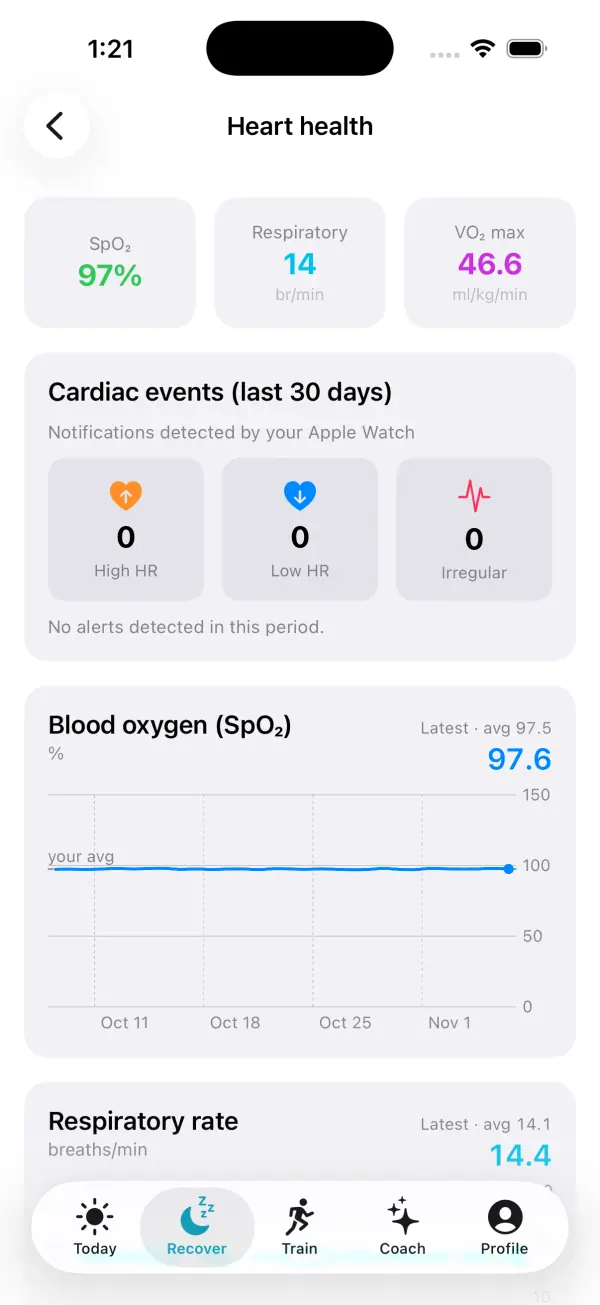
VedaWatch doesn't send its own low heart rate notifications; those come from your Apple Watch. In the iPhone app, Recover → Heart health shows a Cardiac events (last 30 days) card that counts the high heart rate, low heart rate and irregular rhythm notifications your Watch saved to Apple Health. If there are any, it suggests sharing recurring notifications with your clinician.
From the same screen, ECG & AFib History lists each rhythm notification from the last 90 days with its date, time and the threshold the Watch used, such as below 40 bpm. The Doctor report builds a PDF covering 2, 4 or 12 weeks that includes these notifications alongside your resting heart rate, HRV, ECG recordings and blood pressure, so you can bring a clear history to an appointment.
None of this is a diagnosis. It's a way to see whether alerts are a one-off or a pattern, and to share that with your doctor.
Frequently asked questions
What is the default low heart rate threshold on Apple Watch?
Apple says the default is 40 bpm. You can change it, or turn the alerts off, in Settings → Heart on the Watch or in the Apple Watch app on iPhone under My Watch → Heart → Low Heart Rate.
Is a heart rate of 40 while sleeping normal?
For many healthy, fit people, yes. Heart rate falls during sleep, and in a large study of healthy 50 to 65 year olds the lowest one-minute heart rate averaged about 48 to 51 bpm, with plenty of people lower. It's worth checking with a doctor if it's new or comes with symptoms.
Can I set the low heart rate alert below 40 bpm?
You choose from preset values in the Heart settings, and 40 bpm is the default. If even the lowest option fires every night because you're very fit, ask your doctor whether turning it off is reasonable for you.
Why do I get low heart rate notifications at night?
The alert checks while you're inactive, and sleep is when your heart rate is usually lowest. Fit people often dip below 40 to 50 bpm overnight without any problem.
Is bradycardia in athletes dangerous?
Usually not. Sports cardiology recommendations treat sinus bradycardia down to 30 bpm in trained athletes as a normal adaptation. Fainting, dizziness or breathlessness still need checking, however fit you are.
Does a low heart rate notification mean something is wrong with my heart?
Not necessarily. It means your rate stayed below your threshold while you were still. What matters is whether that's normal for you and whether you had symptoms like dizziness, fainting or breathlessness.
Related guides
- Apple Watch high heart rate notification: causes and what to do
- Resting heart rate on Apple Watch: what's high, low, and why it changes
- Apple Watch heart rate wrong? 9 fixes for accurate readings
- How to take an ECG on Apple Watch and what the results mean
- Apple Watch AFib History explained: what it does and doesn't do
- How to lower your resting heart rate: what works and how long it takes
Sources & further reading
- Apple Support: Heart health notifications on your Apple Watch
- Apple Watch User Guide: Monitor your heart health on Apple Watch
- Apple: Using Apple Watch to measure heart rate, calorimetry, and activity (November 2024)
- Apple Support: Get the most accurate measurements using your Apple Watch
- Apple Developer: HKCategoryTypeIdentifier.lowHeartRateEvent
- Cleveland Clinic: Bradycardia
- NHLBI: Types of arrhythmias
- Persson AP, et al. Reference ranges for ambulatory heart rate measurements in a middle-aged population. Heart, 2024;110(12):831-837
- Parry-Williams G, Sharma S. Current ECG interpretation guidelines in the screening of athletes. Cardiovascular Medicine, 2018;21(1):7-11
This guide is educational, not medical advice, and has not been clinically reviewed. VedaWatch is not a medical device. If you have symptoms or concerns about your heart or health, contact a qualified healthcare professional.
Put your trends in perspective.
Explore HRV, sleep, and recovery with VedaWatch on your iPhone.
Download VedaWatch on the App Store →