 VedaWatch
Comparisons
Apple Fitness+ alternative: when classes aren't enough
Looking for an Apple Fitness+ alternative? What Fitness+ does well, what it doesn't do yet (recovery-based training, lift tracking) and which apps fill each gap.
By VedaWatch editorial team · · 10 min read
The short answer
The best Apple Fitness+ alternative depends on what you're missing. If you love video classes, Fitness+ is hard to beat and Nike Training Club or Peloton are the closest swaps. If you want sessions that adapt to your sleep and HRV, or a log of your lifts over time, add an app built for that instead.
What is the best Apple Fitness+ alternative?
There isn't one best replacement, because people leave or supplement Fitness+ for different reasons. Some want a free or cross-platform class library. Some want their workouts to change on days they slept badly. Some lift weights and want to see their numbers go up week after week. Each of those is a different kind of app.
A quick way to decide: if what you like is following a trainer on screen, stay with a video class app (Fitness+, Nike Training Club or Peloton). If what you want is a plan that reacts to how recovered you are, you need an app that reads recovery data from Apple Health. If you want strength progression, you need an app that logs exercises, reps and weights, not just a workout's duration and heart rate.
Many people end up using two apps: one for classes and one for planning and tracking. That works well on iPhone, because workouts from most apps land in Apple Health, where other apps can read them.
What Apple Fitness+ does well
As of November 2026, Apple's Fitness+ page lists 12 workout types: Cycling, HIIT, Kickboxing, Yoga, Rowing, Pilates, Strength, Treadmill Run, Dance, Core, Mindful Cooldown and Meditation, with workouts from 5 to 45 minutes. Most need no equipment; some use dumbbells, a band, or a bike, treadmill or rower of any brand.
The production quality is the main draw. Classes are filmed with a team of trainers, and you can watch on iPhone, iPad or Apple TV, or AirPlay to a compatible TV. With an Apple Watch, your heart rate, calories and Activity ring progress appear on screen during the class, and the Burn Bar compares your effort with others who did the same workout. The Watch also gets audio-guided walks, runs and meditations.
Fitness+ has planning tools too. Custom Plans can build a premade plan (Get Started, Stay Consistent or Push Further) from your Fitness+ history and preferences, or you can build your own by picking workout days, time per day, plan length and up to five activities. Stacks queue several workouts back to back.
In the US, Apple lists Fitness+ at $9.99 a month or $79.99 a year, it's included in Apple One bundles, and it can be shared with up to five family members. If you enjoy instructor-led classes and already own Apple devices, it is genuinely good value.
What Fitness+ doesn't do (as of November 2026)
Fitness+ plans don't adapt to recovery. Apple's support guide describes Custom Plans as built from your Fitness+ history and preferences, such as favourite activities, durations, trainers and days. It doesn't mention sleep, heart rate variability (HRV) or resting heart rate. A plan that schedules a 45-minute HIIT class on Thursday schedules it whether you slept eight hours or four. Apple Watch does have its own Training Load view, but Fitness+ plans aren't described as using it.
Strength progression has been the bigger gap. A regular Fitness+ strength class tells you to grab light, medium or heavy dumbbells, but the class itself doesn't record which exercises you did, how many reps, or what weight, so there's no history of your lifts to compare against next month.
That is starting to change. On November 3, 2026, Apple added a beta called Gym Strength in iOS and iPadOS 27.3, reported by 9to5Mac. It builds four-week progressive plans from your goals, experience, schedule and equipment, lets you log reps and weight (on the Watch too), and adjusts the next week based on what you logged. Each exercise has a short demo video. It's a beta, Apple hasn't announced a public release date, and coverage doesn't say whether it uses sleep or HRV, so check the current version before deciding.
Does a workout plan that adapts to recovery actually help?
The idea behind recovery-based training is simple: do the hard sessions on days your body looks ready for them, and go easier when it doesn't. HRV and resting heart rate measured overnight are common signals for that, because both tend to move when you're short on sleep, stressed, or getting ill.
The evidence is promising but modest. A 2021 meta-analysis of 8 studies (198 participants) compared HRV-guided endurance training with fixed, predefined plans. HRV-guided training had a medium-sized benefit on submaximal fitness measures, but only a small, non-significant effect on performance and VO2peak. It was linked to fewer non-responders, people who didn't improve, and most HRV-guided programs actually included fewer moderate and hard sessions.
In practice that suggests recovery-based planning is less about getting fitter faster and more about avoiding bad weeks: fewer hard sessions on days you're run down, and less chance a training block goes nowhere. It doesn't replace common sense. If you feel ill, dizzy or have chest pain, skip the workout and talk to a doctor, whatever any score says.
Why tracking strength progression matters
Muscles adapt to a load and then stop changing unless the challenge grows, which is why the American College of Sports Medicine calls progressive resistance training necessary for continued gains. Its position stand suggests that beginners lift a weight they can manage for 8 to 12 reps, and that once you can do one or two reps more than your target, you raise the load by 2 to 10%.
You can't follow that rule without a record. A worked example: you do goblet squats with a 20 kg dumbbell for 3 sets of 10. Two weeks later you're getting 12 clean reps on every set. That's your cue to move up, for example to 22 kg (10% heavier, the top of that range, so expect fewer reps at first) and drop back to 8 to 10 reps. Without a log, most people keep picking up the same dumbbell for months.
A good tracking app makes this automatic. It remembers each exercise, reps and weight, shows your best sets, and may estimate a one-rep max so you can compare sessions done at different rep counts. Heart rate and calories, which every workout app records, say very little about whether you got stronger.
Apple Fitness+ alternatives compared
These are the apps people most often weigh against Fitness+, grouped by what they're best at. Details are from each app's official site or App Store listing as of November 2026; features and prices change, so check before you subscribe. Prices are left out where we couldn't confirm them.
- Nike Training Club: free on the App Store. Trainer-led video classes and whiteboard workouts for strength, HIIT, yoga, pilates and recovery, plus multi-week programs. Works with Apple Watch for heart rate and calories. Best if you want classes without a subscription; on-demand video classes are only offered in some countries.
- Peloton App: class library covering strength, cycling, running, yoga, pilates, rowing, walking and meditation, from 5 to 90 minutes, on phones, tablets and TVs. App One and App+ tiers, with a 30-day free trial; App+ adds unlimited equipment cardio classes and Strength+. Best if you want the largest class library or use Android too.
- Fitbod: a strength app that generates workouts from your goals and equipment, suggests weights and reps, tracks muscle recovery and progress, and has multi-angle exercise videos. Runs on iPhone and Apple Watch, with a 7-day free trial and then a subscription. Best if you mainly lift in a gym and want each session planned around what you logged.
- Apple Fitness+ Gym Strength (beta): if you already pay for Fitness+ and want weight logging with weekly adjustments, it's worth trying once it reaches your iOS version.
- VedaWatch: guided strength, conditioning, Zone 2, mobility and recovery sessions on Apple Watch or iPhone, with a daily session picked from your readiness, training load and sore muscles, and lift tracking from every guided set. No filmed classes. Best if you want recovery-aware sessions and strength progress in one app built around Apple Health.
How to choose the right alternative for you
Start from the gap, not the feature list. Answer these in order and stop at the first yes.
- Do you mainly want motivation from a trainer on screen? Keep Fitness+, or try Nike Training Club (free) or Peloton for a different library.
- Do you train on non-Apple devices too? Peloton runs on more platforms than Fitness+.
- Do you lift weights at least twice a week and want to know you're getting stronger? Pick an app that logs exercises, reps and weight: Fitbod, Fitness+ Gym Strength once it's available to you, or VedaWatch.
- Do you often feel flat after poor sleep or a heavy week and want the plan to bend? Pick an app that reads sleep, HRV and resting heart rate from Apple Health and adjusts the day's session.
- Do you want both classes and smarter planning? Keep a class app for the days you want a trainer, and use a planning or tracking app for the rest. Workouts saved to Apple Health from either app still count.
How VedaWatch's guided sessions fill the gaps
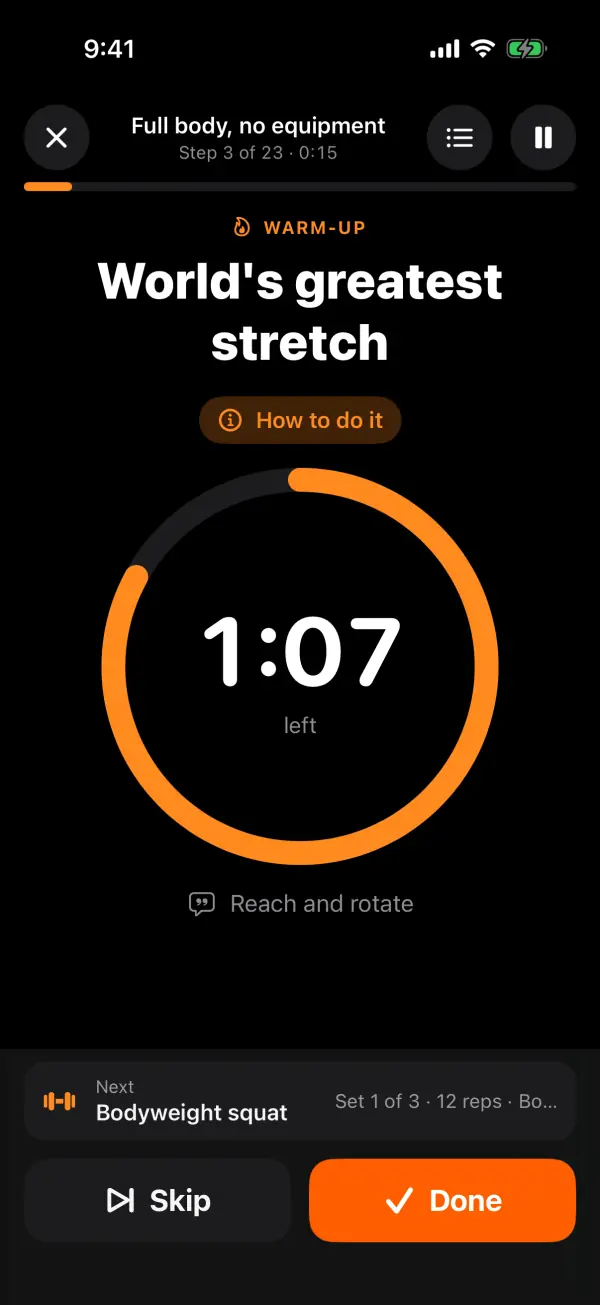
VedaWatch isn't a video class service. There are no filmed trainers. Instead, its Guided library on the Train tab has more than 40 ready-made sessions and well over 100 exercises, from bodyweight and dumbbell strength to kettlebell and gym sessions, conditioning, intervals, Zone 2, mobility and recovery. Each exercise has written how-to steps, coaching cues, easier and harder swaps, and a muscle map. You can start a session on your Apple Watch or iPhone, and the player walks you through every set and rest with timers and spoken cues in a recorded coach voice over your music.
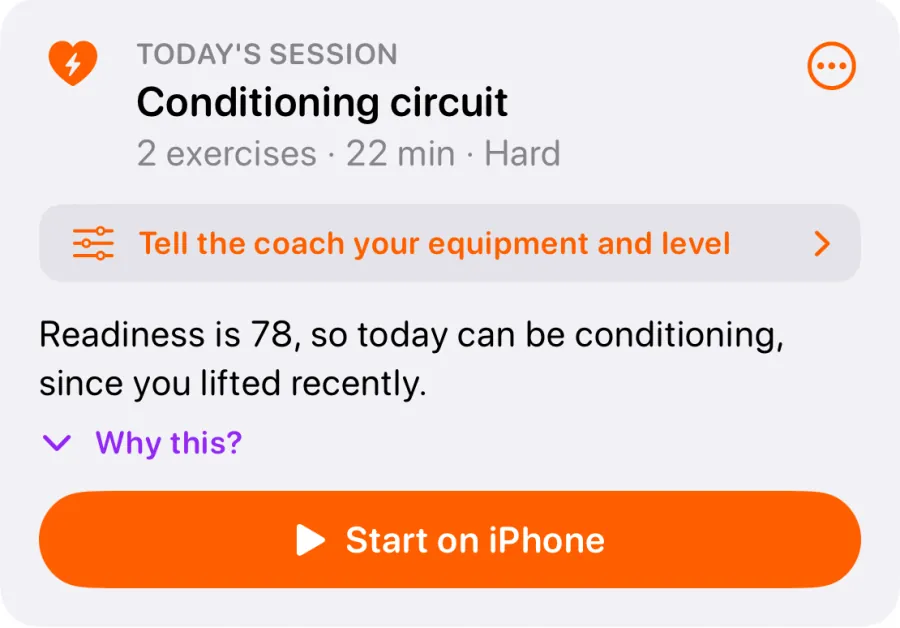
The daily coach handles the recovery side. Each day it suggests one session on the Train tab. A readiness score of 70 or more counts as a push day, 50 to 69 as a hold day, and below 50 as a rest day with a gentle mobility session. If your training load is spiking, nothing hard is planned, a low Daily Charge shortens the session, and muscles you worked hard in the last 48 hours or marked as sore are rested. Tap Why this? to see every reason.
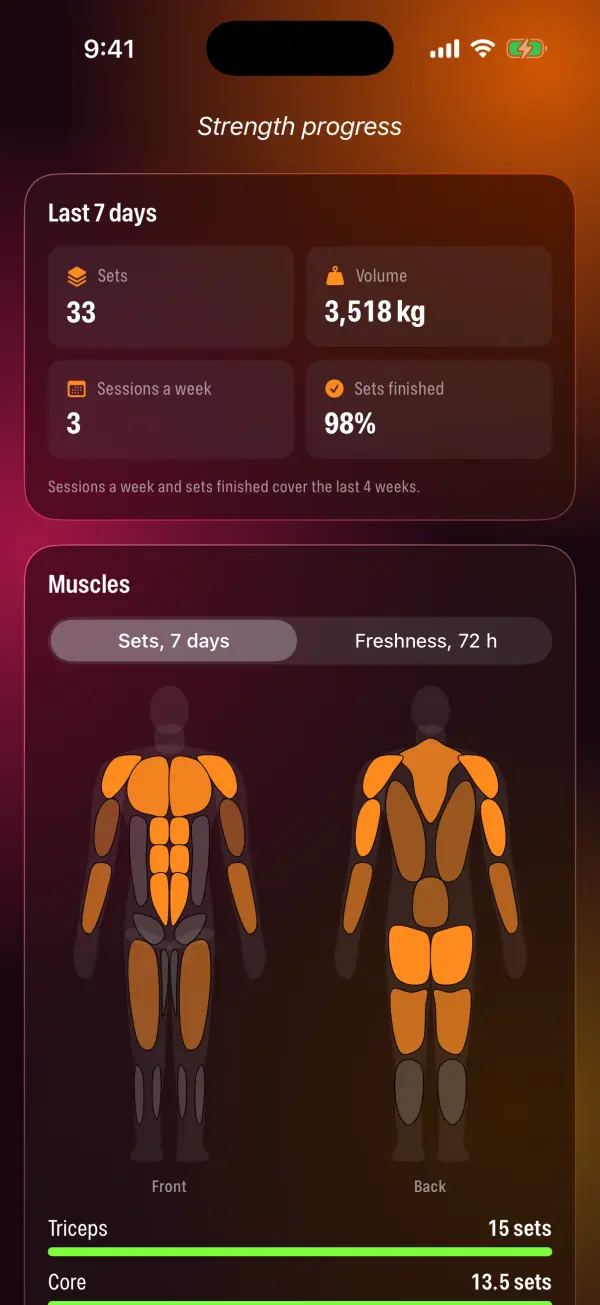
For strength, every completed set in a guided session is logged with its reps and weight. On Apple Watch, VedaWatch can count many reps from your wrist motion, such as squats, presses and rows. Strength progress shows sets per muscle against a 10-sets-a-week guide, an estimated one-rep max (Epley formula) and best sets for each exercise, and records once you have something to beat. The coach uses double progression: reps go up until the top of the range, then the weight steps up, for example 2 kg for most dumbbell moves.
It also works alongside Fitness+. Workouts saved to Apple Health, including Fitness+ classes recorded on your Watch, count toward VedaWatch's training load, so a hard class on Tuesday can make Wednesday's suggestion easier. Strength progress only comes from VedaWatch's own guided sessions, because other workouts don't say which exercises, reps or weights you did. Multi-week training plans are a Pro feature. Everything here is general fitness guidance, not medical advice.
Can you keep Fitness+ and use another app?
Yes, and for many people that's the best setup. Fitness+ is strong at making cardio, HIIT, yoga and pilates enjoyable. A tracking or planning app is strong at deciding how hard today should be and remembering what you lifted. Neither has to replace the other.
A simple weekly pattern: two or three strength sessions in a tracking app so your weights progress, one or two Fitness+ classes you enjoy, and easy walks or Zone 2 on low-readiness days. The World Health Organization recommends muscle-strengthening activity on at least 2 days a week for adults, alongside 150 to 300 minutes of moderate aerobic activity, so a mix like this covers both.
Just make sure each workout is recorded once. If you start a Fitness+ class on your Watch, don't also start a separate workout in another app for the same session, or your training load will count it twice.
Frequently asked questions
Is there a free alternative to Apple Fitness+?
Nike Training Club is listed as free on the App Store and offers trainer-led video classes and programs. Apple's own Workout app on Apple Watch is also free for tracking, though it has no classes.
Does Apple Fitness+ track weights and reps?
Regular Fitness+ classes don't log your weights or reps. The Gym Strength beta added in iOS 27.3 in November 2026 does let you log reps and weight and adjusts the following week, but it's still in beta.
Does Apple Fitness+ use my HRV or sleep?
Apple describes Custom Plans as based on your Fitness+ history and preferences, and doesn't mention HRV, sleep or recovery. For sessions that adapt to those, you need a separate app that reads them from Apple Health.
Do I need an Apple Watch for Fitness+?
No. Apple says an iPhone is all you need. An Apple Watch adds live heart rate, calories and ring progress on screen, and AirPods Pro 3 or Powerbeats Pro 2 can supply heart rate on iOS 26.
Will Fitness+ workouts count in other apps?
Workouts recorded with Apple Watch are saved to Apple Health, so apps you allow to read workouts, such as VedaWatch, can include them in training load. They won't include exercise-level detail like reps and weights.
Related guides
- Guided strength workouts on Apple Watch: step-by-step sessions with spoken cues and rep counting
- Train by readiness: how VedaWatch picks today's workout from your Apple Watch data
- How to track strength training progress with Apple Watch: volume, 1RM and muscle balance
- Best strength training app for Apple Watch: 2026 roundup
- Progressive overload explained: how to progress every lift
- Apple Watch Training Load and ACWR, explained (and why sports scientists argue about it)
Sources & further reading
- Apple: Apple Fitness+ (workout types, devices, pricing, Custom Plans)
- Apple Support: Use Custom Plans in Apple Fitness+
- Apple Support: Track your training load on Apple Watch
- 9to5Mac (2026): Apple announces Fitness+ Gym Strength program with personalized workout plans
- Düking P et al. Monitoring and adapting endurance training on the basis of heart rate variability monitored by wearable technologies: a systematic review with meta-analysis. J Sci Med Sport. 2021
- American College of Sports Medicine. Progression models in resistance training for healthy adults. Med Sci Sports Exerc. 2009
- World Health Organization: Guidelines on physical activity and sedentary behaviour (2020)
- App Store: Fitbod (gym and fitness planner)
This guide is educational, not medical advice, and has not been clinically reviewed. VedaWatch is not a medical device. If you have symptoms or concerns about your heart or health, contact a qualified healthcare professional.
Put your trends in perspective.
Explore HRV, sleep, and recovery with VedaWatch on your iPhone.
Download VedaWatch on the App Store →