 VedaWatch
AI & Health Data
AI personal trainer vs human coach: an honest comparison
AI personal trainer vs human coach compared on cost, form feedback, accountability, data and safety, with who each one suits and a simple hybrid plan.
By VedaWatch editorial team · · 9 min read
The short answer
A human coach is better at teaching technique, spotting form problems and working around injuries. An AI personal trainer is cheaper, available every day, and can adjust to your sleep, HRV and recent workouts. Most people do best with a hybrid: a few sessions with a qualified human, then an AI app for daily programming.
AI personal trainer vs human coach: which is better?
Neither wins on every count, because they're good at different jobs. A human coach watches you move, notices when your knees cave in on a squat, knows when you're having a rough week, and can change the plan around an old injury. An AI personal trainer is on your phone every day, costs a fraction of in-person sessions, and can read data a human never sees, such as last night's sleep and this morning's heart rate variability (HRV).
The research on supervision points the same way. In a 2025 randomized trial of 79 trained adults, the group coached in person gained more squat strength over 10 weeks than people following an app or a PDF plan, but bench press gains were similar across all three groups. A 2022 meta-analysis of 12 studies found supervision gave a moderate edge for strength and almost none for body composition. In other words, a coach adds the most where technique and effort are hardest to judge alone.
So the better question is what you need right now: learning to lift, staying consistent, training around a health issue, or just a smart plan that adapts to your recovery. The sections below compare the two on cost, form, accountability, data and safety, then show how to combine them.
What an AI personal trainer can and can't do
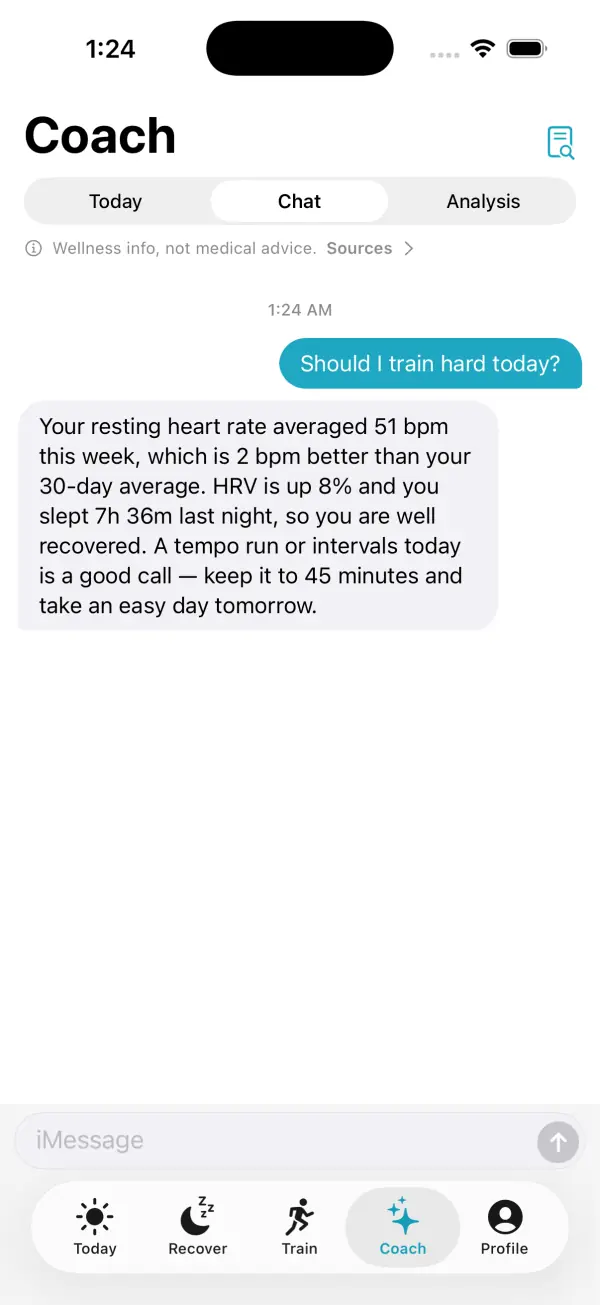
"AI personal trainer" covers three different kinds of app. Workout generators build sessions from your goal, level and equipment. Adaptive planners change the next session based on what you logged, adding weight or reps when you hit your targets. Chat coaches answer questions like "Should I train hard today?" using your own health data. Some apps do all three.
What they do well: give you a plan every day without waiting for an appointment, progress the load steadily, keep a perfect log, and use wearable data to suggest an easier day when your recovery looks low. What they can't do: see how you actually move (unless the app uses your camera, and even then it sees one angle), physically guide you into position, or know about pain, stress or a medical condition you haven't told them about.
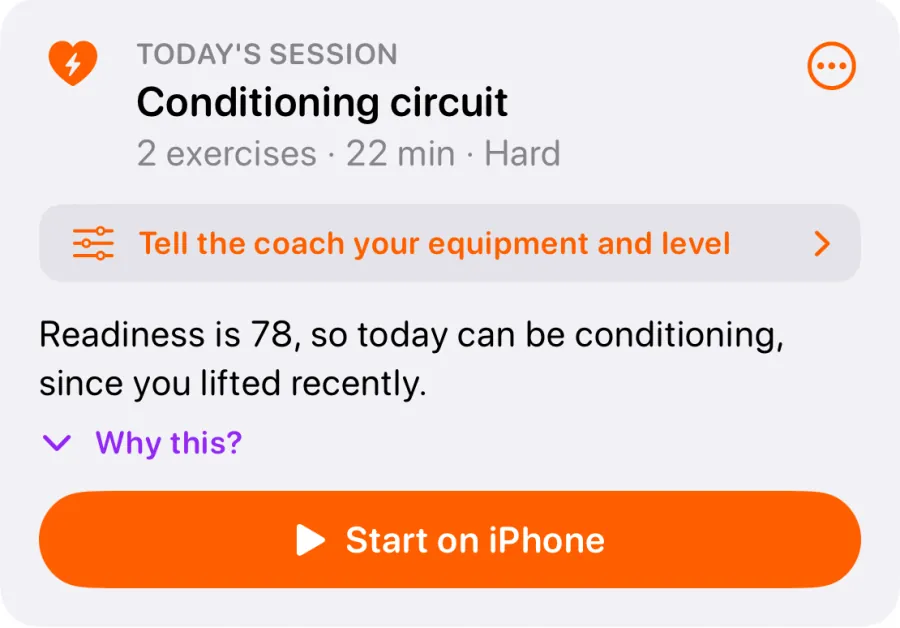
A good AI trainer shows its reasoning. Look for an app that tells you why it picked today's session, such as low readiness or muscles you trained yesterday, so you can tell when its logic doesn't fit your day.
How much does an AI trainer cost compared with a human coach?
This is the clearest difference. A human trainer charges per session or per package, and rates vary widely by city, gym and experience, so get quotes from two or three local trainers. Most AI trainer apps charge a monthly or yearly subscription, usually with a free trial, and a month of an app often costs about what one in-person session does, though that depends on your local rates.
Here's a worked example with made-up round numbers, just to show the arithmetic. If a trainer quotes $60 a session and you train with them twice a week, that's about 8.7 sessions a month (2 x 52 weeks / 12), or roughly $520 a month. Drop to one session a fortnight to check your form, about 2.2 sessions a month, and the same trainer costs about $130 a month. Add an AI app for the days in between and you still pay far less than full-time coaching.
Count what you get for the money, not just the price. A human session is an hour of undivided attention. An AI subscription is a plan and feedback every day, but no one in the room. Also check what the app's free tier includes, whether AI features cost extra, and how easy it is to cancel.
Can an AI trainer correct your form?
Only partly. Most AI trainer apps teach form with written steps, videos and spoken cues, and some count reps from your watch's motion sensors. A few use your phone camera to estimate body position. None of these can see everything a trained eye sees from different angles, and none can put a hand on your back to show you where neutral is.
The studies suggest form and effort matter most on big lower-body lifts. In the 2023 trial by Coleman and colleagues, 36 trained adults followed the same 8-week program with or without direct supervision. The supervised group gained more squat strength and more muscle thickness at several sites, while bench press strength was similar. The 2025 trial found the same pattern: squat gains of about 27 kg with a coach versus about 19 kg with an app or PDF, but near-identical bench press gains.
Practical rule: if you're learning the squat, deadlift, overhead press or Olympic lifts, book at least a few sessions with a qualified coach. Film yourself from the side, compare with the app's cues, and bring the clips to your coach. For movements you already do well, an app's cues and a steady progression are usually enough.
Does a human coach keep you more consistent?
Usually, yes. Knowing someone is waiting for you at 7 am is powerful. In the 2025 trial, people coached in person attended 88.2% of sessions, the app group (video instruction with remote progress tracking) 81.2%, and the PDF-only group just 52.2%. The app group was much closer to in-person coaching than to training alone.
Tracking also helps. A 2022 umbrella review of 39 systematic reviews found that wearable activity trackers increased physical activity, roughly equal to about 1,800 extra steps a day. Reminders, streaks and a visible weekly target work on the same idea: making progress easy to see.
What an app can't do is notice that you've gone quiet, ask what's going on, and adjust. If you know you skip workouts when nobody's expecting you, that's a strong reason to keep a human in the loop, even if it's a monthly check-in or a training partner.
Who makes better use of your health data?
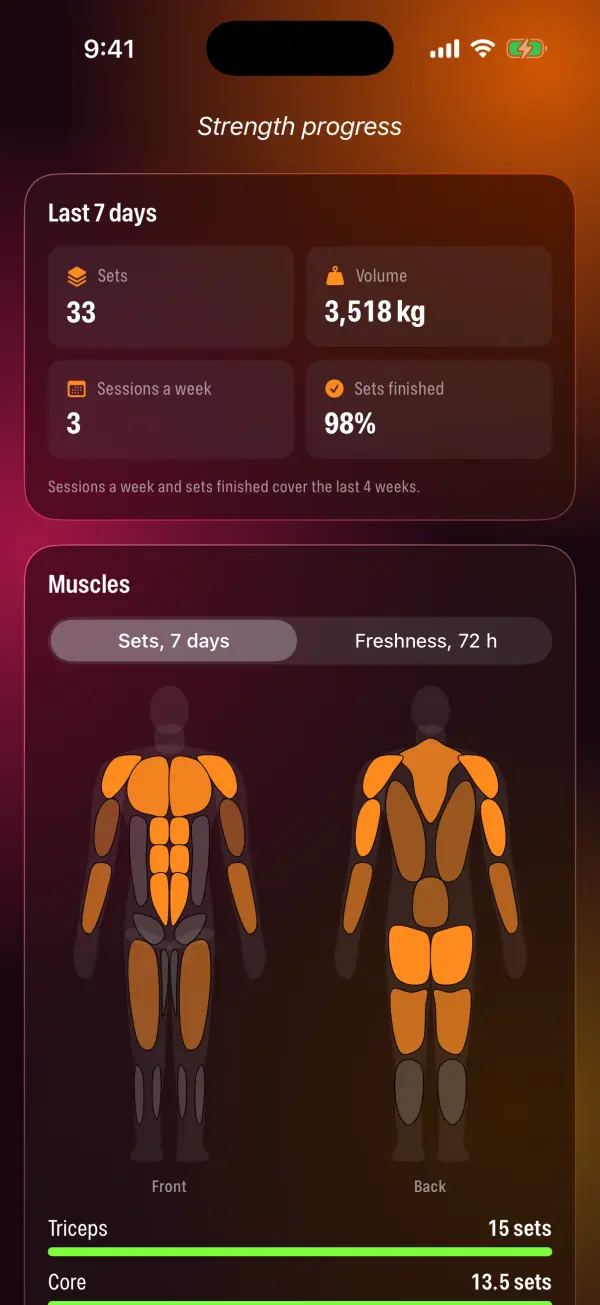
A human coach sees you for maybe one to three hours a week and relies on what you tell them. An AI trainer connected to Apple Health can look at every night of sleep, every workout, your resting heart rate and HRV trends, and your logged weights, then compare today with your own normal. That's a real advantage for deciding between a hard day and an easy one.
But more data isn't the same as better judgment. Wearable numbers are estimates, a single low HRV reading can be noise, and an AI can sound confident while being wrong. When researchers asked a 2023 version of ChatGPT for exercise advice for 26 clinical populations, the answers were 90.7% accurate but only 41.2% comprehensive, and they were written at a college reading level.
The best setup combines both: the app keeps the record and spots the trends, and you or your coach decide what they mean. If you work with a human, share a weekly summary or an export of your training log so they see the same numbers the app does.
Is an AI personal trainer safe?
For healthy adults building up gradually, an AI-generated plan is generally a reasonable place to start. The risks come from what the app doesn't know. In the same chatbot study, more than half of the inaccurate answers (8 of 15) concerned whether people needed medical clearance before exercising.
The American College of Sports Medicine bases its preparticipation screening on three things: how active you are now, whether you have signs or symptoms or known heart, metabolic or kidney disease, and how hard you plan to exercise. An app can ask about the first and third. The second needs you to be honest, and sometimes needs a doctor.
Talk to a doctor before starting or stepping up training if you have a heart, lung, metabolic or kidney condition, are pregnant, or are returning after surgery or injury. Stop and get medical help for chest pain, fainting, unusual shortness of breath or a racing or irregular heartbeat during exercise. For ongoing pain or rehab, see a physiotherapist rather than relying on any app or general trainer.
Who should choose an AI trainer, a human coach, or both?
Match the option to where you are. Here's a quick guide:
- Complete beginner to lifting: start with a human coach for 3 to 6 sessions to learn the main lifts, then move to an AI app for daily programming.
- Experienced and self-motivated: an AI trainer is usually enough. Book an occasional form check when you change programs or plateau.
- Training for a race or competition: an AI plan handles structure and recovery well. A human coach adds value for tactics, pacing and race-specific skills.
- Injury, chronic pain or a medical condition: work with a clinician or physiotherapist first. Use apps only within the limits they set.
- Struggling with consistency: a human coach or a training partner helps most. An app's reminders and weekly targets are a good second layer.
- Tight budget: an AI app plus filmed form checks gets you most of the way. Spend on a coach only for the lifts you're unsure about.
How to combine an AI trainer and a human coach
A hybrid plan gives you a coach's eye on technique and an app's daily adjustments for a fraction of full-time coaching. Here's a simple way to set it up over your first three months:
- Weeks 1 to 2: book two or three sessions with a certified trainer. Ask them to assess your movement and teach the lifts in your plan, and write down their main cues.
- Week 3: set up your AI app with your real level, equipment and training days. Grant it access to workouts, heart rate, HRV and sleep so it can adjust to recovery.
- Weeks 3 to 8: follow the app's sessions. Film one set of each main lift every week or two and compare it with your coach's cues.
- Every 4 to 6 weeks: book one check-in with your coach. Bring your videos and the app's training log or weekly summary.
- Any time: if something hurts, a lift feels wrong, or the app suggests a big jump in load, pause and ask your coach or a clinician before carrying on.
- Month 3: review. Keep the mix that's working, or change how often you see the coach.
How VedaWatch helps on the AI side
VedaWatch is an iPhone and Apple Watch app that works on the daily side of a hybrid plan. Each day the Train tab suggests one guided session based on your readiness score (your HRV, resting heart rate and sleep compared with your recent baseline), what you trained recently, your level and your equipment. Tap "Why this?" to see every reason, or make it shorter or easier. Weights and reps step up from your own history when you hit your targets.
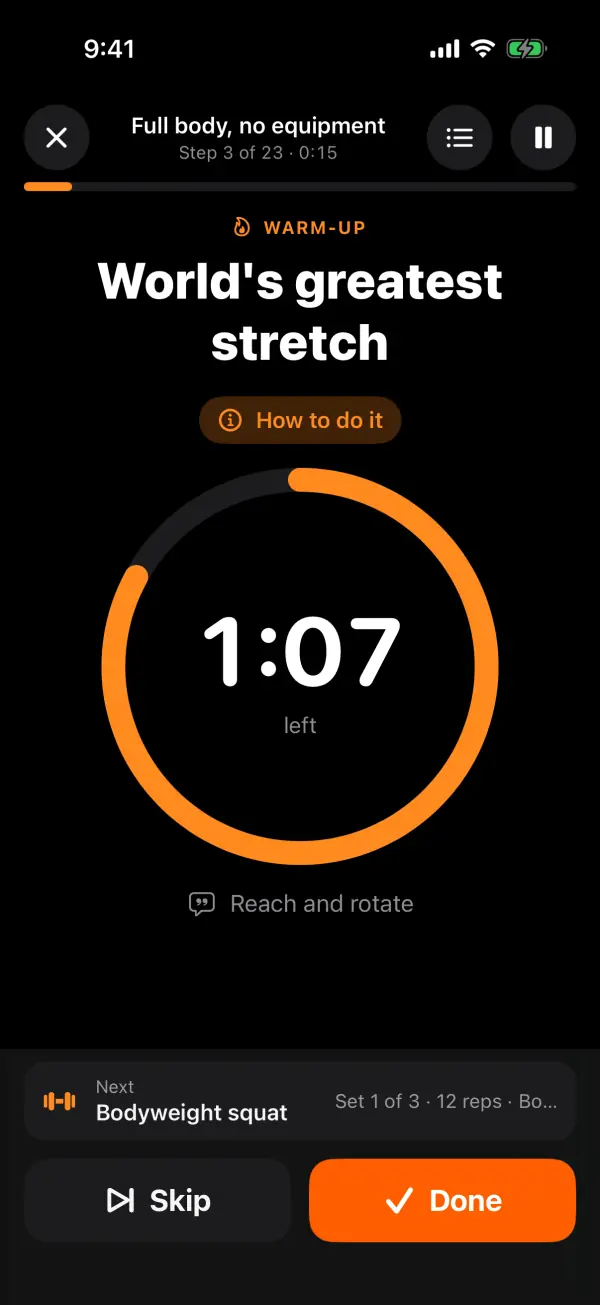
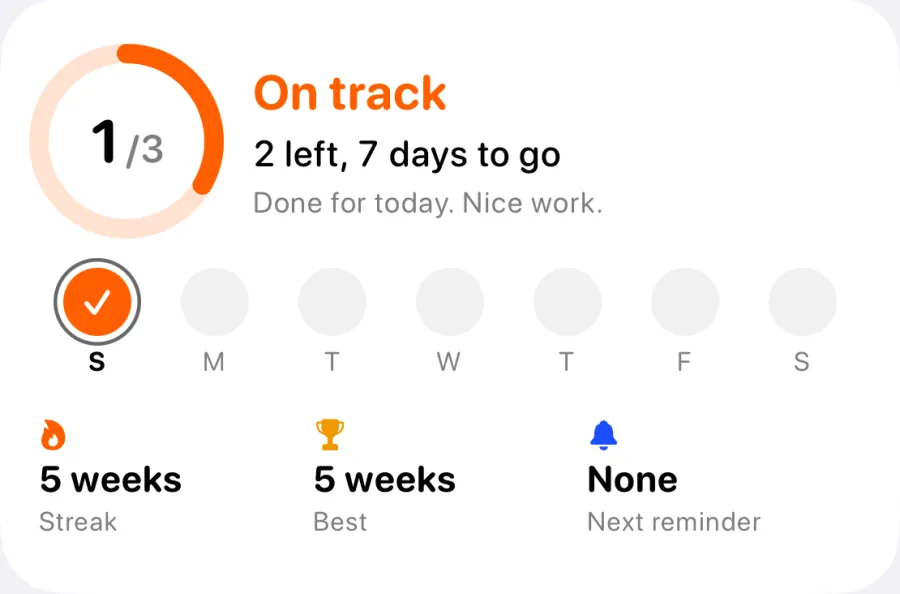
Guided sessions play on your Apple Watch or iPhone with timers, spoken cues and How to do it steps for each exercise, and the watch can count many strength reps from your wrist motion. It doesn't watch your form, so pair it with a coach for technique. A weekly target with reminders and streaks helps with consistency.
On Pro ($6.99 a month or $59.99 a year), the AI Coach answers questions about your own numbers, writes weekly reports you can copy or share with a human coach, and can suggest changes to your week plan. It never edits the plan itself: you tap Apply or Dismiss. AI features stay off until you agree to send daily summaries of your synced Health data to third-party AI models. It's wellness information, not medical advice.
Frequently asked questions
Will AI replace personal trainers?
Unlikely for most people. AI is taking over routine programming and tracking, but hands-on technique coaching, injury work and accountability still favor a human. The two also work well together, with an app handling the days between coaching sessions.
Can ChatGPT be my personal trainer?
It can write a reasonable general plan, but on its own it doesn't know your sleep, recovery or what you lifted last week, and it can miss safety points such as medical clearance. It becomes more useful when connected to your real training data and checked by you.
How do I check a human trainer's qualifications?
Ask which certification they hold and check that it's accredited, for example by the NCCA in the US, and that it's current. Also ask whether they hold current CPR and first aid training. Ask about their experience with clients like you, especially if you have an injury or condition.
Is an AI trainer good enough for building muscle?
It can be. A 2022 meta-analysis found supervision made little difference to body composition, though the 2025 trial saw more lean mass gain with in-person coaching. A well-progressed app plan with enough protein and sleep can build muscle; a coach helps most with heavy lower-body lifts and technique.
What should a good AI trainer app show me?
The reason behind each session, how load progresses, what data it reads, and what happens to that data. Avoid apps that make big jumps in training volume or give medical advice.
Related guides
- Best AI fitness coach apps for iPhone and Apple Watch (2026)
- Train by readiness: how VedaWatch picks today's workout from your Apple Watch data
- Guided strength workouts on Apple Watch: step-by-step sessions with spoken cues and rep counting
- How to stay consistent with workouts: set a weekly training target
- Ask an AI coach about your Apple Watch data: what VedaWatch's Coach can do
- Progressive overload explained: how to progress every lift
Sources & further reading
- Journal of Strength and Conditioning Research (2025): Optimizing resistance training outcomes: in-person supervision, online coaching and self-guided approaches, a randomized controlled trial (Gavanda et al.)
- Journal of Sports Sciences (2023): Supervision during resistance training positively influences muscular adaptations in resistance-trained individuals (Coleman et al.)
- International Journal of Strength and Conditioning (2022): The role of supervision in resistance training; an exploratory systematic review and meta-analysis (Fisher et al.)
- JMIR Medical Education (2024): Comprehensiveness, accuracy, and readability of exercise recommendations provided by an AI-based chatbot (Zaleski et al.)
- Medicine & Science in Sports & Exercise (2015): Updating ACSM's recommendations for exercise preparticipation health screening (Riebe et al.)
- The Lancet Digital Health (2022): Effectiveness of wearable activity trackers to increase physical activity and improve health (Ferguson et al.)
This guide is educational, not medical advice, and has not been clinically reviewed. VedaWatch is not a medical device. If you have symptoms or concerns about your heart or health, contact a qualified healthcare professional.
Put your trends in perspective.
Explore HRV, sleep, and recovery with VedaWatch on your iPhone.
Download VedaWatch on the App Store →